Touch the Universe: A NASA Braille Book of Astronomy (2002)
Chapter: Saturn
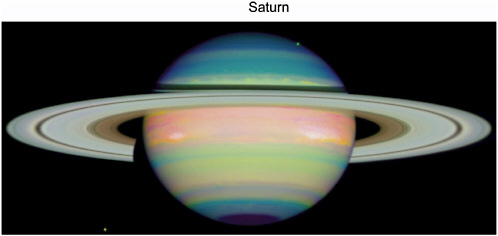
Figure 4.
SATURN
Saturn, the sixth planet from the sun, is often called the “ringed planet.” It is not the only planet with rings, but it does have the most numerous and spectacular rings. The rings are made of ice and small rocks.
Saturn is the second largest gas-giant planet in our solar system. It has a diameter of almost nine and a half times that of Earth. Saturn orbits the sun at a distance that is more than nine and a half times the distance between the Earth and sun. To the naked eye, Saturn appears as a dim yellow star; but when seen through a small backyard telescope, Saturn appears as a disk with elongations that resemble ears!
Figure 4 is an image of Saturn that was taken with the HST in January 1998 by E. Karkoschka (University of Arizona).
Different shades of blue indicate variations of cloud particle sizes and chemical compositions. Green and yellow indicate haze. The different colors are represented by tactile stripes across the planet. The rings are shown with a bumpy texture.