Touch the Universe: A NASA Braille Book of Astronomy (2002)
Chapter: Galaxy Cluster Abell 2218
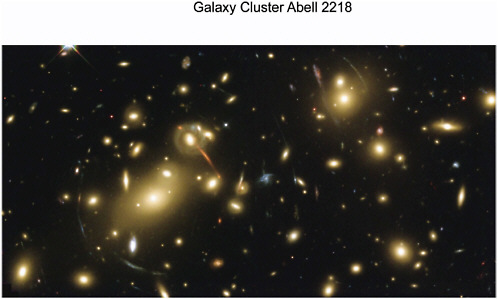
Figure 13.
GALAXY CLUSTER ABELL 2218
Galaxies come in different shapes. Our Milky Way Galaxy is spiral-shaped. Some galaxies have only circular or slightly elongated shapes; these are called elliptical galaxies. Some galaxies are shaped like Saturn, with a circular center and elongated sides; these are called lenticular galaxies. Some galaxies look like spirals but have a line of stars (called a bar) crossing their centers; these are called barred spiral galaxies. Some galaxies have non-symmetrical shapes; they are called irregular or peculiar galaxies.
Galaxies are gravitationally bound together in groups. Our Milky Way is part of the Local Group which, with other clusters of galaxies, forms the Local Supercluster.
In January 2000, A. Fruchter and the ERO team used the HST to image a cluster of galaxies called Abell 2218, located in the constellation of Draco. This galaxy cluster is shown in Figure 13. This group of galaxies lies 2 billion light years from Earth. The cluster contains spiral, lenticular, and elliptical galaxies. The spiral galaxies are raised to show the spiral arms, the lenticular galaxies are raised to show elongations, and the elliptical galaxies are filled circles and elongated circles.