Touch the Universe: A NASA Braille Book of Astronomy (2002)
Chapter: HST orbits Earth
Figure 2.
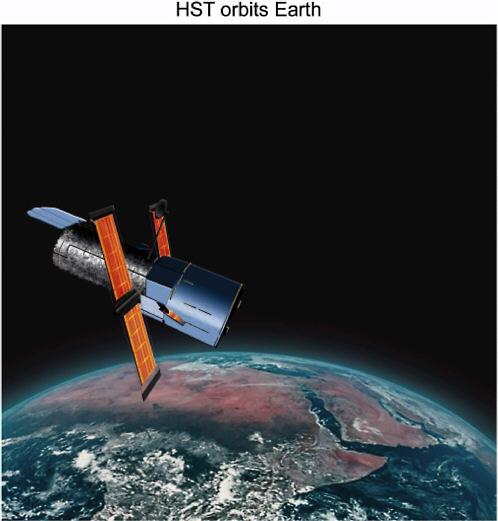
HST ORBITS EARTH
The HST orbits about 370 miles (600 km) above the Earth’s surface. Because it is above the Earth, it does not have to see through the haze of the Earth’s atmosphere. Hubble is not affected by clouds, rain, or other types of bad observing conditions caused by Earth’s atmosphere.
With its clear view of space, the HST has provided some of the most amazing views of distant celestial objects. From neighboring planets, to the birth and death of stars, to groups of stars and galaxies beyond the Milky Way, Hubble is helping us to better understand objects of our universe and our place within it.
Figure 2 depicts the HST orbiting the Earth. The Earth’s edge (limb) is shown as a broken curve. The border of Africa is shown by a dotted line. This image also appears on the cover of this book.