Touch the Universe: A NASA Braille Book of Astronomy (2002)
Chapter: The Ring Nebula
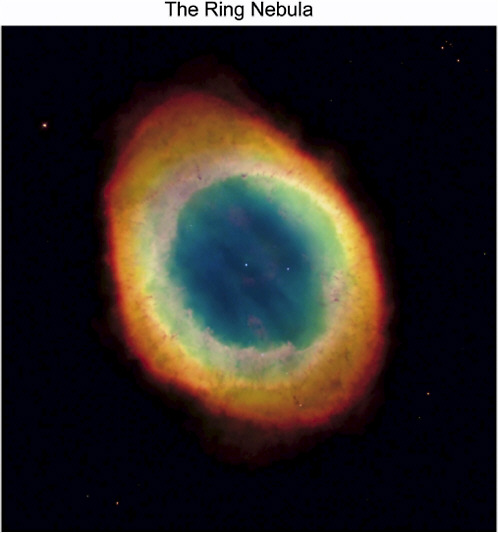
Figure 6.
THE RING NEBULA
We now leave our solar system and travel toward a constellation called Lyra. Within this star pattern is a planetary nebula called the Ring Nebula. This cloud is the remains of a star, near the end of its life, which is shedding its outer layers. Early astronomers using telescopes observed such “planet-shaped” clouds in space and named them planetary nebulae, but they are not really related to planets.
The Ring Nebula resembles a “smoke ring” in space. The dying star is visible in the center. A telescope is required to see the Ring Nebula.
The Hubble Heritage Team used the HST to image the Ring Nebula in October 1998, as seen in Figure 6. The true colors in this image indicate different layers of gases: helium (blue), oxygen (green), and nitrogen (red). The outline of the outer layer of cool nitrogen is represented by a dotted texture, the middle hot layer with oxygen has a texture of parallel lines, and the very hot center area of helium, with a star, has no texture.