Touch the Universe: A NASA Braille Book of Astronomy (2002)
Chapter: The Hubble Space Telescope
Visit
NAP.edu/10766
to get more information about this book, to buy it in print, or to
download it as a free PDF.
Previous Chapter:
Introduction
Figure 1.
Next Chapter: HST orbits Earth
Suggested Citation:
"The Hubble Space Telescope." Noreen Grice. 2002. Touch the Universe: A NASA Braille Book of Astronomy. Washington, DC: Joseph Henry Press.
doi: 10.17226/10307.
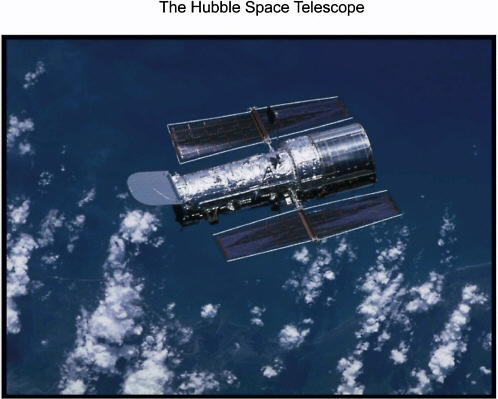
Figure 1.
THE HUBBLE SPACE TELESCOPE
The Hubble Space Telescope (HST) was named after the American astronomer Edwin Hubble. It is 43.5 feet (13.1 meters) long and 14 feet (4.27 meters) wide. The telescope weighs 25,500 pounds (11,000 kilograms).
The HST was constructed on Earth and deployed into space by the space shuttle in 1990. Two solar panels, one on either side of the telescope, provide power for the telescope’s equipment. Astronomers on Earth control the telescope. Images are relayed by satellites down to the control center in Baltimore, Maryland.
Suggested Citation:
"The Hubble Space Telescope." Noreen Grice. 2002. Touch the Universe: A NASA Braille Book of Astronomy. Washington, DC: Joseph Henry Press.
doi: 10.17226/10307.
Figure 1 shows the Hubble Space Telescope in space. The solar panels have a checkered texture. The telescope and solar panels are raised by a tactile outline.
Suggested Citation:
"The Hubble Space Telescope." Noreen Grice. 2002. Touch the Universe: A NASA Braille Book of Astronomy. Washington, DC: Joseph Henry Press.
doi: 10.17226/10307.
Subscribe to Emails from the National Academies
Stay up to date on activities, publications, and events by subscribing to email updates.