Touch the Universe: A NASA Braille Book of Astronomy (2002)
Chapter: Jupiter
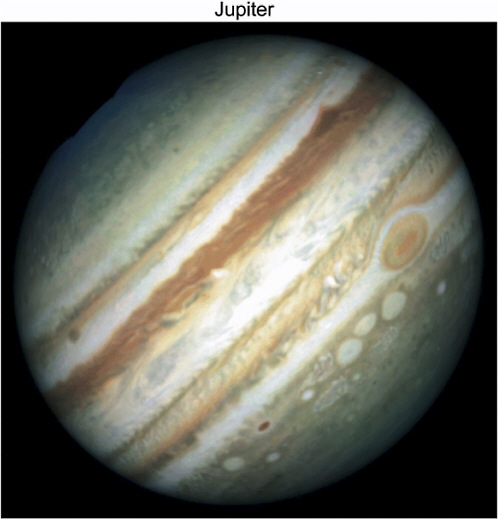
Figure 3.
JUPITER
Jupiter is the largest planet in our solar system. It has a diameter over eleven times that of Earth. Over one thousand Earths could fit inside Jupiter!
This giant planet orbits the sun five times farther out than Earth. It takes about twelve years for Jupiter to complete one trip around the sun.
Jupiter is a gas planet, made mostly of hydrogen, helium, ammonia, and methane. To the naked eye, it appears as a bright white star. Through a telescope, it reveals stripes called bands. The planet rotates once in about 10 hours and this makes the planet very windy. As the bands move past each other, they whirl around circular storms.
Jupiter boasts the largest storm in the solar system. It is called the Great Red Spot and has been observed for hundreds of years.
This photograph of Jupiter was taken by Rita Beebe (New Mexico State University) and Amy Simon (Cornell University) with the HST in February 1995.
Figure 3 shows the outline of Jupiter. The bands are displayed as tactile lines that cross the planet. The broken curved lines indicate different currents in the bands of gas. The Great Red Spot is raised along with a few smaller storms (shown as hollow circles).