Touch the Universe: A NASA Braille Book of Astronomy (2002)
Chapter: Gaseous Pillars in M16--The Eagle Nebula
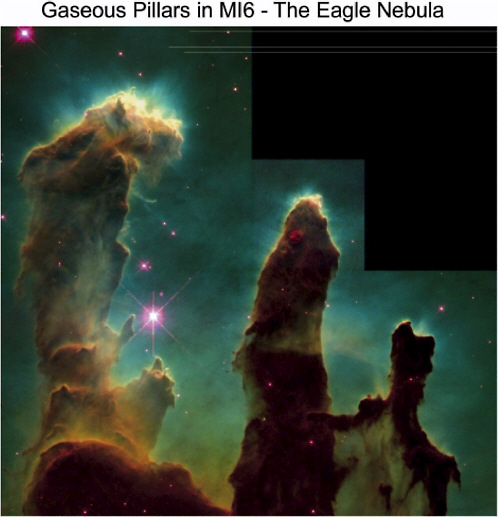
Figure 10.
GASEOUS PILLARS IN M16 -THE EAGLE NEBULA
Not all nebulae are the result of dying stars. Within the constellation of Serpens is M16, also called the Eagle Nebula. This is an area of gases that resembles the shape of an eagle’s wing.
We approach the tip of a wing and see pillars of gas, thousands of light years away, in space! (A light year is the distance that light travels in one year, about 6 trillion miles or 9.5 trillion kilometers.) This is the astonishing discovery made by J. Hester and P. Scowen of Arizona State University, using the HST, with which they captured this image in April 1995.
The pillar-like structures are actually columns of cool interstellar hydrogen gas and dust that act as incubators for new stars.
Ultraviolet radiation from nearby stars is eroding the pillars. Young stars will eventually emerge from the pillars.
Figure 10 shows the Eagle Nebula pillars with a mixture of colors that represent different layers of gas: sulfur (red), hydrogen (green), and oxygen (blue). The pillars are outlined by a solid tactile line with broken curved lines inside representing the mixing gas layers.