Touch the Universe: A NASA Braille Book of Astronomy (2002)
Chapter: Eta Carinae
Visit
NAP.edu/10766
to get more information about this book, to buy it in print, or to
download it as a free PDF.
Previous Chapter:
NGC 2392--The Eskimo Nebula
Figure 9.
Next Chapter: Gaseous Pillars in M16--The Eagle Nebula
Suggested Citation:
"Eta Carinae." Noreen Grice. 2002. Touch the Universe: A NASA Braille Book of Astronomy. Washington, DC: Joseph Henry Press.
doi: 10.17226/10307.
Figure 9.
ETA CARINAE
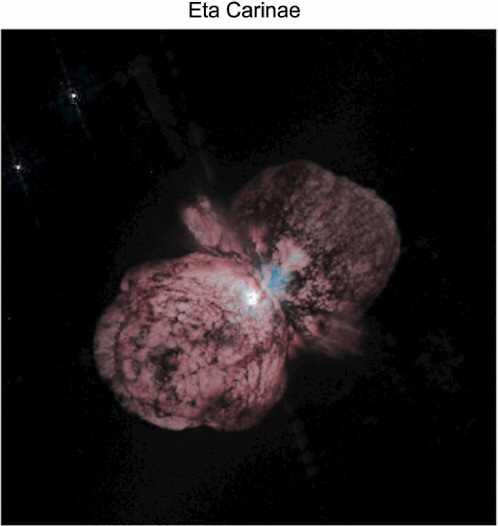
Traveling to the constellation of Carina, we see a star called Eta Carinae, one hundred times more massive than our sun. This star became very unstable and had a tremendous explosion when, one hundred fifty years ago, it became one of the brightest naked-eye stars in the southern hemisphere.
In September 1995, J. Morse (University of Colorado) used the HST to image Eta Carinae. Huge “blobs” of gases are seen on each side, moving away from the center at speeds of 1.5 million miles (2.5 million kilometers) per hour. The central star, not visible in this image, radiates five million times more power than our sun!
Suggested Citation:
"Eta Carinae." Noreen Grice. 2002. Touch the Universe: A NASA Braille Book of Astronomy. Washington, DC: Joseph Henry Press.
doi: 10.17226/10307.
In Figure 9, Eta Carinae is shown as a tactile outline. Gases are represented by broken curved lines.
Suggested Citation:
"Eta Carinae." Noreen Grice. 2002. Touch the Universe: A NASA Braille Book of Astronomy. Washington, DC: Joseph Henry Press.
doi: 10.17226/10307.
Subscribe to Emails from the National Academies
Stay up to date on activities, publications, and events by subscribing to email updates.