Mendel in the Kitchen: A Scientist's View of Genetically Modified Foods (2004)
Chapter: 12 The Organic Rule
12
THE ORGANIC RULE
These mushroom ideas of agriculture are failing; Mother Earth deprived of her manurial rights is in revolt; the land is going on strike; the fertility of the soil is declining.
—Sir Albert Howard (1940)
Sir Albert Howard was a British colonial officer with the cumbersome title of Chemical Botanist to the Government of the Raj at Pusa. Working with poor farmers in India early in the last century, he became convinced that farming was mining the soil of its humus, the dark, partially decayed organic matter that makes soil fertile. In particular, it was using up the nitrogen essential for plants to grow and produce crops. At the Institute of Plant Industry in Indore, India, Howard developed methods for composting animal wastes and urban residue and for using such composts, together with plants grown specifically for the purpose, to improve the soil. He particularly appreciated the importance of mycorrhizal fungi, as well as the fertility-enhancing properties of legumes, plants in the pea and bean family.
Howard believed that the future of civilization depended on the answer to one question: “Can mankind regulate its affairs,” he asked in An Agricultural Testament in 1940, “so that its chief possession—the fertility of the soil—is preserved?” “We must look at soil fertility,” he argued, “as we would study a business where the profit and loss account must be taken along with the balance-sheet, the standing of the concern, and the method of management.” He believed that soils de-
prived of their “manurial rights”—the nutrients not only in animal manure, but also in human wastes—not only lost their ability to support crops and animals, but promoted the spread of disease on the farm. He further advanced the hypothesis that people who consumed produce grown in healthy, well-aerated soils were themselves healthier and more vigorous than people who consumed foods grown in depleted soils, a view echoed by contemporary advocates of what have come to be known as organic foods.
Eve Balfour, one of the first women to graduate from the University of Reading with a degree in agriculture, was inspired by Howard’s work. Lady Balfour had bought a farm in Suffolk, England, where she began to compare conventional and “natural” farming methods. In 1943 she published The Living Soil; she subsequently organized the Soil Association with other farmers, scientists, and nutritionists, and served as its first president. “The criteria for a sustainable agriculture,” she wrote, “can be summed up in one word—permanence, which means adopting techniques that maintain soil fertility indefinitely; that utilise, as far as possible, only renewable resources; that do not grossly pollute the environment; and that foster biological activity within the soil and throughout the cycles of all the involved food chains.”
This concept of sustainable agriculture, with an emphasis on natural as opposed to manmade or synthetic means of maintaining soil structure and fertility, has evolved into contemporary organic farming. One of its most important American champions was Jerome Rodale, founder of the Rodale Press. In 1950 he began publishing Prevention magazine. Among its missions, he wrote, was “to alert the big-city dweller to the possibilities of obtaining wholesome food either through selective buying or through finding a minute plot on which to grow a few vegetables.” He was inspired both by Howard’s ideas and by the biodynamic agriculture movement. Biodynamic agriculture grew out of the philosophy of anthropologist Rudolf Steiner, who in 1924 wrote a book called, simply, Agriculture. Steiner’s approach, like Howard’s, focused on soil health, although its composting method relied more heavily on the recycling of animal parts, which today puts it under threat from regulations aimed at reducing the spread of Mad Cow disease.
Another ingredient in contemporary organic farming—the complete avoidance of synthetic pesticides—dates from 1962, when Rachel Carson’s Silent Spring was published. Silent Spring raised awareness about the effects of DDT, a widely used pesticide, on the environment and particularly on songbirds, whose spring voices would fall silent if use of the pesticide continued. Silent Spring led to the banning of DDT in this country. For some farmers and consumers, all pesticides were therefore suspect.
The modern organic philosophy expressed by the company Duchy Originals, an organic food retailer founded by Britain’s Prince Charles in 1990, is indisputable: “Humans must recognise that humans can only survive and thrive if they live in harmony with the delicate balance of nature between plants, animals, earth, and humans. In farming, that means using methods that conserve and enrich the soil without causing pollution, damaging wildlife, or using up too many of the world’s resources. The world’s shallow layer of topsoil, on which all our future food depends, contains billions of tiny live organisms in a single handful. These are essential to soil fertility. Protecting the soil and preventing its erosion are essential to our future.”
The only point of dispute is how best to achieve those goals.

In its early days organic farming was largely a cottage industry, with consumers buying produce directly from the farmer. This practice continues in some places today. Participants in community-supported agriculture groups pay an annual fee for weekly deliveries of organic produce from local farms. But the demand for organic foods grew so rapidly during the last decades of the twentieth century that organic farming became a commercial enterprise, with a clear separation between farmers and retailers. In the 1990s the organic food market was one of the fastest growing sectors of the U.S. food industry, increasing by an average of 23 percent per year. It reached an estimated $7.8 billion by 2000. Organic grocery store chains, such as Whole Foods and Wild Oats, grew and continue to grow, with Solomon Smith Barney predicting a $40 billion market in 2004.
As with any rapidly expanding industry, the central problem for organic food became one of ensuring quality. Given its varied philosophical underpinnings, it had no universal definition of “organic.” It was difficult for retailers and consumers to know what they were getting when they bought organic food. Certification organizations had begun to develop in the 1970s, including the Demeter Association and the California Certified Organic Farmers. Many of these were under the auspices of state governments. By 1980 some 40 different organizations were certifying organic farmers and defining standards for organically grown food, each with slightly different rules. Not surprisingly, such differences led to lawsuits.
In 1990, to bring uniformity to this burgeoning business, Congress passed the Organic Food Production Act as part of the Farm Bill. The act established the National Organic Standards Board, with representatives from the food industry, consumers, and environmental groups, and charged it with developing a set of national standards. The bill also established the National Organic Program within the USDA’s Agricultural Marketing Service to administer the standards developed by the board. The first National Organic Standards Board was appointed in 1992, the same year that the FDA issued its first guidelines on genetically modified crops. The board issued its first recommendations in 1997.
Popularly known as the Organic Rule, these recommendations took up more than 100 pages in the Federal Register, and provoked an unprecedented volume of comments—several hundred thousand, most of them critical. People objected to the idea that irradiated foods, for instance, could be called organic. The electron-beam technique being used to kill tropical pests on Hawaiian rambutans and other exotic fruits is one form of food irradiation; other forms use gamma rays or X-rays to kill disease-causing bacteria and parasites on spices, wheat flour, potatoes, fruits and vegetables, and meats.
People also objected to the use of synthetic compounds such as antibiotics (if they were not already common practice) in the production of organic foods. And they objected to the use of treated sewage sludge, called biosolids, as fertilizer. This idea had been championed by Howard at the very beginning of the organic movement. It fell under
his concept of “manurial rights.” In his view, the farm’s soil had a right to the nutrients that had been extracted from it when city-dwellers consumed the farm’s produce. Fertilizing with night soil—sewage—was necessary, he felt, to keep the soil healthy.
But the one point that produced the loudest protest was the USDA’s proposal to allow genetically engineered plants and animals to be used in organic farming. A majority of the National Organic Standards Board had voted to exclude them, yet government policy said that they and their products should be regulated based on risk, not on how they were produced. The USDA proposed that they be treated the same as plants and animals modified by other genetic techniques accepted by the organic community, such as the chromosome-doubling drug colchicine and radiation mutagenesis.
The controversy that followed publication of the draft Organic Rule revealed wide disparities among organic farmers and retailers, insiders and watchdogs. Is organic farming a philosophy of production that makes no claims about food quality? Or is organic food indeed more nutritious, as consumers widely believe? Is organic farming a more sustainable approach to farming than advanced conventional agriculture or isn’t it? Is the use of synthetic additives permissible and if so, is the list fixed by very old conventions or can the list evolve in the light of new findings?
Eric Kindberg of the Organic Farmers Marketing Association claimed: “Organic as a market label will be destroyed, both domestically and internationally, if the consumer justifiably reaches the conclusion that an organic product is no healthier than any other labeled product.” By contrast, Roger Blobaum of Organic Watch, an advocacy group, objected to USDA’s proposal to test organic foods on the grounds that organic farmers had never claimed that their produce was free from all pesticide residues or that they were safer or more nutritious than other produce. Jay Feldman, executive director of the National Coalition Against the Misuse of Pesticides, an organization representing consumers, farmers, environmentalists, and labor, called the USDA draft “a disappointing effort that will have the effect of undermining organic farming practices, environmental protection, and consumer support for the organic label in the marketplace.” The no-
tion of organic as a natural way of farming emerged as somewhat at odds with the notion of organic as a source of superior, more nutritious produce, justifying its marketing at a premium price.
In June 1998 the Senate Agriculture Appropriations Committee leaned on the USDA. The committee said it expected the USDA to “construct a National Organic Program that takes into account the needs of small farmers.” Fees should be “progressive” (based on income) so that small farmers were not “excessively burdened.” Furthermore, the committee ordered the USDA to “follow the recommendations of the National Organic Standards Board, as required by the 1990 farm bill, in issuing final regulations as to what substances are on the national list”—among other things, that meant genetically modified foods had to go.
Secretary of Agriculture Dan Glickman announced that the USDA would revise its Organic Rule in response to public comment and congressional directive. The final Organic Rule was published in 2000. “We listened to consumers and organic farmers and closely followed the recommendations of the National Organic Standards Board to develop a national organic standard that is better than our original proposal,” Glickman said. “We believe these new standards fully meet consumer expectations and reflect current organic farming practices.”
The final rule specifically prohibits the use of genetically engineered plants and animals, of sewage sludge in fertilizer, and of irradiation in the production of food products labeled organic. It also prohibits the use of antibiotics in organic livestock production and requires 100 percent organic feed for organic livestock. Thus, it was public opinion and the needs of the industry to make a profit that ultimately determined what could and couldn’t be labeled organic in the United States, not Howard’s or even Rodale’s concepts of soil health.
And in spite of the Senate committee’s concern that the Organic Rule “takes into account the needs of small farmers,” the rule was hardly in effect before small farmers began to see that it did not. “A curious thing happened on the way to a national organic standard: the small farmer, once at the heart of the organic movement, got left behind,” wrote Samuel Fromartz in an opinion piece published in the New York Times in October 2002. “At local farmers’ markets around the country,
you’ll find many farmers who say their vegetables are ‘grown without chemicals’ or that their meat is ‘free of antibiotics,’ but many won’t use the ‘O’ word.” Why? “The costs—administrative, monetary, and philosophical—of using the government-defined label are too great.” One farmer complained, “After farming for 12 hours a day, I am not going to spend two hours doing paperwork.”
Whether grown on small farms or not, whether government certified or not, whether labeled or not, the questions remain: Is organic food more nutritious than food grown with synthetic fertilizers? Does it taste better? Is it safer because synthetic pesticides are not used—or less safe because animal manures are used?
Sir Albert Howard wanted to believe that there was a direct connection between the nutrient content of the soil and the health of humans. That belief persists, if unspoken, among organic farmers and consumers who buy foods bearing the organic label. Although diet is central to health, time and research have consistently failed to establish the link Howard sought. What studies have shown over and over is that diets rich in fruits and vegetables reduce cancer risks—regardless of how those fruits and vegetables are grown.
Neither taste tests nor chemical analyses have been able to consistently distinguish organically grown fruits and vegetables from conventionally grown ones. In Israel in the early 1990s, groups of 40 to 60 consumers were asked to taste fruits and vegetables and to express their preferences. Tasters picked the fresher and riper fruits and vegetables—how they were grown didn’t make a difference. The researchers also analyzed the chemical composition of the foods. They found no significant differences between those that were organically grown and those that were grown conventionally.
As for pesticides, a 2002 study commissioned by Consumers Union found that 23 percent of organic fruits and vegetables did contain traces of pesticides, including long-banned chemicals like DDT that persist in the soil. The study included 90,000 samples of 20 crops, a little more than 1 percent of which were organically grown. The scien-
tists did not test for pesticides that are approved for use on organic crops, such as Bt sprays. Of the conventionally grown fruits and vegetables tested, 75 percent showed traces of pesticides.
These results were reported in the press in two ways. An Associated Press story began, “Think organic fruits and vegetables are free of pesticides? Think again.” The New York Times took the opposite tack: “The first detailed scientific analysis of organic fruits and vegetables, published today, shows that they contain a third as many pesticide residues as conventionally grown foods.” The Associated Press said that “the findings don’t mean that any of the produce is unsafe. The residues are seldom even close to the limits set by the Environmental Protection Agency.” The New York Times quoted a spokesman from the American Council on Science and Health as saying that “the amounts of pesticide residues to which we are exposed on our foods pose no significant health risks to human beings.” The reporter, food critic Marian Burros, then added, “The Environmental Protection Agency disagrees and has been working to reduce pesticide levels since 1996.” Readers of the Associated Press story might begin to question whether organic produce was worth the higher cost, because they are not completely free of pesticides. Readers of the New York Times account, on the other hand, would be reassured that organic produce is, as the story’s final line states, “a very good way” to reduce your exposure to pesticides.
The point both stories fail to address is, Does it matter? Certainly, eating high concentrations of pesticides makes people sick and can even kill them. So does eating most concentrated chemicals—even aspirin. In the words of Paracelsus, the sixteenth-century Swiss physician considered to be the father of modern toxicology,“The dose makes the poison.” The important question is whether the pesticide residues actually present on foods in the supermarket are high enough to cause harm.
Based on risk assessments, the EPA sets what it calls tolerances, maximum permissible amounts for herbicide, fungicide, and pesticide residues in foods. Part of a risk assessment is determining the dose at which adverse effects of a chemical are seen in animals and then calculating the corresponding dose for people. As a report from the Codex
Alimentarius Commission, the international food safety committee convened by the WHO and the FAO, explains, “In most cases … the substance to be tested is well characterized, of known purity, of no particular nutritional value, and human exposure to it is generally low. It is therefore relatively straightforward,” the commission continued, “to identify any potential adverse health effects of importance to humans.” The test simply involves feeding guinea pigs or laboratory rats or other animals higher and higher doses of the chemical until the animal gets sick, then setting the human “tolerance” correspondingly lower.
The studies are carried out both by the manufacturers who develop the chemicals and by independent laboratories, and then are evaluated by EPA scientists. The process is far from perfect. There are occasional surprises, both negative and positive. One is the phenomenon called “hormesis.” Hormesis is the general name given to the observation that toxic substances—and even other damaging agents such as radiation—have positive health effects at very low doses.
The idea dates to the nineteenth century and was the basis for homeopathic medicine, long viewed with suspicion by the medical community, particularly in the United States. Today hormesis has been indisputably documented, although arguments about its generality continue, as do investigations into its physiological basis. The toxicological implications and the impact on risk assessment are just beginning to be discussed. And there may be important health implications. There is growing evidence, for example, that the increasing incidence of asthma might be the result not of dust and dander in the environment, but of their absence. Small doses of irritants early in life might be necessary to build tolerance. Perhaps if the environment is too clean, the body comes to view normal irritants as foreign and mounts allergic reactions to them.
When pesticides or other chemicals are tested in animals, a common adverse effect of high doses is cancer. “Causes cancer in laboratory rats” is a standard descriptor for a chemical that consumer groups want to see banned. But Bruce Ames, developer of the Ames test for carcinogens, doesn’t mince words in summarizing a decade of work on what actually does cause cancer. He says, “The major causes of cancer
are: (1) smoking, which accounts for about a third of U.S. cancer and 90 percent of lung cancer; (2) dietary imbalances: lack of sufficient amounts of dietary fruits and vegetables. The quarter of the population eating the fewest fruits and vegetables has double the cancer rate for most types of cancer than the quarter eating the most; (3) chronic infections, mostly in developing countries; and (4) hormonal factors, influenced primarily by lifestyle.”
Ames does not believe that we can extrapolate from cancer in rats to cancer in humans. He points out that more than 99 percent of the chemicals people eat are natural. Coffee, for example, contains more than a thousand different chemicals: 28 have been tested, and 19 turned out to be carcinogens in rats and mice. Plants produce many natural pesticides: 71 have been tested, and 37 are carcinogens in rats and mice. Ames further questions the wisdom of trying to reduce what are hypothetical risks of exposure to very low doses of synthetic chemicals. The amount of pesticide residues on and in foods derived from plants, he argues, is insignificant compared to the amount of natural pesticidal compounds. He estimates that Americans eat somewhere between 5,000 and 10,000 natural pesticides, ingesting 1,500 milligrams of such chemicals per person per day—about 10,000 times more than the 0.09 milligram of synthetic pesticide they eat in conventionally grown foods. He concludes, “There is no convincing evidence that synthetic chemical pollutants are important as a cause of human cancer.” He states emphatically that “if reducing synthetic pesticides makes fruits and vegetables more expensive, thereby decreasing consumption, then the cancer rate will increase, especially for the poor.”
When discussing pesticides on organic produce, Bt sprays are usually left out. Yet the source bacterium of the Bt toxin, Bacillus thuringiensis, is a possible allergen. It has also been isolated from burn wounds, suggesting that it might be an opportunistic pathogen. Moreover, Bacillus anthracis, which causes anthrax, Bacillus cereus, which causes food poisoning, and Bacillus thuringiensis, which is the most widely used organic pesticide in the world, all belong to the same species according to the latest studies. The safer way to make use of this bacterium’s pesticidal properties is to take the toxin genes out and express them in plants. Plants that produce the toxic proteins, which are
harmless to humans, could be used to reduce the use of Bt sprays in organic farming in a way that is completely consistent with the underlying organic philosophy—but for the press of public opinion.
In the debate over the safety of organic versus conventionally grown foods, pesticide residues receive an inordinate amount of attention. More significant food safety issues, on the other hand, are often ignored. Of the factors that make food unsafe, chief in the FDA’s eyes today are the microbes that produce toxins. More than 75 million cases of food poisoning are caused by microbial toxins in the United States each year; thousands of people die of it. The microbes responsible include Salmonella, Listeria, virulent strains of E. coli, Campylobacter, Shigella, and many others. They are found on all raw foods. How that food is washed, stored, and cooked, and whether it is properly salted, pickled, frozen, or otherwise preserved, determines whether or not the microbes will increase to the numbers required to cause food poisoning. The well-known Jack-in-the-Box food poisoning episode resulted in the deaths of three children; 600 people were sickened as a result of eating undercooked hamburgers served by the fast-food restaurant. The meat was contaminated with E. coli strain O157:H7. But while we are chary of raw and undercooked meats, American food preferences have been changing to include more fresh fruits and vegetables eaten raw. As consumers have come to prefer buying presorted, prewashed, and precut salad greens and ingredients in easy-to-use packages, outbreaks of food poisoning have begun to be traced to fruits and vegetables.
We rarely think that salad greens and raw vegetables carry such noxious organisms. They do. Often the contamination can be traced to one supplier. How did it get on the lettuce? The route of transmission is fecal-oral. People’s unwashed hands can spread the germs when they handle the food. These bacteria are also present in animal manure. A recent study traced E. coli strain O157:H7 to—and into—lettuce from manure through irrigation water. Blocking such routes for infection will receive more attention in the future, both for organically and for conventionally grown fresh foods.
Also important will be finding ways to kill these bacteria on fresh foods, after they are picked and before they are eaten. Of the many
means known, some are more effective than others. The best—other than cooking the food thoroughly—is irradiation. If Jack-in-the-Box had used irradiated meat, the restaurant could have served its hamburgers rare with no risk of making anyone sick. Food can be irradiated by gamma rays, X-rays, or electron beams, as is done with the Hawaiian rambutans to clean them of tropical pests.
Both gamma rays, produced by radioactive forms of the elements cobalt or cesium, and X-rays have also been used since the 1950s by plant breeders to induce mutations in seeds. Popular varieties of durum wheat, barley, and rice were created through radiation mutagenesis. The difference between food irradiation and radiation mutagenesis is merely a question of dose. Radiation damages DNA. The higher the dose, the more the damage. If the damage isn’t too bad, the cells repair it. Mutations occur because the repair job isn’t always done correctly; the repair machinery is error-prone. If the damage is more than the cells can cope with, however, the damaged DNA itself activates a process that causes the cell to self-destruct. Irradiate at a sufficiently high dose, and you kill anything that has DNA in it, including viruses (which are very small targets) and bacterial or fungal spores (which have very tough coats).
If the food contains living cells, as seeds and potatoes do, these are damaged along with the germs. According to a fact sheet from the CDC, “This can be a useful effect. For example, it can be used to prolong the shelf life of potatoes by keeping them from sprouting.” For plant breeders, the skill in radiation mutagenesis involves finding a dose that causes mutations but doesn’t kill the seed. For purposes of food safety, the right dose is one that kills harmful bacteria but doesn’t heat the food enough to change its nutrition or taste.
Food irradiation has been accepted only slowly in the United States, largely because of fears that irradiated food is radioactive. It is not, no more than people become radioactive when the dentist X-rays their teeth. Yet the USDA bowed to public pressure and stipulated in the revised Organic Rule that irradiated food could not be certified as organic. Plant varieties created through radiation mutagenesis, on the other hand, can. And the problem of food poisoning remains.
The eighteenth- and nineteenth-century pioneers of the agricultural sciences—Joseph Priestley, Theodore de Saussure, Justus von Liebig, Friedrich Wöhler, Sir John Bennett Lawes, James Murray, Julius von Sachs—showed that plants were almost magical in their ability to grow on air and water, a few minerals, and sunshine. But pulling nitrogen out of thin air is no small trick. Plants can’t do it on their own. They need the help of soil bacteria, some of which capture nitrogen from the air, while others assist in the chemical conversions that free nitrogen from decaying plants and manure.
Among the most remarkable are the soil bacteria belonging to the genus Rhizobium. These form partnerships—symbiotic relationships—with peas, beans, and other legumes. Sensing chemicals that the plants’ roots produce, they invade the roots, traveling up a thin infection thread into the root’s interior. In response, the root forms a small nodule to house the bacteria, lining it with proteins that keep oxygen away from the crucial bacterial enzyme that fixes nitrogen. That enzyme, called nitrogenase, breaks the nitrogen molecule’s strong triple bond and converts it to a compound the plant can use. Housing the bacteria costs the plant energy, but the plant benefits because it need not rely on the meager supply of soil nitrogen to make its proteins and nucleic acids. And the soil’s capacity to supply nitrogen determines a plant’s productivity—how much plant protein can be harvested from an acre of land.
Most of the nitrogen in soil is unavailable to plants. Some is in compounds that plants can’t use, some is tied up in partly decayed plants and in manure. Breaking these down, then converting the nitrogen to a form the plants can absorb (a process called mineralization) takes several kinds of bacteria. Both Howard’s composting procedures and those of the biodynamic agriculture movement sought to recapture nitrogen from human and animal wastes and, using bacteria, to convert it into a usable form. When these early organic farming principles were being formulated, animal manure was still relatively plentiful. As well, night soil (a polite term for human excrement) was collected and returned to the fields in many places around the world.
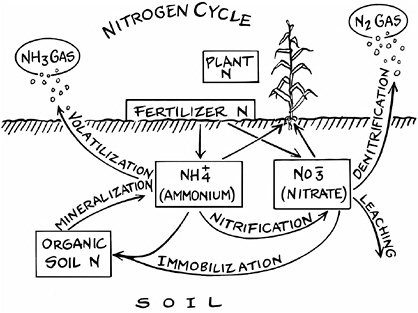
The reactions of nitrogen in the soil
In China it was still being used as fertilizer until the 1980s. But this practice carries the danger of spreading germs and parasites. Most Chinese farmers who used unfermented night soil were infected with parasites.
In his book about nitrogen, Enriching the Earth, Vaclav Smil recounts that manure use reached a peak in the Paris suburbs late in the nineteenth century when horse-drawn vehicles provided transportation. Many tons of manure were generated in stables daily and shipped off to farms around cities. For growing vegetables, as much as 500 tons—100,000 pounds—of manure were applied to a single acre of soil. At this extraordinary application rate, even the tiny amounts of nitrogen in manure provided enough to grow luxuriant crops.
With the growth of human populations that followed the industrial revolution, increasing amounts of nitrogen-rich guano (bird excrement) and nitrates were imported by rich European nations from South America to maintain and increase agricultural yields. But it is air that holds a virtually unlimited supply of nitrogen, and many late-nineteenth-century chemists worked on the problem of converting gas-
eous nitrogen to a form that would support plant growth. Two German scientists succeeded. In 1909 Fritz Haber invented a process to produce ammonia from hydrogen and nitrogen. Over the next few years Carl Bosch developed it into the large-scale process used today. Nitrogen fertilizers made it possible to double and even triple the productivity of land. An official at a sewage authority in South Carolina testified before Congress in 1993 that it would take 50 times the amount of sewage sludge produced in America each year to replace the nitrogen in the chemical fertilizers used in farming.
In Sir Albert Howard’s time, land was not a limiting factor. His answer to the nitrogen question, based on his long experience in India, was to grow nitrogen-fixing legumes on any and all spare land. This green manure, plowed under, increased the nitrogen content of the soil, a practice that is a rule of organic farming today. Because synthetic fertilizers are forbidden to organic farmers, productivity is limited by the ability of bacteria to fix nitrogen from the air and their ability to recycle nitrogen from green manure and animal wastes. The nitrogen content of both of these organic fertilizers is very low, and farmers need extra land on which to grow either fodder for their animals or the nitrogen-fixing plants that provide green manure. Because it takes roughly twice as much land to produce the same amount of food, organic farmers must charge a higher price for their produce than conventional farmers do. Countries such as our own and those in Europe enjoy a good climate for growing crops, ample land for their human population, and high income levels. These countries can easily afford to support organic farmers. Such luxuries of land and income are far from universal, however.
People who argue for organic farming—as defined by the USDA’s Organic Rule—as a worldwide solution often overlook three points: the higher cost of food, the need for more land, and the need for more hard manual labor.
A six-year study of Washington apples, published in Nature in 2001, was said to have “established that organic production of apples is more sustainable than conventional apple production.” The researchers, from Washington State University, planted four acres of Golden Delicious apples in 1994 and divided them into plots managed accord-
ing to organic, conventional, and integrated farming practices. (Integrated farming, they said, mixes parts of organic and conventional methods.) Because yields were equal, the researchers reported that “with the price premiums generally awarded to organic produce, the organic apples were more profitable.” The profit margin without the price premiums was not discussed.
An outspoken proponent of organic farming in developing countries is Miguel Altieri, a native of Chile and an associate professor of insect biology at the University of California, Berkeley. As an example of how organic farming can work, he cites a 1998 study of organic potato growing in Bolivia. The yield on the organic farms was 11.4 tons per hectare compared to 17.6 tons per hectare on the modern industrialized farms in the same region. The economic gain per ton of potatoes, after the cost of fertilizer and other chemicals was deducted, was slightly higher for the organic farmer than for the high-yield modern farmer. “So organic farming looks pretty good,” notes Per Pinstrup-Andersen, director general of the International Food Policy Research Institute from 1992 to 2002.
Until you take a second look. When calculating the yield of potatoes per hectare, the researchers did not take into account the additional hectares of land needed to produce the organic farmers’ fertilizer. “Land will have to be set aside either for growing supplementary plants to be used as green manure—in the Bolivian experiment lupines were used—or as acreage for livestock to produce manure.” To have enough manure, the organic farmers must either reduce the size of their potato fields or put more land to the plow. “When the cost of the additional land is factored into the study, the figures for yield per hectare do not look so good,” says Pinstrup-Andersen. “If we set aside the ecological risks of bringing more land under cultivation, organic farming may be a perfectly acceptable solution in regions with unused land that can be cultivated without damaging the environment.” But, he adds, “Such regions are becoming scarce.”
In the Bolivian study, 1.5 tons of lupines were used as green manure on every hectare of potato field. The labor involved in growing, harvesting, and applying the lupines to the potato fields was also not accounted for in the cost of producing the potatoes. “In a Kenyan
study,” Pinstrup-Andersen notes, “for every hectare of land used in maize production, four tons of weeds had to be lugged from hedgerows and roadsides to redress the loss of phosphorous and nitrogen. This is considered women’s work.” He continues, “Some proponents of organic farming assume that the labor-intensive nature of the farming is itself a good thing.” Yet, he says, in parts of Africa, particularly, there is a severe labor shortage, one that is worsening steadily as the AIDS epidemic progresses.
Ebbe Schioler, also with the International Food Policy Research Institute, visited rice growers in Africa. The weeds they faced were “stout thistles, coarse grasses, large thick-leaved plants with tough stalks, and little bushes that … produce a powerful, deep-reaching root system.” The farmers use no herbicides. “Everything is done by hand and hoe, and even though the children do their bit, it is still touch and go. It takes 40 days of sweating and straining each year to keep just one hectare of land weed-free.”
Suggestions that organic farming is appropriate for countries with high population pressures and limited arable land and water supplies sound suspiciously like Marie Antoinette’s “Let them eat cake.” Or, as Peter Raven has noted, “Organic agriculture is essentially what is practiced in sub-Saharan Africa today, and half of the people are starving; so it is clear that more is needed.”