Mendel in the Kitchen: A Scientist's View of Genetically Modified Foods (2004)
Chapter: 2 The Wild and the Sown
2
THE WILD AND THE SOWN
There is always enough seed escaping the harvest to maintain the stand. Domestication begins when the people plant that which has been harvested. Then there are two populations, the wild and the sown.
—Jack R. Harlan (1999)
In 1786 Antoine Augustin Parmentier received permission from King Louis XVI of France to grow potatoes on 50 sandy acres outside Paris. Potatoes, at the time, were not popular. French fries had not yet been invented. Rather, potatoes were said to cause leprosy, cholera, scrofula, rickets, and tuberculosis. Being roots, they upset the body’s balance. They corrupted the blood; they caused flatulence. Relatives of mandrake, henbane, nightshade, and belladonna, they were undoubtedly poisonous—or aphrodisiacs, as the English had thought since Shakespeare’s day. They were unfit for any but beasts and, being pig fodder, would lower the standard of living if humans ate them. Besides, no good farmer would grow potatoes. Not only weren’t they fit to eat, they ruined the soil.
Parmentier disagreed. He persuaded Queen Marie Antoinette to put potato flowers in her posies to rehabilitate the image of the poor plant. He asked for a sandy wasteland as his trial garden to show how well potatoes could grow in land useless for other crops. He then asked the king to post a royal guard. The soldiers stood guard only during the day. Each night, Parmentier was pleased to learn, peasants crept in while the guard was gone and stole potatoes—to plant, Parmentier
hoped, or at least to eat. Parmentier, a pharmacist by trade, had argued since 1770 that potatoes could replace bread when the wheat harvests failed, as those harvests quite often did in eighteenth-century Europe. But despite the success of his ruse—pretending his heavily guarded potatoes were only for royalty, not common folk—his idea caught on too late. Soon after his Paris experiment a bad harvest sparked the bread riots of the French Revolution, occasion for the famous line attributed to Marie Antoinette, “Let them eat cake.”
Potatoes were not new to Europe in the late 1700s. The Spanish had brought them from Peru two centuries before. Nor are they the only food now considered central to our lifestyle to be greeted at first with suspicion. A Jesuit priest wrote in 1590, “The main benefit of this cacao is a beverage which they make called Chocolate, which is a crazy thing valued in that country. It disgusts those who are not used to it, for it has a foam on top, or a scum-like bubbling.” Likewise, in 1674 a group of Englishwomen described coffee, in a petition to government to ban coffee shops, as “base, black, thick, nasty, bitter, stinking, nauseous puddle water.”
Just as they were chary of trying new foods, Europeans clung to the old ones when they emigrated to America. The tomato, a New World staple, was “treated with derision” and fed to the pigs as late as the nineteenth century. Instead, the settlers brought the foods they knew from their homelands: apples, oranges, figs, sugar, wine grapes, wheat, oats, barley, rice, cabbages, watermelon, and cantaloupe. They also imported honeybees, not found in America, to pollinate their new crops. To sustain their imported cattle, they imported grass seed, including English clover (which when it was introduced into England in the 1500s had been called French clover, the best varieties having come from France). Soon these imported grasses had taken over so completely—and often merely by the expanded grazing of cattle, who carried the seeds in their dung—that “within a generation of settlement,” writes one historian, “many were believed to be native.”
Nowadays, notes Edgar Anderson in his book Plants, Man, and Life, “Few Americans realize how completely our American meadow plants came along with us from the Old World. In our June meadows, timothy, redtop, and bluegrass, Old World grasses all three, are starred
with Old World daisies, yarrow, buttercup, and hawkweeds. The clovers too, alsike and red and Dutch, all came from the Old World. Only the black-eyed Susans are indigenous. An informed botanist viewing such a June meadow may sometimes find it hard to point out a single species of plant which grew here in pre-Columbian times.”
Even before the settlers came with their Old World fruit trees, grains, and grasses, humans had been remaking the American landscape. The Wampanoag of Massachusetts burned the forest underbrush each year to make it easier to find and follow game. In California, according to Florence Shipak of the University of Wisconsin-Parkside, the Kumeyaay harvested the grains of wild grasses, then burned the fields; after the autumn rains, they broadcast some of the harvested grain, along with seeds of green, leafy plants and other vegetables that would ripen at the same time. Other wild foods and medicinal plants they divided and transplanted to similar ecological niches, expanding their range. They planted oaks and desert palms, mesquite, wild plums, and pines whose nuts were edible. To destroy insects and diseases, they burned stands of agave, yucca, and other plants every 5 to 10 years. These ways of domesticating whole landscapes—called firestick farming, hobby farming, or proto-farming—anthropologists now believe were practiced by humans for thousands of years before we domesticated individual plants. Rather than being a revolution as momentous as the discovery of fire, agriculture was the evolutionary next step in our everyday efforts to ensure our food supply.
Some theories say the step was taken for religious reasons: the best seeds were saved and planted to propitiate the gods. Others argue that humans were pushed over the edge by crowding or climate change or the loss of their major prey, or by all of these factors combined. It’s no coincidence, they argue, that the earliest conclusive proof of true agriculture—a few grains of domesticated wheat found in the Near East—dates to the end of the last Ice Age. The glaciers were melting. Sea levels rose, affecting habitats around the globe. The Bering land bridge by which humans had crossed into North America disappeared. More than 70 percent of the large game animals in North and South America went extinct, including the mastodon, mammoth, ground sloth, peccary, several camels, the horse, and a guinea pig the size of a hippo.
Their disappearance was due to overhunting or to the change in climate, or to a combination of the two. In any case, it is likely that only those humans who already knew how to supplement their hunting with hobby farming could thrive. Such people in South America had already domesticated beans, peppers, and squash, and were on their way to adding tomatoes, corn, and potatoes. In China they were growing rice in paddies. In the Near East they found the wild grasses—especially wild wheat—particularly amenable to domestication because of their dense stands and large seeds.

The city of Jericho is far from the natural range of wild wheat. In prehistoric times its 6 acres, on the West Bank of the Jordan River, sheltered a population of at least 300—an extraordinary concentration of people for those days. A single family in a hunting and gathering culture of that period required a range of 3 square miles. Jericho, moreover, was built of stone and had an elaborate system of ditches and walls to divert floodwaters, as well as a 9-foot-high circular tower whose purpose we can only guess at.
By the time the tower was built 10,000 years ago, wheat had already gone through several changes at the hands of humans. The change most convincing to an archeaologist is in how the spikelet holding the seed or grain attaches to the stalk. In wild wheat the spikelets shatter easily so that a light breeze can scatter the ripe seeds onto the ground. The end of a wild spikelet is smooth. In domesticated wheat the seed spike is not so brittle. The spikelets remain fixed to a miniature stem or “rachis” so strongly that no breeze can break them free. “The seeds ‘wait’ for the harvester,” notes botanist Daniel Zohary. An archaeologist can identify a grain that has been harvested and threshed by the rough scar on its end.
This change from a brittle to a sturdy rachis was caused by the mutation of one gene. To wild wheat such a mutation would be deadly: its ripe seeds would dangle on the stalk, with no chance of being buried in soil, germinating, and continuing the species. But domestication in many ways inverts the rules of nature. The process has been likened to making plants into “wards” of people. Jared Diamond, a professor at
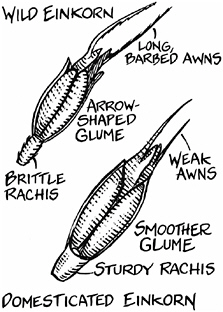
How to tell wild wheat from domesticated wheat
the University of California, Los Angeles, puts it this way in his book Guns, Germs, and Steel: “Human farmers reversed the direction of natural selection by 180 degrees: the formerly successful gene suddenly became lethal, and the lethal mutant became successful.”
A second mutation that turned wild wheat into domesticated wheat was also lethal. The grains of primitive kinds of wheat are encased in tough hulls. What falls to the ground is not a smooth, rounded, naked kernel but the spikelet, “armed with thorn cells and rough barbs, all pointing upward,” as botanist Jack R. Harlan describes them. Arrow-shaped, these spikelets “work their way into the soil, often aided by rough awns that vibrate in the wind.” Once buried, the bristles have another function: the seed cannot germinate until the hull is broken down. Depending on the weather they are exposed to, seeds from the same summer will be ready to sprout at different times, sometimes years apart. This dormancy is the species’ guarantee of survival. “If all the seeds sprouted with the first rains and there followed a long dry period before the next rains, the species would then become extinct. Some dormancy is required to build up a seed bank in the soil,” writes Harlan in his book The Living Fields. Yet not only do the spikelets take
some effort to thresh and winnow into grindable grains, the seeds’ dormancy is a nuisance to the farmer, who wants all his seeds to sprout at the same time. Again, a mutation in a single gene made the difference between hulled wheat and naked wheat.
A third change farming made to wheat was in the size, shape, and make-up of the grains: they became larger, plumper, and better for making bread or pasta. The changes here were not due to the mutation of a gene, but to the addition of an entire genome, the full set of chromosomes of another plant. Einkorn wheat, the least domesticated variety, is diploid (from the Greek diplo, which means twofold): each plant has two sets of chromosomes. Einkorn inherits one set of 7 chromosomes from the male parent and one set of 7 from the female parent, for a total of 14. Because a human is also diploid, inheriting 23 chromosomes from father and 23 from mother for a total of 46, we tend to think of this situation—two sets of chromosomes making up one genome per organism—as normal. But botanists and plant breeders know it is not always so.
Emmer wheat, which along with einkorn was found buried at Jericho, is tetraploid. Each emmer plant has four sets of 7 chromosomes, for a total genome of 28. The relationship between the diploid einkorn and the tetraploid emmer was worked out early in the twentieth century by the Japanese scientist T. Sakamura. Einkorn’s genome of 14 chromosomes, in two sets of 7, Sakamura called AA. Emmer wheat had all of these AA chromosomes, but it also had a pair of completely different chromosomes, which he labeled BB. These chromosomes, botanists believe, came from a weed common in wheat fields, most likely a kind of goat grass (Aegilops speltoides). At some point Triticum urartu—which is very similar to modern einkorn wheat—and this weed had hybridized, even though they were different species not even grouped together in the same genus. Because the resulting hybrid, emmer wheat, had more chromosomes than either of its parent types, it could not breed with either one: it was an entirely new species. Emmer wheat is known by the species name Triticum turgidum.
Emmer wheat was quite popular in the ancient world—the Romans preferred it to barley—and its sticky flour is still a favorite for making pasta. Durum wheat is a modern variety of emmer. But the
major wheat of the world, bread wheat, is yet another species, Triticum aestivum. It is a hybrid of emmer and “a bristle-headed little weed of the Near East,” as botanist Edgar Anderson has described it: Aegilops squarrosa, another kind of goat grass. It is thus a hexaploid, containing six sets of chromosomes, and is labeled AABBDD. It contains all the chromosomes of emmer wheat (AABB) and all the chromosomes of the weed, Aegilops squarrosa (DD), for a total of 42 chromosomes—three complete genomes.
The most ancient variety of bread wheat is spelt. Jack Harlan, who made a career of studying crop evolution, believed that the original cross between emmer wheat and goat grass to produce spelt happened near the southern end of the Caspian Sea shortly after emmer wheat itself was domesticated. This cross made wheat both drought-resistant and cold-tolerant, traits that permit it to be grown in North America, far from its origins. It also increased the quantity of gluten proteins in the wheat—these are the proteins that give bread dough its elasticity and allow bread containing yeast to rise.
But spelt is a hulled wheat. Its grains have to be heated, or parched, to free the kernel from the hull for grinding, and this destroys the structure of the gluten proteins. To arrive at the modern varieties of bread wheats—and make possible the invention of soft, raised bread—required two gene mutations (one to an A-chromosome gene and one to a D-chromosome gene). These mutations allowed for naked grains, giving harvesters a smooth, rounded kernel for easy grinding into a flour high in gluten proteins.
When scientists suggested that bread wheat got its goodness from two nuisance weeds, they turned the whole history of wheat on its head. That history had been written by taxonomists, scientists who study the shape and structure and habits of a plant and assign it to a genus (of which the plural is “genera”) and species. As Edgar Anderson, writing in the 1960s, remembers, “We had set out to study the origin of wheat, and the taxonomists had told us we were studying Triticum, and there were such and such species in that genus. We now learn that our commonest wheats belong to the genera Agropyron and Aegilops quite as much as they do to the genus Triticum. Were it possible to sacrifice convenience to accuracy, our bread wheats could more fittingly be des-
ignated as Aegilotriticopyron.” (Since then, botanists have determined that the Agropyron weeds—quack grass—did not, in fact, contribute to modern wheat.)
The history written by the plants’ own chromosomes was proved right in the end by plant breeder Sam McFadden. He crossed emmer wheat with Aegilops squarrosa, producing a hybrid with the chromosomes ABD. It was sterile, having an odd number of chromosomes. “Otherwise it looked like a primitive bread wheat,” Anderson writes. Ernest Sears then took McFadden’s sterile plants and treated them with colchicine, the chemical that doubles a plant’s chromosomes. The result was a hexaploid wheat with the chromosomes AABBDD. It was “virtually identical” with spelt, says Anderson, and bred normally with ordinary European spelt varieties.
Millennia before genetic engineering was invented, how did humans succeed in transferring genes for cold tolerance and drought resistance from weeds into wheat? How did they break, not only the species barrier, but the presumably greater barriers between one genus and another? They did so by changing the conditions under which the plants grew. Their new technology, arable farming, allowed mutants with ordinarily lethal genetic changes not only to survive but to expand their range.
The difference between arable farming and other ways of encouraging plants to grow is plowing: the farmer breaks the soil, uproots all other vegetation, and sows the seed in bare dirt. There, protected from pests and predators, watered and weeded, a hybrid is at no disadvantage—provided it looks like the crop the farmer intended. As Anderson concluded after studying the patterns of hybridization of two common American weeds, “There were no hybrids in the wild, not because the two species were not cross-fertile, nor because bees did not carry pollen back and forth, but because in the strict interlocked economy of nature there was no room for something different. There was no niche into which they could fit.” When he grew the two species side by side in a garden, hybrid weeds quickly appeared—and flourished. Likewise in the farmer’s field the new wheats found their niche.
Mutant plants were also favored by other practices of early farming. In his Crop Evolution Laboratory at the University of Illinois, Jack
Harlan found that three seasons of sowing and reaping were enough to eliminate seed dormancy. Producing wheats with seedheads that didn’t shatter was an accident of technology. Harlan writes, “I have personally harvested wild-grass seeds by hand-stripping and with flint-bladed sickles, beater and basket, beater and boat … steel sickles, scythe, mechanical stripper, mechanical blower, binder, and power mower/swather followed by pickup combine and grain combine.” He estimates that none of these methods, ancient or new, collects more than half the crop. Of the ancient ways, though, some seemed to be much less work, involving less stooping. For instance, he notes, “Having used both sickle and beater, I have long wondered why the sickle was ever preferred.” Although archaeologists have not yet answered his question, they have determined the result of that switch.
Gordon Hillman and Stuart Davis of University College London experimented with planting wild wheat on the scale they thought the first farmers might have used, then calculated how long it would take for domestic wheat to appear. By domestic they meant a mutant with a seed spikelet that did not shatter in a breeze. In a 2- to 4-acre plot it would take 5 to 6 years. In a tiny plot only 30 yards square it would take 10 to 20 years. But, they warn, “domestication would have occurred only if the crops were harvested while partially ripe (or near ripe) by means of sickle reaping or uprooting.” Although beating the grain into a basket is quick and requires less stooping, it leaves on the stalk those seed heads that don’t shatter easily. These, write Hillman and Davis, “are stripped by birds, and even if their spikelets were to fall to the ground, their almost complete failure to penetrate ground litter and self-implant ensures their predation by rodents, birds, and ants.” They contribute little to the crop the next year, even if the same field is replanted.
On the other hand, a farmer who uses a sickle to cut the stalks, then bundles the sheaves together to thresh out the grain later, loses the seeds from heads that do shatter easily. The seeds that make it home, to be stored and sown the next year, are those whose spikelets are held tight to the stalk by a sturdy rachis. “Crops sown from the harvested grain will reflect this increased proportion of tough-rachised forms, and the increase will continue, year on year, for as long as crops are
always sown on new land from harvests taken from the previous year’s new plots(s),” Davis and Hillman write. “Eventually the crop will be composed entirely of tough-rachised forms, and at this point domestication (in respect of the fixation of semitough rachis) is complete.”
At about the same time that farmers in the Near East were reshaping grass and weeds into bread wheat, farmers in the New World were creating corn. Corn, or maize, known to science as Zea mays, may be the greatest feat of genetic engineering yet. While domesticating einkorn wheat took a “few simple changes,” in the words of Jared Diamond, creating corn seems to have required a “drastic biological reorganization.” Like wheat, corn depends on humans to sow its seeds, stuck tight as they are on its enormous ears, which themselves remain firmly attached to the stalk. But whence came this huge ear, “the span of a human hand and thick as an arm,” as Columbus limned it to the king and queen of Spain in 1493?
That answer was a point of contention among plant scientists for most of the last century. Corn, unlike wheat, bears little resemblance to its wild relatives. Was its big-eared ancestor extinct? Or was corn, as some scientists asserted, an extraordinary, even catastrophic mutation of a wild grass called teosinte?
Botanists in the nineteenth century had classified teosinte as Euchleana mexicana: it looks so different from corn that no one suggested it should be placed in the same genus (Zea), not to mention the same species (mays). Teosinte looks like a grass. It has many branches and grows in clumps. Its ear, like an ear of early wheat, is a row of easily dispersed seeds, each enclosed in a hard hull or fruitcase. Crosses of corn and teosinte do exist in the wild, but they were not recognized as such until the late 1800s. They looked so different from either parent that they were classified as a third species, Zea canina.
Then in 1896 a Mexican agronomist named José Segura crossbred corn and teosinte, producing fertile plants that looked just like wild Zea canina. His work was noticed by G. N. Collins of the USDA’s Bureau of Plant Industry, who traveled to Mexico in search of teosinte
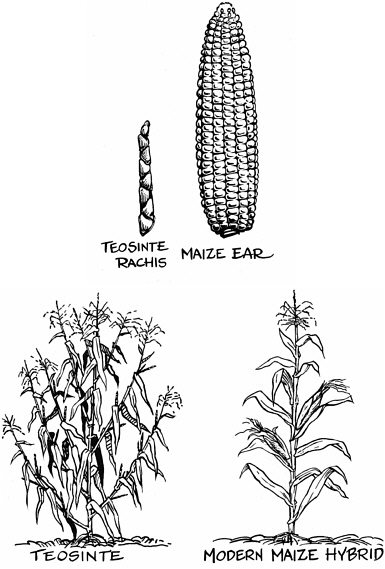
Corn and its ancestor, teosinte
in 1919. Following the advice of Edward Palmer, an ethnobotanist at Harvard’s Peabody Museum, Collins collected teosinte on the banks of an irrigation ditch in Durango, Mexico. He brought back both plants and seeds, which he grew until he had enough teosinte not only for his own research, but to share with other scientists, including Rollins
Emerson of Cornell University. Emerson, a geneticist, was less interested in the history of corn than in the link between chromosomes and inheritance. Among his graduate students was George Beadle, who would share the Nobel Prize in 1958 for the “one-gene one-enzyme” hypothesis. Emerson asked Beadle to make hybrids between teosinte and maize. It proved easy to do: the plants are 100 percent interfertile. After studying the hybrids’ chromosomes, Beadle and Emerson concluded in 1932 that maize and teosinte belonged not only to the same genus, but to the same species: the two plants shared even the order of the genes on each chromosome. Beadle and Emerson considered the puzzle of the history of corn solved.
Their solution did not persuade everyone. Other maize geneticists, particularly Paul Mangelsdorf, believed that the ancestor of corn was either extinct or had not yet been found. The differences in how maize and teosinte grew and reproduced were just too great. Mangelsdorf could not believe that teosinte, with its inedible seeds, could turn into the most productive food plant on the face of the earth.
In 1938 Mangelsdorf and Robert Reeves proposed a new theory of the origin of corn. Although cumbersome, it came to be widely believed. From Edmund M. East, Mangelsdorf’s thesis advisor at Harvard University, they borrowed the idea that maize evolved from an extinct South American species. From Edgar Anderson, another student of East, they adopted the idea that teosinte came from a cross between maize itself and a grass in the genus Tripsacum. The diversity in contemporary corn, they said, could be traced back to this “infection” by Tripsacum. After many attempts they were able to germinate and grow a few, mostly sterile, hybrids between maize and Tripsacum. They also crossed maize-teosinte hybrids back to maize and analyzed these backcrosses, identifying a number of differences they attributed to the Tripsacum infection.
When two genomes that are very distant come together, the differences between them do not disappear. Telltale signatures persist in the DNA. Mangelsdorf’s hypothesis would one day be testable. But in 1938 it was not, and Mangelsdorf and Beadle sparred for years about who was correct. (Some of their efforts were quite theatrical. According to Jack Harlan, to prove that teosinte was the same species as corn,
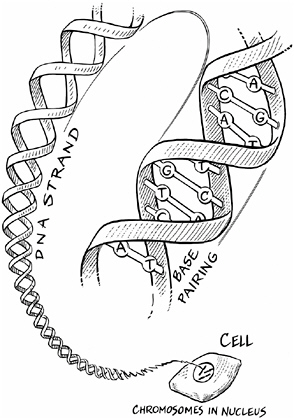
DNA, the double helix
“George Beadle ground up fruitcases, seed and all, made tortillas out of the flour, and ate them.”)
Beadle worked on a very different organism, the orange bread mold Neurospora, for most of his career and then served as president of the University of Chicago. Mangelsdorf became a professor at Harvard and influenced generations of archaeologists through his collaborations with Harvard archaeologist Richard MacNeish, who studied early agriculture in Mexico. When Beadle retired he returned to the teosinte question. In 1971 he organized a teosinte hunt in Mexico to look for more wild maize relatives. Some of the teosinte seeds he collected on that expedition, from the Balsas River valley, found their way to John Doebley, now at the University of Wisconsin-Madison.
Doebley belongs to a new generation of geneticists able to ask much more detailed questions about the evolution of plants. With
molecular markers and statistical methods, geneticists can now figure out which pieces of which chromosomes are responsible for the seemingly huge differences between teosinte and maize. They can even estimate how many genes might be involved. Their methods rely on the fact that DNA changes at a remarkably rapid pace.
It had long been known that DNA mutates. Each time a cell divides, its DNA is copied. During this copying process, mistakes—mutations—can occur. To make a copy, the long twisting DNA double helix is first unwound: from resembling a spiral staircase, it begins to look much more like a ladder. Then the rungs of the ladder, each made of two linked bases, are separated. A new partner is found for each base until there are two copies of the original DNA.
These copies are usually identical because the bases, known by the first letters of their chemical names as A, T, G, and C, are very particular in their pairing. A pairs only with T; G pairs only with C. But the copying mechanism does make mistakes, putting a C where an A should go, for example. Such so-called “point” mutations are rare, occurring perhaps once in every million times a gene is duplicated. But they do happen.
Point mutations do not always have an effect on the plant. Not all of a plant’s DNA is devoted to genes—to the code, the instructions, for making proteins. And even a mutation in a gene doesn’t always change the protein that the gene codes for. Nor are these substitutions the only kind of change that can happen to a DNA sequence. Frequently, the molecular machine that copies DNA gets stuck and, in effect, stutters. A short sequence such as AT becomes ATAT, then ATATAT, and so on. These changes, which are quite common and usually have no effect, are called simple sequence repeats or microsatellites. The reverse also happens, when the DNA copier skips a set of repeats, and ATATAT becomes ATAT or AT. Other kinds of mutations that add or delete larger strings of bases are relatively frequent as well. Often they too are harmless. A final source of change comes from transposons, familiarly known as jumping genes. Maize and its ancestors are particularly rich in these mobile stretches of DNA.
Because DNA is always changing in these small ways, the chromosomes of any two plants belonging to the same species differ in many
places. Plants like maize and teosinte, which have reproduced separately for thousands of years, have accumulated many, many differences. Doebley and his students sought to link these differences in DNA to differences in the maize and teosinte plants, particularly in the structure of the all-important seed-bearing parts. They crossed maize to teosinte, then backcrossed the hybrid to its maize parent for many generations. When they compared the various offsprings’ DNA (automated DNA sequencing machines and massive computer programs have made this task quite simple), they could identify even small lingering bits of teosinte DNA.
Emerson, Beadle’s advisor, had suggested back in the 1920s that only a few genetic changes were needed to transform teosinte into maize. In 1992 Doebley and his colleagues came to much the same conclusion: changes in no more than five major regions of the genome made the difference. In two cases they could trace the change to an individual gene.
One was a gene that affects the glume, one of the structures that encloses the kernel. In teosinte the glume is hard, almost stonelike. It forms the fruitcase around the kernel. This stony fruitcase ensures that even if the kernel is eaten, it passes through the eater’s digestive tract unscathed. But the plant’s success in thus scattering its seeds is a nutritional failure for humans. The hardness, size, and curvature of the glume, Doebley and his colleagues found, is controlled by a gene named teosinte glume architecture, or tga1. (Genes are often named for the way a mutation in the gene affects the plant. Two mutations giving the same kind of phenotype, or form, even if they involve different genes, are given the same name, but different numbers are used in their abbreviations.) The hardness of the teosinte glume is due partly to silica deposits in its outer cells (silica also makes the surface of teosinte kernels shiny) and partly to lignification (some glume cells become filled with lignin, the same substance that makes wood hard).
Maize kernels do not have a stony fruitcase. In a plant that has the maize version of tga1, silica is deposited in only a few glume cells. The cells are also less lignified. Finally, in maize the glumes grow more slowly, so they do not fully enclose the kernel. A change in this one gene moved teosinte a long way toward becoming a useful food plant.
It was quite bad for teosinte, however, because its kernels were no longer as resistant to destruction. The only way the mutation would persist is if people made sure some of the seeds were planted. George Beadle believed that people must already have been harvesting, grinding, and probably cooking teosinte seeds when the mutation occurred. They were most likely farmers as well, because squash was domesticated even longer ago than maize. To these early farmers, the change to softer seeds probably just reduced the amount of work it took to make the seeds edible. Hugh Iltis, on the other hand, has suggested that teosinte plants were cultivated at first because their stalks are sweet, much like sugar cane, and that it was the tga1 mutation that first made the seeds useful as human food.
The second gene Doebley’s team studied was named teosinte branched or tb1. Teosinte plants have lots of long side branches that make them look like bushy grasses. Each side branch has a tassel, a male pollen-producing flower, at its tip. Teosinte’s female flowers, which become the ears, are produced by secondary branches that grow from these main branches. Maize, on the other hand, is generally not branched. It has one main stalk with a pollen-producing tassel at the very top. Its side branches are very short and end in ears, the female flowers. Much of the difference in the way the two plants look and grow is due to the tb1 gene. The maize form of the gene keeps the lateral shoots from growing long, converting the bushy shape into the slim, single-stalked maize. It telescopes the side-branches into ears and surrounds them with layers of leaves—the husks—growing close together. Finally, it converts what would have been male flowers, the pollen-producing tassels, into female ears.
Hugh Iltis had predicted this mutation in 1983, when he was director of the herbarium at the University of Wisconsin-Madison. He called it “the catastrophic sexual transmutation.” It was, he wrote, “a gross and sudden quantum evolutionary emergence of a ‘hopeful monster’,” turning a male part into a female part. Iltis has been described as “the Sir Richard Burton of the plant world, scaling the Andes in search of a wild potato.” His theory of how teosinte turned into corn was “as flamboyant as his person,” but by 2002 he had reconsidered the “monster’” part of his theory. At a botany conference he noted
that his theories on how to transmute teosinte tassel spikes into maize ears were “unnecessary explanations of common phenotypic variability. This was well understood but its implications totally missed by this author. To quote Mark Twain, ‘The eye cannot comprehend when the imagination is out of focus.’”
Interestingly, both the tga1 and tb1 genes code for proteins that control the expression of a group of other genes. For tb1 it is not the structure of the protein that makes the difference, but how much of it is made. The part of the tb1 gene that encodes its protein did not change much as teosinte evolved into maize. But maize plants produce twice as much of the tb1 protein as teosinte plants.
If several such mutations were needed to create corn, then the plant at some point in its evolution might have met a bottleneck. An evolutionary bottleneck is a time when the size of a population is vanishingly small. It consists of only a few plants, each carrying the crucial mutations. All of the maize plants throughout the world would be descended from these few plants. This prediction, too, can now be tested. A large population of individuals has in the aggregate a great many differences in its DNA. Based on how frequently these differences arise, scientists can create a molecular clock. Using a molecular clock for maize, Brandon Gaut and his colleagues, then at Rutgers University, estimated how many generations and how many founding parents it would take to account for the variability in modern corn. Their results were consistent with a bottleneck of just 10 generations and a founding population of 20 individuals.
The traits that distinguish corn from teosinte seem to come as a package. In teosinte the rachis that holds the seeds always has two rows, it always has single spikelets holding its kernels, and it always shatters easily. The maize ear, by contrast, always has many rows and pairs of spikelets, and it does not shatter. Yet several genes contribute to this cluster of traits, to rows, spikelets, and shattering. One way these traits could all change at once is if there were a single controlling gene. A mutation in the controlling gene might then change how all the genes under its control were expressed, affecting the whole cluster of traits at the same time. Or there could be another explanation: differences in the genes could accumulate undetected—as cryptic changes, hidden
variation—until, at some critical point, one final change reveals all the others.
To see if there was cryptic variation in teosinte, Doebley and his student Nick Lauter made a hybrid between two different types of teosinte (subspecies mexicana by subspecies parviglumis), then crossed that hybrid to maize. They looked at seven traits in the hybrid—such as an easily shattering ear—that couldn’t be detected in either one of the parent teosintes. Did either of the teosinte subspecies, they asked, have an effect? For four of the seven traits, they found, genes from both teosinte parents made the maize-teosinte hybrid more maize-like. For the other three, one of the teosinte parents made a maize-like contribution, the other one did not. There was, they concluded, cryptic variation in teosinte, hidden mutations that were suddenly revealed, switching the plant onto a new evolutionary track.
Finally, they asked, had this sudden change happened just once or did it happen many times in many places? Because maize is such an extraordinarily variable plant, both in its appearance and in its genome, scientists had conjectured that teosinte had been transformed into maize many times. This question can be answered by constructing family trees based on the genetic similarities and differences among modern corn varieties and various types of teosinte. If maize arose from different types of teosinte multiple times, we should be able to derive several family trees, tracing the domestication events back to the particular variety of teosinte that gave rise to each one. If it happened only once, all modern corn varieties should fit into a single family tree tracing back to a single teosinte ancestor. Doubley’s group published the results of this experiment in 2002. They had screened a hundred different genes using microsatellites, the small repetitive sequences that change so rapidly. Their results were unequivocal: all modern corn belongs in a single family. It was domesticated only once.
Knowing how fast genetic differences arise, and how many there are today, they could also estimate when this event happened. Moreover, knowing where the descendents of the genetically closest teosinte live today, they could pinpoint where it happened. Maize, they concluded, arose from teosinte of the subspecies parviglumis in the Balsas River basin of southern Mexico between 5,000 and 13,000 years ago.
Until recently the oldest archaeological evidence of domesticated corn came from cobs found in the San Marcos Cave in the Tehuacan Valley in southern Mexico. These cobs are roughly 4,700 years old. In 2001, however, cobs from the Guila Naquitz Cave, excavated in 1966, were redated by accelerator mass spectrometry and found to be more than 6,200 years old. While these early cobs do not look much like our huge modern corncobs, they look even less like ears of teosinte. All three fossilized cobs have kernels that are tightly attached, unlike teosinte. While two of the fragments have only two rows of kernels, like teosinte, one has four, more like modern corn. Moreover, in these ancient cobs the grain-bearing spikelet is set perpendicular to the stem, as it is in maize but not in teosinte. Finally, the glumes of the kernels appear to be flexible, like those of maize, suggesting that the tga1 gene had already mutated and the kernel had lost its stony fruitcase.
The Guila Naquitz Cave is in southern Mexico, 400 to 500 kilometers east of the Balsas River area where corn’s closest teosinte relative lives today. The age of these earliest cobs pushes the origins of corn back to well within the estimate arrived at by the molecular biologists. The new maize varieties traveled from hand to hand with incredible speed—on an evolutionary timescale—creating what might be regarded as an early “Green Revolution.” Recent molecular analyses of the tb1 gene show that by 2,000 years ago a crop containing the maize version of the gene was already being grown as far north as New Mexico.
For corn, domestication was wildly successful. Humans remade the landscape, clearing forests and plowing-under the prairies to plant more corn. The first Europeans to reach the New World, writes Margaret Visser in her book Much Depends on Dinner, were “staggered by the size of the maize plantations: Diego Columbus, Christopher’s brother, said he walked 29 kilometers (18 miles) through an immaculate field of corn, bean, and squash mounds, and never came to the end of it.” Columbus brought maize back to Spain; now it grows on every continent, covering 80 million acres of America alone. While its teosinte relatives remained in a very small geographical area, corn can now be
found at latitudes from 50° N to 40° S, and at elevations from sea level to 12,000 feet.
The same is true for wheat. “Wheat is not quite as adaptable as man, who exceeds all other species in the range of environments in which he can survive,” writes Felipe Fernandez-Armesto in his history of food, Near a Thousand Tables, “but it has diversified more dramatically, invaded more new habitats, multiplied faster, and evolved more rapidly without extinction than any other known organism.” It grows on more than 600 million acres around the world. Fernandez-Armesto predicts that far in the future, when historians look back on our age, “They will classify us, perhaps, as puny parasites … whom wheat cleverly exploited to spread itself around the world.” Yet world dominance for wheat and corn came at a cost: domestication meant that each plant would henceforth and forever be a ward of humans, dependent on them for its survival—just as human societies soon became dependent on their crops.
The new foods could be easily harvested and stored. Barns (originally places to store barley) and granaries (for any grains) were built—which is one possible explanation for the circular tower found in ancient Jericho. To protect their food stores, once-nomadic tribes settled permanently. Towns developed in which full-time specialists—potters, weavers, dyers, metallurgists, masons, priests, and others—could practice their arts and professions supported by the surrounding farmers and herdsmen. “Where agriculture was invented,” writes Joel Cohen of the Laboratory of Populations at Rockefeller University, “local populations grew ever so slightly faster. Whether the invention of agriculture enabled the population to grow faster or a faster-growing population was driven to devise agriculture, or both—these remain questions for speculation.”
There was, in any case, a link between the two. “In all parts of the world where adequate evidence is available,” writes Jared Diamond in Guns, Germs, and Steel, “archaeologists find evidence of rising densities associated with the appearance of food production.” Agriculture is, he explains, “an autocatalytic process—one that catalyzes itself in a positive feedback cycle, going faster and faster once it has started. A gradual rise in population densities impelled people to obtain more
food, by rewarding those who unconsciously took steps toward producing it.”
When farming began, 10,000 to 50,000 years ago, the world human population was between 4 and 10 million. Then it began to grow. By the time of Christ it had risen to between 100 and 300 million. By 1700 it had reached 600 million. Cities, kingdoms, and empires were built on the growing of grain.
People in early agricultural societies were not necessarily healthier than their hunter-gatherer relatives. Farming did not provide nearly as varied a diet as hunting and gathering had. Crops failed, stored grain grew moldy. Studies of early skeletons show that the first farmers were less robust than their hunting ancestors. They suffered from nutritional disorders, infections, and diseases that their ancestors had escaped. The amount of protein and the number of calories each person ate declined for everyone except members of the privileged class. Yet the farmers’ children might have been more numerous. Grains, pounded into gruel, notes anthropologist Mark Nathan Cohen, “would have simplified the problem of feeding the very young whether or not it improved nutrition.” Corn-fed children can be weaned earlier and their mothers (if well fed) can bear the next child sooner. And if the birth rate can exceed the death rate, even a poorly nourished people can multiply.
As Diamond remarks, “Some productive hunter-gatherer societies reached the organizational level of chiefdoms, but none reached the level of states: all states nourish their citizens by food production.” He adds, “Food production was indirectly a prerequisite for guns, germs, and steel. Hence geographic variation in whether, or when, the peoples of different continents became farmers and herders explains to a large extent their subsequent fates.”
Part of that geographical variation has to do with the third plant trait people changed through their early efforts in genetic modification. Although they did not understand what they were doing in terms of genes and genomes, by choosing which seeds to eat and which to sow the first farmers were identifying the slightly different versions of genes, the alleles, that made a plant more useful to humans.
The crucial alleles in a crop control three characteristics: the size
of the seed, how and when it is dispersed, and the plant’s dependence on day length. How long it takes for a plant to flower and set seed determines where it can grow. Yet exactly when a plant flowers in the summer—and it must flower to set seeds—depends on how long the days are. Plants have many proteins that absorb light. Among them are phytochromes, which absorb red light, and cryptochromes, which absorb blue light. These proteins interact with each other to sense both the quality of light—how much blue and how much red—and to monitor the length of the day. Only when both are right does the plant flower.
On the equator, the length of the day is constant all year round. Because the earth’s axis is tipped, the farther north or south you go, the greater the difference between the length of a summer day and that of a winter one. Plants read these cues precisely. To make a plant flower outside its original zone means tampering with the genes required for sensing the length of a day. This kind of genetic modification is easy, though it might take centuries: when people grow crops in a new environment, they can harvest and replant the seeds from only those plants that flower. The formation of potato tubers is also controlled by day length. This effect might well be why Parmentier was able to grow potatoes in Paris just before the French Revolution when his predecessors had failed.
There are more than seven species of cultivated potato. Some species, like wheat, are polyploids, with three, four, or five sets of chromosomes instead of a single pair. Like corn, they and their wild relatives hybridize very easily. Potatoes can, as the eighteenth-century French feared, be poisonous. Both wild and domesticated potatoes contain bitter chemicals called glycoalkaloids which can reach toxic levels. “In the cultivated potato,” Jack Harlan writes, “strains have been selected that are relatively safe, but even today, in areas far removed from the Andes, certain clones under some conditions can be dangerous.”
In the potato’s homeland the problem is more acute. “In the Andes, strains selected for low toxicity often cross with wild and weedy races and toxic tubers are produced: the local people must somehow live with the poisons.” Many of them use an elaborate freeze-drying technique to get rid of the toxins. Others dip potatoes in a certain kind of
clay which, like Kaopectate, protects the stomach. Chemical ecologist Timothy Johns concludes, “Undoubtedly potatoes were an unpredictable and dangerous resource until some way was found to eliminate their potential toxicity.”
Modern potatoes, from the Idaho to the All Red, are all varieties of a single subspecies, called tuberosum, of the species Solanum tuberosum. This subspecies originated in Chile. The first potato found by the Spanish explorers and brought to Europe, however, was a different subspecies of Solanum tuberosum. It was called andigena because it came from the Andes. Andigena potatoes were described by Juan de Castellanos in 1537 as “white and purple and yellow, floury roots of good flavor, a delicacy to the Indians and a dainty dish even for Spaniards.” They did not grow well in Europe. Because they came from a high altitude but a low latitude, writes plant physiologist Lloyd Evans, “andigena potatoes were well adapted to the cool conditions but not to the long days of European summers. Although it was not understood at the time, the long days of summer prevented tuber formation until close to the autumn equinox, leaving little time for tuber growth.” It took 250 years of selection by European gardeners and botanists—who grew potatoes as ornamental bushes, beautiful but “savage-looking” with their hairy stems and blue-purple flowers—before Parmentier had a plant he and his fellow Parisians could eat. Unfortunately, Parmentier was unable to persuade his countrymen to do so until hunger had led to revolution.
“The tuber ran smack into centuries-old customs that decided two of the most basic questions of peasant life, what to put in the soil and on the plate,” writes Larry Zuckerman in The Potato: How the Humble Spud Rescued the Western World. “Existence was fragile enough without letting in what was new and uncertain, even though what was new might help. The fear of change ran so deep that people were ready to die rather than alter their ways.”