Understanding and Preventing Violence, Volume 2: Biobehavioral Influences (1994)
Chapter: Afferent Connections
better understanding of how the motor cortex and trigeminal system regulate such responses as paw striking and jaw closure (Edwards and Flynn, 1972; MacDonnell and Fessock, 1972).
In this paper, we have chosen to summarize or provide references to information that we believe is critical to understanding the neural bases of aggressive behavior as studied in the cat. This includes (1) the anatomic substrates and pathways that underlie the expression and control of each of these forms of attack behavior; (2) the regions along the limbic-midbrain axis that serve to enhance or diminish the likelihood of these responses; this encompasses, as well, the effects of temporal lobe seizures on attack behavior; and (3) the role of the opioid peptide system in the regulation of affective defense behavior.
It should be noted that the structures of the limbic-hypothalamic-PAG axis would appear to constitute the neural substrates for the motivational properties of the response mechanism. In contrast, the outputs of the hypothalamus and PAG to lower brain stem neurons appear to constitute the initial neurons in a system of pathways that descend to the spinal cord or that make synapse with lower motor neurons of the brain stem. This system of fibers, therefore, may comprise part of the motor components of the behavioral response. A second level of motor function may arise from the cerebral cortex. In this context, Flynn et al. (1970) postulated a "patterning mechanism" in which it was hypothesized that sensory and motor regions of the cerebral cortex receive inputs from hypothalamic cell groups linked to the attack response. In turn, the pattern of neuronal responses evoked in the cerebral cortex thus results in a set of output signals to motor and autonomic regions of the lower brain stem and spinal cord that constitute a coordinated attack response.
THE ANATOMY OF AGGRESSIVE BEHAVIOR
PREDATORY ATTACK
Afferent Connections
Predatory attack can be elicited from a variety of regions throughout the forebrain and brain stem, an area that extends from the anterior hypothalamus through the midbrain PAG to the level of the pontine tegmentum (see Figures 2A and 2B).
Concerning the hypothalamic sites from which predatory attack can be elicited, Smith and Flynn (1980a) identified cells in a
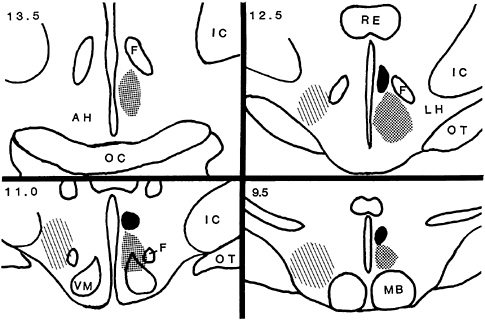
FIGURE 2A Distribution of regional sites within the preoptico-hypothalamus from which affective defense (stippled area), quiet biting attack (striped area), and flight behavior (dark area) can be elicited most frequently by electrical stimulation. Data for this figure and for Figure 2B are based on experiments conducted in the laboratory of Allan Siegel. Number in upper left-hand corner of figure indicates the frontal plane of the section. Abbreviations: AH, anterior hypothalamus; F, fornix; IC, internal capsule; LH, lateral hypothalamus; MB, mammillary bodies; OC, optic chaism; OT, optic tract; RE, nucleus reuniens; VM, ventromedial nucleus.
number of regions that are known or believed to modulate this response. Several of these key structures include the midbrain PAG, locus coeruleus, substantia innominata, bed nucleus of the stria terminalis (BNST), and central nucleus of the amygdala. Other afferent sources of the lateral hypothalamus include the lateral septal nucleus, diagonal band of Broca (Brutus et al., 1984; Krayniak et al., 1980), and midline thalamus (Siegel et al., 1973). A more detailed discussion of the anatomic pathways from limbic nuclei that modulate the attack response is presented below in the section "Limbic-Midbrain Modulation of Aggressive Behavior in the Cat."
The other major sites from which predatory attack can be elicited include the following brain stem regions: the midbrain PAG, ventral tegmental area, and pontine tegmentum. A major
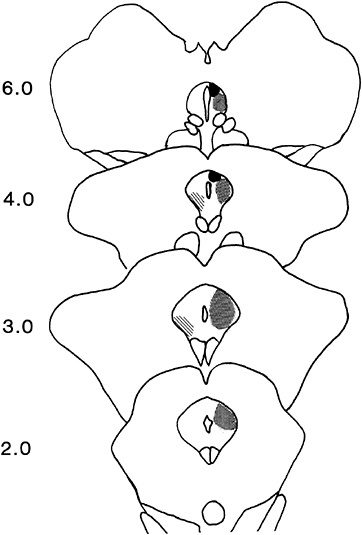
FIGURE 2B Distribution of regional sites within the midbrain periaqueductal gray matter from which affective defense (stippled area), quiet biting attack (striped area), and light (dark area) can be elicited most frequently by electrical stimulation. Number on the left side of each figure indicates the frontal plane of the section. Note that flight and affective defense sites are generally situated dorsal to those sites from which quiet biting attack is elicited. A recent study by Bandler (1984), however, has suggested that affective defense reactions characterized by howling and growling can also be elicited from ventral portions of the periaqueductal gray, especially when stimulation is applied at caudal aspects of this structure. SOURCE: Siegel and Pott (1988).


