Understanding and Preventing Violence, Volume 2: Biobehavioral Influences (1994)
Chapter: LIMBIC-MIDBRAIN MODULATION OF AGGRESSIVE BEHAVIOR IN THE CAT
(Figures 2A and 2B) and include primarily the medial preoptico-hypothalamus and dorsal aspect of the midbrain PAG.
The work of Smith and Flynn (1980b), Stoddard-Apter and MacDonnell (1980), and Shaikh et al. (1987) suggests that the cell bodies of origin that project to these regions lie within other areas of the hypothalamus, limbic areas including the medial amygdala and medial septal nuclei, and the midbrain PAG itself. Forebrain structures projecting to the relevant areas of the PAG (i.e., from which affective defense could be elicited) include the lateral hypothalamus, and the ventromedial, dorsomedial, and anterior hypothalamus (Bandler and McColloch, 1984; Bandler et al., 1985). The anteromedial hypothalamus may provide the most significant behaviorally relevant impact to the PAG (Fuchs et al., 1985a).
Efferent Connections
Space limitations are such that we can only summarize the extensive work on identification of the efferent connections from the structures involved in affective defense. These are depicted in Figures 4 and 5. Included are the anterior medial hypothalamus and the medial preoptic region; in addition, the expression of the entire affective defense response involves the central tegmental fields of the midbrain and pons, locus coeruleus, and motor and sensory nuclei of the trigeminal complex (Fuchs et al., 1985b). This latter pathway is probably important for the vocalization component of the affective defense response, since its axons regulate the jaw-opening reflex. Research continues on the description of this system.
LIMBIC-MIDBRAIN MODULATION OF AGGRESSIVE BEHAVIOR IN THE CAT
As noted in the beginning of this chapter, it has long been recognized that the limbic system plays a major role in the regulation of emotional behavior. Such a view was originally derived front early theoretical papers of Papez (1937) and MacLean (1949), and has been reinforced by more recent authors such as Monroe (1978) who postulated the ''episodic dyscontrol" syndrome as a consequence of limbic system dysfunction. In addition, other support comes from clinical investigations that have identified a relationship between limbic system disorders associated with either tumors or epilepsy of this region and "episodic dyscontrol"-like behavior (Malamud, 1967; Bear and Fedio, 1977; Falconer, 1973; Heimburger et al., 1978; Hood et al., 1983; Martinius, 1983;
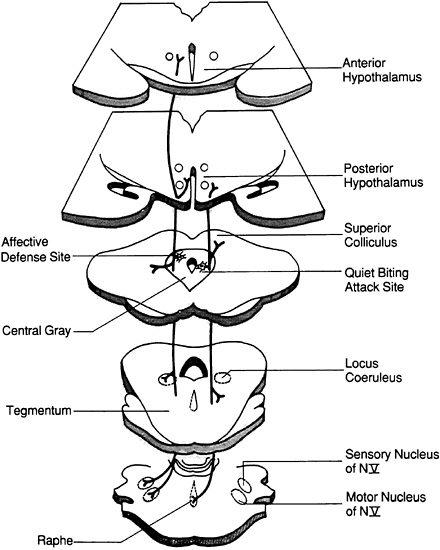
FIGURE 5 Diagrams indicating the principal efferent projections from midbrain periaqueductal gray sites associated with affective defense (left side) and quiet biting attack behavior (right side). Note that fibers associated with affective defense, which arise from the periaqueductal gray, are distributed rostrally to the medical preoptico-hypothalamus, from which this response can also be elicited, and caudally to the locus ceruleus, tegmental fields, and trigeminal complex. In contrast, the fibers associated with quiet biting attack have a more limited distribution. Ascending fibers synapse within the posterior lateral hypothalamus from which this response can also be elicited, while descending fibers supply the central tegmental fields and median raphe. SOURCE: Siegel and Pott (1988).

