Understanding and Preventing Violence, Volume 2: Biobehavioral Influences (1994)
Chapter: Efferent Connections
input to the PAG arises from predatory attack sites in the perifornical lateral hypothalamus (Chi and Flynn, 1971; Fuchs et al., 1981).
With respect to the ventral tegmental area, the major projections to this structure arise from the gyrus proreus (prefrontal cortex) and perifornical hypothalamus. The key role of the ventral tegmental area in predatory attack is supported by the studies of Bandler and Flynn (1972), Proshansky et al. (1974), and Goldstein and Siegel (1980).
The precise sites at which attack was obtained included mainly the parabrachial region of the tegmentum. Structures that may influence pontine control of predatory attack include the perifornical lateral hypothalamus, PAG, BNST, and central and lateral nuclei of the amygdala (Smith and Flynn, 1979).
Efferent Connections
In an early study, Chi and Flynn (1971) placed lesions at sites in the lateral hypothalamus from which predatory attack was elicited. The procedures enabled these investigators to trace the course of the degenerating axons from the lesion site. The results demonstrated both ascending and descending projections from lateral hypothalamic attack sites. Ascending projections were noted to pass through the preoptic zone into the diagonal band of Broca and septal area, regions known to modulate the attack response. Descending projections could be followed through the hypothalamus into the midbrain ventral tegmental area and PAG.
More recently, Fuchs et al. (1981) examined the projection system from lateral hypothalamic attack sites. The anteriorly directed projections from the attack sites were similar to those described by Chi and Flynn (1971). Fibers were traced through the anterior hypothalamus to the preoptic region, diagonal band of Broca, and lateral septal area. The significance of these projections remains unknown, but these fibers may constitute part of a "feedback" pathway that serves to regulate how these limbic forebrain structures, in turn, control the attack mechanism at the levels of the hypothalamus and brain stem. With regard to the descending projections, fibers were followed caudally through the medial forebrain bundle into the ventral tegmental area and PAG. Of particular interest is the fact that fibers traced from attack sites in the perifornical region were also observed to terminate in the locus coeruleus and motor nucleus of the trigeminal complex as well as the tegmental fields of the pons (Figure 3).
The significance of the latter (trigeminal) projection is that it
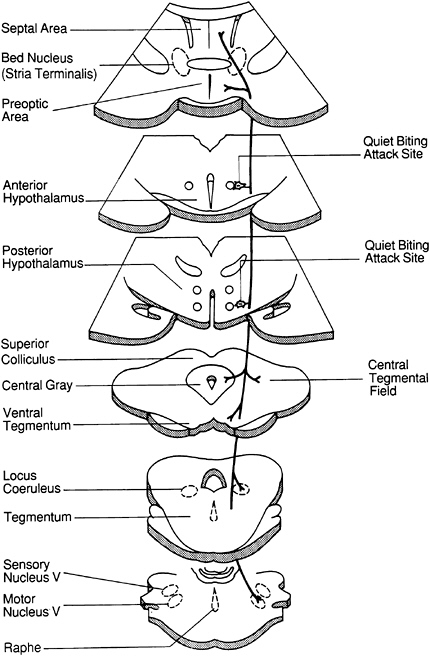
FIGURE 3 Diagram indicating the principal ascending and descending projections of the perifornical lateral hypothalamus associated with quiet biting attack behavior. Of particular interest and presumed importance are the connections from the perifornical region to the periaqueductal gray, tegmental fields, locus coeruleus, and the motor nucleus of the fifth nerve. SOURCE: Siegel and Pott (1988).

