Understanding and Preventing Violence, Volume 2: Biobehavioral Influences (1994)
Chapter: NEUROENDOCRINOLOGY
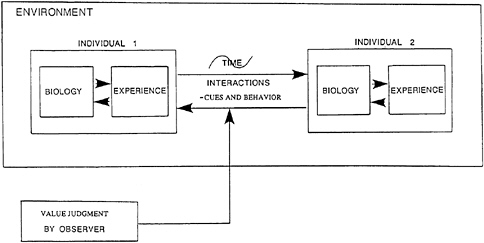
FIGURE 1 Schema showing the relationship(s) between biology and aggression: factors to be considered in rating "simple" interactions between individuals. SOURCE: Brain (1989a).
really dealing with some quite complex interactions between biology and experience. Some of these effects are mediated by changes in aggressive motivation, some by influencing other behaviors that compete for expression with the aggression, others by changing the social signals that organisms direct toward each other, and yet others by the way in which individuals perceive those social signals. There are also changes over time and the impact of the particular environment to consider. One has to add to this complex mix that whether one chooses to call a behavior aggression or not, is based the observer's value judgment. It is consequently highly improbable that one will find simple relationships between any one biological factor and expressed behavior.
NEUROENDOCRINOLOGY
Although the neural and endocrine systems have tended to be regarded separately, it is currently thought by a variety of authorities that they are best considered components with differing characteristics (in terms of the speed, duration, and diffuseness of their actions) of a single neuroendocrine coordinating system. Certainly there is an intimate relationship between neural and endocrine factors. Indeed, hormones, neurotransmitters, and neuromodulators can all be defined as information-transferring molecules. Cues received and integrated by the central nervous system (CNS) can
