Understanding and Preventing Violence, Volume 2: Biobehavioral Influences (1994)
Chapter: DEFINING "HORMONE"
be passed by the neural elements to specialized neurosecretory cells that essentially convert nerve impulses into hormonal output. These cells (in evolutionary terms, the oldest glands) are modified neurons (with many of the elements of such cells) that secrete protein-derived (peptidergic) or amino-derived (aminergic) material. This material may be transported along the modified axonal elements that end in close association with blood vessels (some of these are called neurohemal organs: e.g., the posterior lobe of the pituitary). It is now apparent that many endocrine glands are innervated by conventional neurons, which suggests that direct neural input can modify their secretory activity. Some neurosecretory cells may have direct effects on muscles and other effector organs, such as exocrine ("ducted") glands.
Although some endocrine glands are primarily controlled by direct neural input (the adrenal medulla), others are controlled by tropic hormones from the pituitary (the adrenal cortex, the gonads, and the thyroid), and a third category largely responds to blood-borne metabolites (the pancreas and the parathyroids). Many endocrine systems maintain homeostasis (a balance vis-à-vis the internal environment) by employing negative feedback mechanisms (see Figure 2). In some cases, positive feedback mechanisms may also operate (e.g., involvement of luteinizing hormone (LH) in ovulation in mammals).
DEFINING "HORMONE"
As mentioned earlier, hormones are secretions of endocrine glands that are passed into the bloodstream and are accumulated by target tissues (including the CNS), where they induce particular physiological or behavioral responses. The use of the term hormone originally implied (1) a natural chemical structure that had been extracted from a recognized endocrine gland and (2) the use of the blood system as the transport mechanism employed to reach the target tissue. The term hormone has, however, recently become less precise. Synthetic hormones, fragments of peptide factors, analogues of hormones, and parahormones (e.g., prostaglandins and opioids) have been included within this heading. Is the neurally located material that is immunoreactive to an anti-body to adrenocorticotropic hormone (ACTH) truly a hormone, even if the substance is chemically identical to ACTH? This peptide may never get near the bloodstream. Are the bodies' own pain killers, enkephalins and endorphins, hormones? They may be derived from the peptide hormone ß-lipotropin, but are they
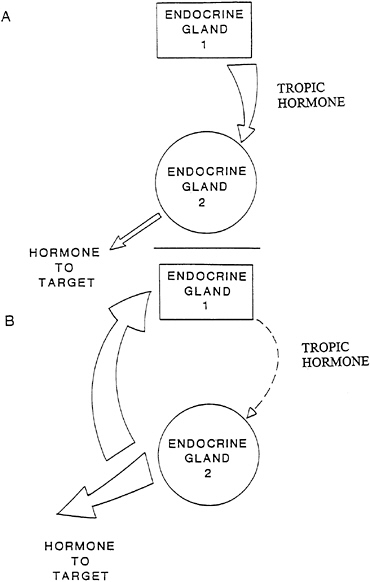
FIGURE 2 Negative feedback arrangement evident between an endocrine gland and a tropic gland (e.g., the adrenal cortex and the anterior pituitary). SOURCE: Brain (1989c). Reprinted by permission of Kluwer Academic Publishers.
best regarded as degradation products? A certain degree of flexibility seems consequently appropriate in this area at the present time. The main systems discussed in this review are the HPG (hypothalamus-pituitary-gonadal axis, which includes hypothalamic luteinizing hormone (LH) releasing factor (LHRF), gonadotropins from the pituitary, and sex steroids from the gonads) and the HPA

