Census Data Field Guide for Transportation Applications (2025)
Chapter: 9 2020 TRB Workshop

CHAPTER 9
2020 TRB Workshop
During the 2020 TRB annual meeting, a Sunday workshop was organized to solicit input from the wider transportation community on what it desired to see in a census field guide. The workshop started with an inventory of census data sources and their uses. This was followed by a discussion of the tentative outline of the draft framework. During the second half of the workshop, the 30 to 40 attendees, who had varying degrees of experience with and expertise in census data, were broken into groups. Moderators led a discussion to identify specific desires and needs, which would be used to develop the field guide.
The feedback from workshop participants is summarized by topic category in the following:
- Audience. The participants felt that the audience for the field guide should cover a broad spectrum, both in terms of industry and job function. Therefore, having a field guide that was both broad and deep in scope was critical to participants.
- Data quality. Participants wanted the field guide to provide them with a better understanding of census data sources, identify what the data covered in terms of geography and different populations, describe how the data were collected, and have a good discussion of uncertainty in the estimates. Participants wanted to know how they could determine if the data were good enough to meet their needs and asked that the field guide provide guidance on determining data quality for use cases.
- Geocoding issues. Participants wanted the field guide to provide a good understanding of the geocoding process and its limitations. Since the Census Bureau has already developed documentation on this question, the field guide will include references to this document along with a high-level summary.
- Case studies and best practices. Participants wanted the field guide to provide a “how to” discussion on processing data and how to apply data quality and checking standards to ensure that results produced are credible. Participants also wanted the field guide to document best practices for data usage and analysis. Participants suggested various case studies for consideration such as using census data to understand non-motorized trips and to quantify temporal population issues such as seasonal residents in Arizona and Florida or fracking workers in North Dakota.
Another case study proposed was to look at “work from home” patterns and identify how the ability to work from home differed in the broader population across market segments defined by occupation and/or income. At the time this workshop was held, COVID-19 was not yet on the horizon in the United States, and “work from home” had not emerged as a major force in fighting the pandemic. Chapter 10 deals with some COVID-19-related issues and how census data can help.
Participants also asked for case studies that would be reflective of their daily work responsibilities. In response to questions asked of them, they wanted to be able to refer to the field guide for similar types of cases in order to identify what census data sources were used and why, how the data were analyzed, and what visualization tools were used for the dissemination of results.
- Large passive data and the Census. Participants felt that it was necessary for the field guide to discuss how census data can be used with large sources of passive data. Participants felt that passive data provide rich information on where and when travel occurs but not necessarily the context in which travel takes place. Participants felt that census data were critical to providing this context and helping expand the passive data to the population. Participants also wanted guidelines on how to blend traditional and emerging data sources to get the best insights from both census and passive data sources.
- Training and outreach. Participants felt that the field guide should document training that is already available and provide materials that are practical and based on work experience. The sentiment expressed was to use simple examples to illustrate the point and to include supplemental discussion that overcomes the limitations of simple examples. In terms of training dissemination, the participants felt that having short training videos would be very useful along with links to user forums for each of the census data sources considered. Other suggestions for outreach included developing a desktop or online application where the user enters their analytical needs, and the application returns with a list of suggested data sources.
- Resources. Participants wanted access to resources like R or Python code, cheat sheets, and links that provide access to different types of census datasets.
Figure 9.1 shows the comments of various participants in the TRB workshop.
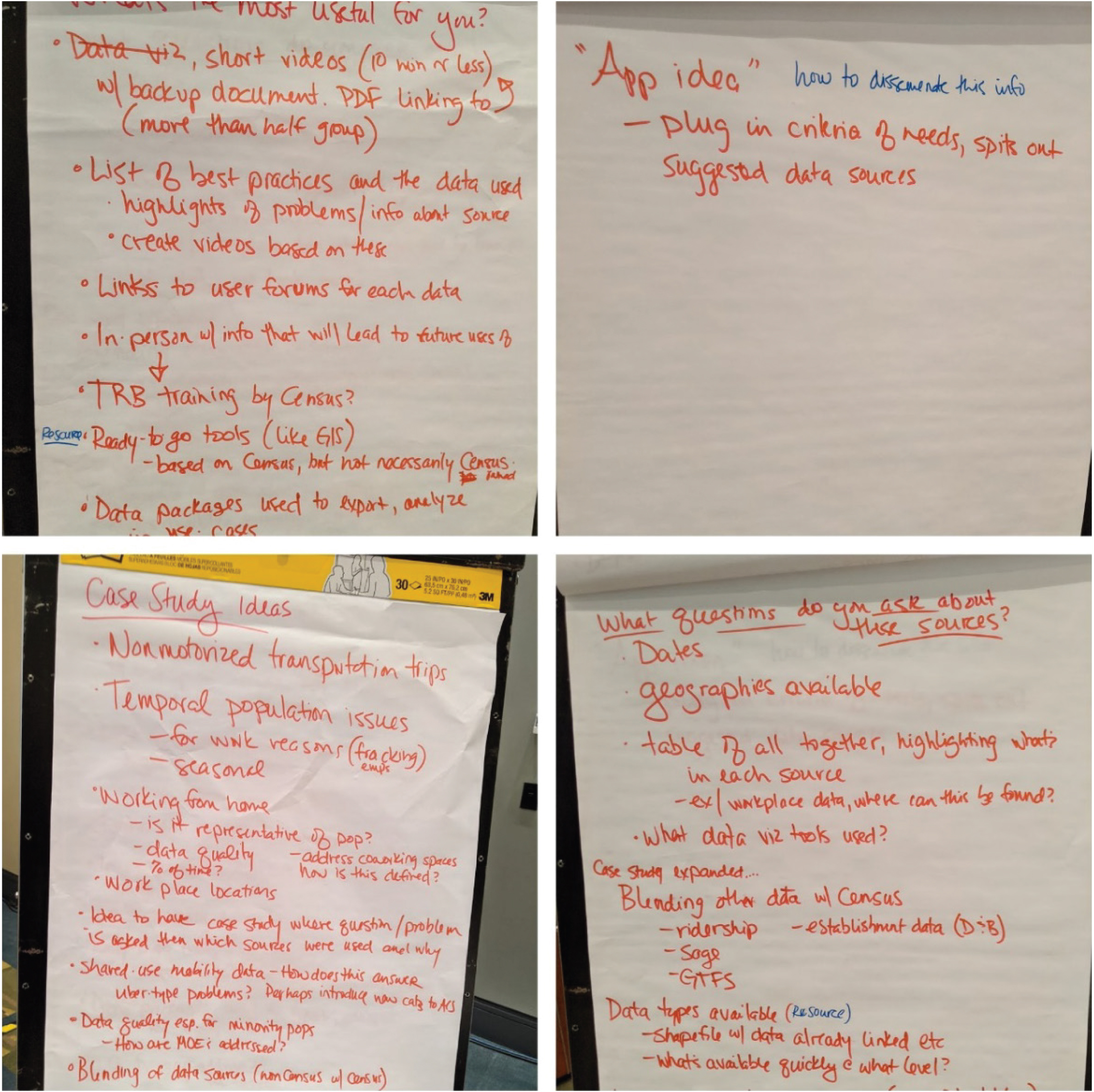
Long Description.
Four handwritten flip chart pages filled with participant comments from the 2020 TRB workshop on the topic of what the transportation community wanted in a census field guide. Topics include what makes resources useful for users, an idea for an application, case study ideas, and data-related questions. The first sheet lists preferences for short videos, documentation of best practices, training, and explanations about data use. The second sheet presents an app idea involving input of criteria or needs with suggested data sources. The third sheet covers case study ideas such as time series comparisons, regional insights, and storytelling formats. The fourth sheet contains questions about available data, geographic boundaries, and variables, along with notes about census geography and use cases.


