Development of a MASH Barrier to Shield Pedestrians, Bicyclists, and Other Vulnerable Users from Motor Vehicles (2024)

Chapter: 8 Test Requirements and Evaluation Criteria for MASH 3-10 and 3-11 Tests

Previous Chapter: 7 System Details for MASH 3-10 and 3-11 Tests
Page 122
Suggested Citation: "8 Test Requirements and Evaluation Criteria for MASH 3-10 and 3-11 Tests." National Academies of Sciences, Engineering, and Medicine. 2024. Development of a MASH Barrier to Shield Pedestrians, Bicyclists, and Other Vulnerable Users from Motor Vehicles. Washington, DC: The National Academies Press. doi: 10.17226/27896.

CHAPTER 8

Test Requirements and Evaluation Criteria for MASH 3-10 and 3-11 Tests

Performed Crash Test Matrix

Table 50 shows the test conditions and evaluation criteria for MASH TL-3 for longitudinal barriers. The target CIPs for each test were determined on the basis of the FE simulations described in Chapter 6 and the information provided in MASH Section 2.2.1 and Section 2.3.2. Figure 75 shows the target CIP for MASH Tests 3-10 and 3-11 on the multifunctional barrier. The crash tests and data analysis procedures were in accordance with guidelines presented in MASH. Chapter 9 of this report presents brief descriptions of these procedures.

Table 50. Test conditions and evaluation criteria specified for MASH TL-3 longitudinal barriers.

Test Designation Test Vehicle Impact Conditions Evaluation Criteriaa
Speed (mi/h) Angle (deg)
3-10 1100C 62 25 A, D, F, H, I
3-11 2270P 62 25 A, D, F, H, I

aDetails on the evaluation criteria are given in Table 51.
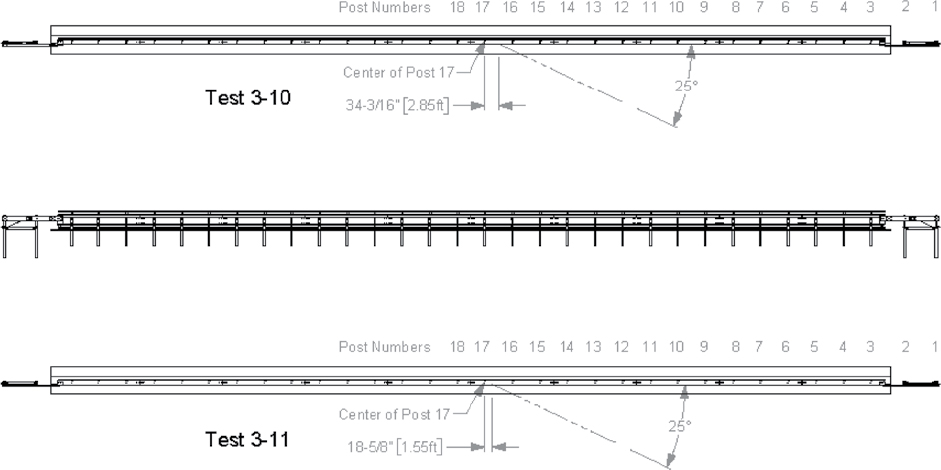
Target CIP for MASH TL-3 tests on multifunctional barrier
Figure 75. Target CIP for MASH TL-3 tests on multifunctional barrier.

Page 123
Suggested Citation: "8 Test Requirements and Evaluation Criteria for MASH 3-10 and 3-11 Tests." National Academies of Sciences, Engineering, and Medicine. 2024. Development of a MASH Barrier to Shield Pedestrians, Bicyclists, and Other Vulnerable Users from Motor Vehicles. Washington, DC: The National Academies Press. doi: 10.17226/27896.

Evaluation Criteria

The appropriate safety evaluation criteria from Tables 2.2 and 5.1 of MASH were used to evaluate the crash tests reported herein. Table 50 lists the test conditions and evaluation criteria required for MASH TL-3, and Table 51 provides detailed information on the evaluation criteria.

Table 51. Evaluation criteria required for MASH testing.

Evaluation Factor Evaluation Criteria
Structural adequacy
  1. Test article should contain and redirect the vehicle or bring the vehicle to a controlled stop; the vehicle should not penetrate, underride, or override the installation, although controlled lateral deflection of the test article is acceptable.
Occupant risk
  1. Detached elements, fragments, or other debris from the test article should not penetrate or show potential for penetrating the occupant compartment or present undue hazard to other traffic, pedestrians, or personnel in a work zone.

    Deformations of, or intrusions into, the occupant compartment should not exceed limits set forth in Section 5.2.2 and Appendix E of MASH.
  1. The vehicle should remain upright during and after collision. The maximum roll and pitch angles are not to exceed 75 deg.
  1. Occupant impact velocities (OIVs) should satisfy the following limits: preferred value of 30 ft/s or maximum allowable value of 40 ft/s.
  2. The occupant ridedown accelerations should satisfy the following limits: preferred value of 15.0 g, or maximum allowable value of 20.49 g.
Page 122
Suggested Citation: "8 Test Requirements and Evaluation Criteria for MASH 3-10 and 3-11 Tests." National Academies of Sciences, Engineering, and Medicine. 2024. Development of a MASH Barrier to Shield Pedestrians, Bicyclists, and Other Vulnerable Users from Motor Vehicles. Washington, DC: The National Academies Press. doi: 10.17226/27896.
Page 122
Page 123
Suggested Citation: "8 Test Requirements and Evaluation Criteria for MASH 3-10 and 3-11 Tests." National Academies of Sciences, Engineering, and Medicine. 2024. Development of a MASH Barrier to Shield Pedestrians, Bicyclists, and Other Vulnerable Users from Motor Vehicles. Washington, DC: The National Academies Press. doi: 10.17226/27896.
Page 123
Next Chapter: 9 Test Conditions
Subscribe to Email from the National Academies
Keep up with all of the activities, publications, and events by subscribing to free updates by email.