Effects of Ionizing Radiation: Atomic Bomb Survivors and Their Children (1945-1995) (1998)
Chapter: 19 Atomic Bomb Survivors Relief Law
19
Atomic Bomb Survivors Relief Law
ITSUZO SHIGEMATSU
Summary
The first official measures for the relief of atomic bomb survivors were taken by the Japanese government in 1957, 12 years after the atomic bombings in Hiroshima and Nagasaki. The Atomic Bomb Survivors Medical Care Law, enacted in this year, provided for health examination of survivors and medical care for health disturbances due to atomic bomb radiation. Thereafter, the need to provide not only medical care but also support to improve their living standards was recognized. The Atomic Bomb Survivors Special Measures Law was effected in 1968 to stabilize survivors' lives and improve their welfare. Since 1995 marked the fiftieth anniversary of the atomic bombings, the survivors and the Japanese people strongly requested implementation of comprehensive relief measures in the areas of health care, treatment, and welfare of the aging survivors. Thus, in July 1995, the Japanese government passed the new Atomic Bomb Survivors Relief Law, which integrates the two previous laws into one and improves and strengthens the measures in force.
Introduction
The first official measures for the relief of atomic bomb survivors were taken by the Japanese government in 1957, 12 years after the atomic bombings in Hiroshima and Nagasaki. In this year, the Atomic Bomb Survivors Medical Care Law was implemented, providing for medical examinations and care for atomic bomb survivors. Thereafter, the need to provide not only medical care but also support for improving living standards was recognized, and the Atomic Bomb Survivors Special Measures Law was passed in 1968 in order to stabilize survivors' lives and improve their welfare.
Measures for atomic bomb survivors in Japan centered around these two laws, but since 1995 marked the fiftieth anniversary of the atomic bombings, the survivors and the Japanese people strongly requested implementation of comprehensive relief measures in the areas of health care, treatment, and welfare of the aging survivors. Thus, in July 1995, the Japanese government effected the new Atomic Bomb Survivors Relief Law, which integrates the two laws into one and improves and strengthens the measures in force.
Circumstances Leading To The Establishment Of The New Law
In August 1945, when the atomic bombs were dropped on Hiroshima and Nagasaki, the populations of those two cities were 330,000 and 250,000, respectively, and totalled 580,000. It is estimated that about one-third of these people died instantaneously from the blast or thermal rays or were acute deaths due to atomic radiation; about another one-third were injured; and the remaining one-third were unaffected. However, the number of atomic bomb survivors was not known until 1950 when a national census was first conducted in Japan after the Second World War. In this national census, 284,000 people claimed to have experienced the atomic bombings.
Although these atomic bomb survivors had various anxieties and problems concerning their health and social life, no official relief measures were taken for them because Japan was then occupied by the allied forces and government measures were subjected to many restrictions, with an especially strict control placed on information concerning the atomic bombs.
However, after the peace treaty was concluded in 1952 and the occupation of Japan was lifted, the government began to take positive measures for atomic bomb survivors, and studies on the methods of treating health disturbances due to the atomic bombs were begun with the establishment of the Council to Study Atomic Bomb Diseases in 1953. In March 1954 the crew of the "No. 5 Lucky Dragon," a Japanese fishing boat, were exposed to radioactive fallout from a hydrogen bomb test conducted by the US in the Bikini Atoll. This episode increased the interest of the people in the issue of radiation exposure. The Atomic Bomb Survivors Medical Care Law was established in March 1957 and health examinations as well as medical care for those designated as survivors by the law began in April of the same year.
As shown in Figure 19.1, the enforcement of this law resulted in the increase of recognized atomic bomb survivors every year from about 200,000 in 1957 to about 280,000 in 1965. In parallel with this, requests not only for health care measures but also for relief measures for improving living standards increased. Thus, in November 1965, the government conducted a nationwide survey on the actual status of atomic bomb survivors. This survey revealed a difference between the survivors and the general population not only in their health conditions but
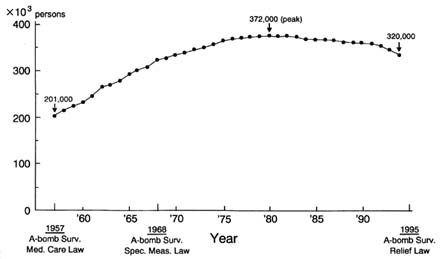
FIGURE 19.1 Enumerated atomic bomb survivors, 1957–1995.
also in their income level and employment status. Therefore, the atomic Bomb Survivors Special Measures Law was established in 1968.
The number of recognized atomic bomb survivors continued to rise with the improvement of measures for survivors, and peaked at about 372,000 in 1980, but it gradually decreased thereafter and was about 320,000 in 1995. As mentioned before, the two laws for the relief of atomic bomb survivors were integrated into a new law called the Atomic Bomb Survivors Relief Law in 1995.
Outline Of The New Law
Differences Between the New Law and the Previous Two Laws
Responsibility of the Nation
Because the health disturbances due to atomic bomb radiation are special damages different from other disturbances due to the war, it was stated in the preamble that relief measures for atomic bomb survivors are the responsibility of the nation.
Funeral Allowances
Funeral allowances will be paid to the bereaved families of the atomic bomb victims. (One hundred thousand yen to one member of a bereaved family recognized as an atomic bomb survivor.)
Commemorative Facility
A commemorative facility will be established where people may pay tribute to the memory of the atomic bomb victims and pray for peace.
Income Restriction
The income restrictions provided under the old laws for the payment of the allowances are abolished.
Welfare Activities
Welfare activities such as nursing homes for atomic bomb survivors, dispatch of home helpers, and so forth, are instituted.
Research Support
Support for research studies on the health effects of atomic bomb radiation and medical care is provided.
Major Stipulations Included in the Two Old Laws Which are Also Prescribed in the New Law
Definition of Survivors
Atomic bomb survivors as defined by the law are provided health handbooks. These handbooks are issued by prefectural governors and the mayors of Hiroshima City and Nagasaki City upon application by atomic bomb survivors who conform to any of the following four conditions:
- Directly exposed: a person who at the time of the atomic bomb detonation was directly exposed within Hiroshima City or Nagasaki City or within a specified adjacent area of these cities.
- Early entrant: a person who entered within two weeks after the atomic bomb detonation a zone about two kilometers from the hypocenter of the atomic bomb.
- Relief party: a person who engaged in relief of atomic bomb survivors or other activities physically affected by radiation.
- In utero exposed: a person who at the time of the atomic bomb detonation was in utero of a mother who meets any of the above three conditions.
Budget for Relief Measures
Funds are also provided for research and investigation related to atomic bomb survivors. The total budgetary outlay in the fiscal year of 1995, that is, from April 1995 to March 1996, was 151 billion Japanese yen (US $ 1.5 billion). The Japanese government provides to health handbook holders the following medical care, allowances, and welfare measures:
- The budget for medical care was 32.5 billion yen which was allocated as follows:
0.1 billion yen for medical treatment of designated diseases.
29.3 billion yen for medical treatment of diseases in general. For treatment of diseases other than designated diseases, the government bears that portion of the expenses not covered by health insurance.
3.1 billion yen for health examination of atomic bomb survivors. Health examinations are available four times a year.
- Various allowances as described below were provided to atomic bomb survivors, with the amount totaling 110 billion yen.
Special Medical Care Allowance (135,400 yen per month for 2,005 persons).
Special Allowance (50,000 yen per month for 1,581 persons).
Atomic Bomb Microcephaly Allowance (46,600 yen per month for 25 persons).
Health Management Allowance (33,000 yen per month for 242,318 persons).
Health Allowance (14,200 yen per month for 16,184 persons and 28,400 yen per month for 2,458 handicapped).
Nursing Aid Allowance (up to 103,150 yen per month for 6,036 cases).
Family Aid Allowances (21,300 yen per month for 30,832 cases).
Funeral Allowance (149,000 yen for each funeral of an atomic bomb survivors, to be paid for 6,890 cases).
- As welfare measures, a total of 2.7 billion yen is made available as subsidies for the following:
Atomic bomb hospitals and homes for atomic bomb survivors.
Home helper and consultation services for atomic bomb survivors.
- Atomic bomb memorial ceremonies.
- For research and investigation of atomic bomb survivors, a budget of 2.8 billion yen was provided for the following:
Research program of the Radiation Effects Research Foundation.
Research and investigation of atomic bomb diseases.
- A budget of 3.0 billion yen was provided as a subsidy to local governmental institutions for atomic bomb survivors.
Comments
The outline of the Atomic Bomb Survivors Relief Law enacted in 1995 was introduced here. It is true that some of the stipulations in this law are not necessarily consistent with the present scientific knowledge on the health effects of atomic bomb radiation, but it should also be considered that this knowledge was not available when the law for the medical care of atomic bomb survivors was first established in 1957. From the viewpoint of the scientific studies on the health effects of atomic bomb radiation, it is a good news that the financial support for these studies was included in this new law.