LTPP Data Analysis: Improving Use of FWD and Longitudinal Profile Measurements (2024)
Chapter: 7 Guidelines for Assessing and Adjusting FWD Measurements
CHAPTER 7
Guidelines for Assessing and Adjusting FWD Measurements
The following describes the proposed guidelines for determining temperature and moisture adjustment factors for FWD measurements on asphalt pavements (Appendix K provides the proposed stand-alone FWD guidelines).
Changes in environmental factors, such as surface temperature and moisture content, can result in changes in pavement material properties. In asphalt pavements, asphalt stiffness is affected by changes in temperature (moduli value increases with decreasing temperature and vice versa). Moisture changes influence asphalt mixture performance (e.g., stripping) and can significantly influence unbound base and subgrade soil properties (e.g., layer modulus, shrink and swell). The combination of temperature and moisture variation can result in a compound effect on pavement performance (e.g., effect of freeze-thaw cycles on layer moduli, impact of unbound layer volume changes).
Air temperature and solar radiation are the primary causes of changes in asphalt layer moduli, and therefore, the asphalt layer’s structural response to traffic loading. Asphalt mix stiffness changes can also be related to the binder properties associated with age hardening and micro-cracking. When characterized by deflection testing, inconsistencies in deflections and backcalculated asphalt layer moduli can be caused by testing at different pavement temperatures.
The approach includes conducting a “limited” one-time series of FWD measurements to quantify the effects of temporal and diurnal effects of temperature and moisture. Each agency should identify the climatic zone(s) and the need for adjusting FWD-measured deflections to temperature and moisture conditions. The testing plan includes identifying and selecting applicable segments representing varying asphalt layer thickness (thin or thick), pavement condition (excellent to poor), rainfall, and subgrade moisture. The selected segments (ideally, 10 or more per climatic zone) should be uniform in asphalt layer thickness, pavement condition, and subgrade soil type over the segment length (minimum 500 ft).
FWD testing includes conducting four or more passes multiple times (e.g., early morning, midday, and late afternoon) during a given day for each season to capture the influence of changes in temporal and diurnal temperature and subgrade moisture. Subgrade moisture content is generally assumed to not vary during a given day. At a minimum, conduct FWD testing every 25 ft over a 500 ft segment length. The FWD testing location and offset should be accurately identified and repeat testing should be conducted at the exact location during each site visit and pass. For each segment, note the rainfall 7 days prior to FWD testing, subgrade moisture content, asphalt layer thickness, and pavement condition. For improved accuracy, subgrade moisture content should be measured at the time of FWD testing. The approach includes separate processes for temperature and moisture adjustment allowing the agency to determine the need for one or both FWD measurement adjustments. As noted in Chapter 5, the LTPP SMP moisture data was limited and adjustment factors relating to the interaction of temperature and moisture on FWD measurement adjustments could not be made. However, an agency interested in determining the interaction of temperature and moisture can use the suggested approach (albeit a larger data set and instrumented pavement segments to determine subgrade moisture content may be required).
The resilient moduli of unbound materials and subgrade soils are dependent on the moisture content, stress level, and seasonal moisture variations. If all other conditions are considered equal, as moisture content increases, layer moduli decrease, resulting in increased pavement deflections. Under freezing temperatures, the resilient modulus of soils containing moisture can be 20 to 120 times greater than in unfrozen conditions. The presence of frost-susceptible soils, moisture, and subfreezing temperature can
lead to ice lens development, potentially creating zones of differential roadway profile changes, and reduced strength during thawing conditions.
To minimize the large variations in deflection due to temperature at the time of testing, FWD testing on asphalt pavements should be conducted at moderate temperatures between 65°F and 105°F. At a minimum, maximum deflections should be adjusted to a reference temperature (typically, 68°F).
FWD testing should be conducted at multiple locations over a given day and in multiple seasons. Each segment, at least 10 segments per climatic zone, should consist of a uniform pavement section (e.g., same layer types and thicknesses), pavement surface condition, subgrade, traffic volumes, and drainage conditions.
FWD testing is conducted in accordance with applicable AASHTO, LTPP, and agency requirements. FWD measurements should include four or more passes over an 8-hour period to capture variation in deflection with changing temperatures. Each pass is performed in the wheel path, every 25 ft over a total section length of 500 ft (at a minimum). It is critical to accurately identify the FWD test location as well as the transverse offset. The same location should be tested during each site visit and pass.
At each FWD testing location, the corresponding temperature at the mid-depth of the asphalt layer at the time of each FWD test should be measured or estimated and paired with each deflection measurement. Based on a statistical analysis of influencing factors from data obtained from the LTPP SMP, additional information needed (and paired to each FWD testing location) includes climatic zone, pavement condition, asphalt layer thickness, rainfall 7 days before testing, and average subgrade moisture.
The measured deflections, at 9,000 lbs., for each FWD test are plotted to determine the adjusted deflection to 68°F using:
| (Eq. 58) |
where,
| D = | measured deflection (mil) |
| K0(T) = | temperature-adjusted deflection to 68°F (mil) |
| K1(T) = | temperature adjustment factor |
| T = | asphalt layer mid-depth temperature at time of testing (°F) |
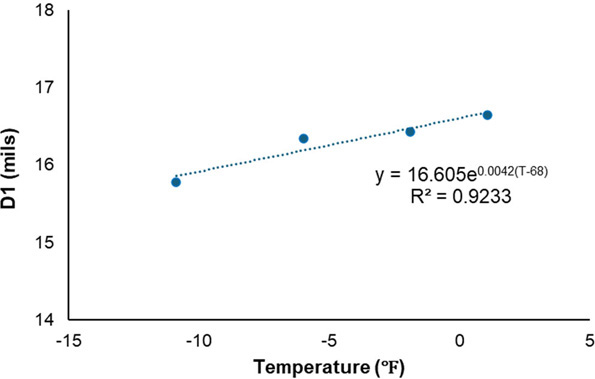
Note the value for K0(T). For example, from Figure 55, K0(T) is 16.605.
The temperature adjustment factor (K1(T)) should be determined based on a regression analysis of measured deflection, pavement layer thickness, pavement condition, and climatic zone.
If all FWD testing is conducted within a single climatic zone, the climatic zone can be removed from the regression analysis.
In the evaluation of the LTPP SMP sections, layer thickness was defined as thin (< 8.5 in.) and thick (≥ 8.5 in.). LTPP SMP section asphalt layer thickness ranged from 2.7 in. to 21.9 in., with a median value of 8.5 in., a mean value of 9.6 in., and a standard deviation of 4.6 in.
From the regression analysis, K1(T) is expressed as:
| (Eq. 59) |
where,
| K1(Ti) = | deflection temperature adjustment factor at sensor i |
| ß0 = | intercept value from the generalized regression model |
| ß1 = | regression coefficient for asphalt layer thickness |
| ß2 = | regression coefficient for pavement condition |
| ß3 = | regression coefficient for climatic zone |
The K1(T) determined from Equation 59 is used in Equation 58 to determine the temperature-adjusted deflection. This approach is repeated for FWD testing conducted for each season within a given year. Temperature-adjusted deflections can be used, for example, in mechanistic-empirical design methods.
The moisture adjustment factor is determined in the same manner as for the deflection temperature adjustment described above. However, the moisture adjustment factors are based on rainfall 7 days before testing, average subgrade moisture, and climatic zone. The generalized regression model is expressed as:
| (Eq. 60) |
where,
| K1(mi) = | moisture adjustment factor for temperature-adjusted deflection at sensor i |
| ß0 = | intercept value from the generalized regression model |
| ß1 = | regression coefficient for rainfall, 7 days before FWD testing |
| ß2 = | regression coefficient for average subgrade moisture |
| ß3 = | regression coefficient for climatic zone |
The K1(mi) determined from Equation 60 is used in Equation 58 to determine the moisture-adjusted deflection.


