LTPP Data Analysis: Improving Use of FWD and Longitudinal Profile Measurements (2024)
Chapter: Guidelines for Adjusting FWD Deflections on Asphalt Pavements to Account for Temperature and Moisture Conditions
Guidelines for Adjusting FWD Deflections on Asphalt Pavements to Account for Temperature and Moisture Conditions
|
1. |
SCOPE |
|
1.1. |
The following summarizes an approach for determining adjustment factors for Falling Weight Deflectometer (FWD) measurements for asphalt pavements to account for the impacts of daily and seasonal temperature and moisture conditions. This approach includes conducting a “limited” one-time series of FWD measurements to determine temperature and moisture adjustment factors. Once the adjustment factors are determined, they are applied to subsequent production-level FWD testing. Detailed specifications for FWD measurement equipment or instruments used to collect the deflection data and temperature are not included in this method. |
|
2. |
TERMINOLOGY |
|
2.1. |
Air temperature—average annual hourly ambient air temperature. |
|
2.2. |
Average subgrade moisture—subgrade moisture content measured, for example, using time domain reflectometry sensors, determined from other sources, or estimated based on agency expertise. |
|
2.3. |
Climatic zone—based on the definitions defined in the Long-Term Pavement Performance (LTPP) program and includes dry freeze, dry no freeze, wet freeze, and wet no freeze. |
|
2.4. |
Rainfall—includes total rainfall 7 days prior to FWD testing. |
|
2.5. |
Standard temperature—defined as 68°F in this guideline but can be modified to agency-specific requirements. |
|
3. |
SIGNIFICANCE AND USE |
|
3.1. |
This practice outlines a method for adjusting FWD measured deflections on asphalt pavements to account for temperature and moisture conditions at the time of testing. |
|
3.2. |
Variations in environmental factors, such as surface temperature and moisture content, can result in changes in pavement material properties. Asphalt stiffness is affected by changes in temperature (e.g., moduli value increases with decreasing temperature and vice versa). Moisture changes influence asphalt mixture performance (e.g., stripping) and can significantly influence unbound base and subgrade soil properties (e.g., layer modulus, shrink and swell). The combination of temperature and moisture variation can result in a compound effect on pavement performance (e.g., effect of freeze-thaw cycles on layer moduli and impacts of unbound layer volume changes). |
|
3.2.1. |
Asphalt materials. Air temperature and solar radiation are the primary causes of changes in asphalt layer moduli, and therefore, the asphalt layer’s structural response to traffic loading. Asphalt mix stiffness changes can also be related to the binder properties associated with age hardening and micro-cracking. When characterized by deflection testing, inconsistencies in deflections and backcalculated asphalt layer moduli can be caused by testing at different pavement temperatures. |
||||||||||||||
|
3.2.2. |
Unbound materials and subgrade soils. The resilient moduli of unbound materials and subgrade soils are dependent on moisture content, stress level, and seasonal moisture variations. If all other conditions are considered equal, as moisture content increases, layer moduli decrease, resulting in increased pavement deflections. At freezing temperatures, the resilient modulus of soils containing moisture can be 20 to 120 times greater than in unfrozen conditions. The presence of frost-susceptible soils, moisture, and subfreezing temperature can lead to ice lens development, potentially creating zones of differential roadway profile changes, and reduced strength during thawing conditions. |
||||||||||||||
|
3.2.3. |
FWD testing. To minimize the large variations in deflection due to temperature at the time of testing, FWD testing on asphalt pavements should be conducted at moderate temperatures between 65°F and 105°F. |
||||||||||||||
|
3.2.4. |
Adjusting FWD deflections to a reference temperature. At a minimum, maximum deflections should be adjusted to a reference temperature (typically, 68°F) using:
where,
|
||||||||||||||
|
4. |
SITE SELECTION |
||||||||||||||
|
4.1. |
Climatic zone (dry freeze, wet freeze, dry no freeze, or wet no freeze) was identified as an important influencing factor for asphalt pavement FWD deflection measurements. Each agency should determine the climatic zone regions and the need for temperature and moisture adjustments to FWD measured deflections. In addition to climatic zone, other influencing factors included: |
||||||||||||||
|
4.1.1. |
Temperature adjustment: pavement condition (excellent, good, fair, or poor), and asphalt layer thickness (< 8.5 inches or ≥ 8.5 inches). |
||||||||||||||
|
4.1.2. |
Moisture adjustment: total rainfall 7 days prior to FWD testing, and average subgrade moisture content. |
||||||||||||||
|
4.2. |
Identify multiple segments (ideally, 10 or more) per climatic zone. Individual segments should have uniform asphalt layer thickness, pavement condition, and subgrade moisture content. The multiple segments should represent varying asphalt layer thickness (thin to thick), pavement condition (excellent to poor), and where applicable rainfall, and subgrade moisture content. |
|
5. |
DATA COLLECTION |
||||||||||||||
|
5.1. |
Conduct FWD testing on each segment in accordance with AASHTO R 32, AASHTO R 33, AASHTO T 256, ASTM D4694, LTPP, and agency requirements. |
||||||||||||||
|
5.1.1. |
FWD measurements should include four or more passes over 8 hours (e.g., early morning, late morning, early afternoon, and late afternoon) per segment (per season within a given 12-month period) to capture the variation in measured deflection with changing temperatures. At a minimum, conduct FWD testing every 25 ft over a total section length of 500 ft. |
||||||||||||||
|
5.1.2. |
It is critical to accurately identify the FWD test location as well as the transverse offset. The same location should be tested during each site visit and pass. |
||||||||||||||
|
5.2. |
At each FWD testing location, measure or estimate the corresponding mid-depth temperature of the asphalt layer. |
||||||||||||||
|
5.2.1. |
Measure asphalt mid-depth temperature according to the LTPP Manual for Falling Weight Deflectometer Measurements or estimated using: BELLS2 (LTPP Protocol):
BELLS3 (shade adjusted):
where,
|
||||||||||||||
|
5.3. |
Note: asphalt layer thickness, pavement condition, total rainfall 7 days before FWD testing, and subgrade moisture content. For improved accuracy subgrade moisture content should be measured at the time of FWD testing. |
||||||||||||||
|
6. |
DEFLECTION TEMPERATURE ADJUSTMENT |
||||||||||||||
|
6.1. |
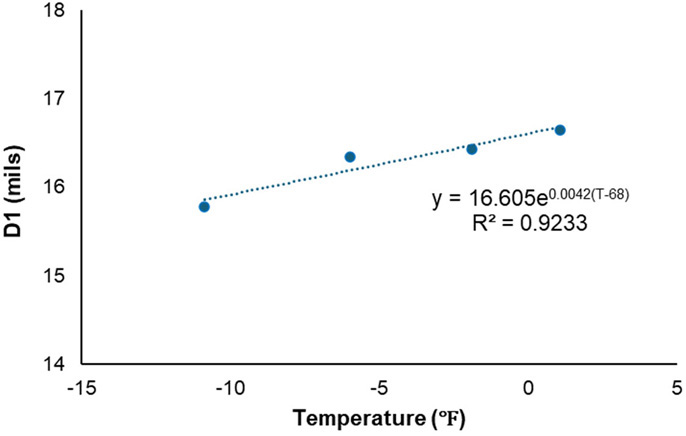
The measured deflections, at 9,000 lb, for each FWD test are plotted to determine the adjusted deflection to 68°F (K0) using (Figure 1):
where,
|
|
|||||||||||||
|
6.1.1. |
Note the value for K0(T). For example, from Figure 1 K0(T) is 16.605. |
||||||||||||
|
6.2. |
The temperature adjustment factor (K1(T)) should be determined based on a regression analysis of measured deflection, pavement layer thickness, pavement condition, and climatic zone. |
||||||||||||
|
6.2.1. |
If all FWD testing is conducted within a single climatic zone, the climatic zone can be removed from the regression analysis. |
||||||||||||
|
6.2.2. |
In the evaluation of the LTPP SMP sections, layer thickness was defined as thin (< 8.5 in.) and thick (≥ 8.5 in.). LTPP SMP section asphalt layer thickness ranged from 2.7 in. to 21.9 in., with a median value of 8.5 in., a mean value of 9.6 in., and a standard deviation of 4.6 in. |
||||||||||||
|
6.2.3. |
From the regression analysis, K1(T) is expressed as:
where,
|
||||||||||||
|
6.2.4. |
The K1(T) determined from Equation 5 is used in Equation 4 to determine the temperature adjusted deflection. |
||||||||||||
|
6.2.5. |
This approach is repeated for each climatic zone and season. |
||||||||||||
|
7. |
DEFLECTION MOISTURE ADJUSTMENT |
||||||||||||
|
7.1. |
The moisture adjustment factor is determined based on a regression analysis of temperature adjusted deflection, rainfall 7 days prior to FWD testing, average subgrade moisture content, and climatic zone. |
||||||||||||
|
7.1.1. |
The generalized regression model is expressed as: |
||||||||||||
|
where,
|
|||||||||||||
|
7.1.2. |
The K1(mi) determined from Equation 6 is used in Equation 4 to determine the temperature adjusted deflection. |
||||||||||||
|
8. |
KEYWORDS |
||||||||||||
|
8.1. |
Asphalt pavement, deflection testing, temperature adjustment, moisture adjustment. |
||||||||||||
|
9. |
REFERENCED DOCUMENTS |
||||||||||||
|
9.1. |
AASHTO R 32, Standard Practice for Calibrating the Load Cell and Deflection Sensors for a Falling Weight Deflectometer. |
||||||||||||
|
9.2. |
AASHTO R 33, Standard Practice for Calibrating the Reference Load Cell Used for Reference Calibrations for a Falling Weight Deflectometer. |
||||||||||||
|
9.3. |
AASHTO T 256, Standard Method of Test for Pavement Deflection Measurements. |
||||||||||||
|
9.4. |
ASTM D4694, Standard Test Method for Deflections with a Falling-Weight-Type Impulse Load Device. |
||||||||||||
|
9.5. |
LTPP Manual for Falling Weight Deflectometer Measurements, Version 4.1. FHWA-HRT-06-132 Federal Highway Administration, U.S. Department of Transportation, McLean, VA, 2006. |
||||||||||||
|
9.6. |
Lukanen, E. O., R. Stubstad, and R. Briggs. Temperature Predictions and Adjustment Factors for Asphalt Pavement. FHWA-RD-98-085. Federal Highway Administration, U.S. Department of Transportation, McLean, VA, 1999. |
||||||||||||
|
9.7. |
Rada, G. R., G. E. Elkins, B. Henderson, R. J. Van Sambeek, and A. Lopez. LTPP Seasonal Monitoring Program: Instrumentation, Installation, and Data Collection Guidelines. FHWA-RD-94-110. Federal Highway Administration, U.S. Department of Transportation, McLean, VA, 2000. |
||||||||||||


