Advancing the Art and Science of Decision-Making: A Guide (2026)
Chapter: Get the Right Information from Your Team

Get the Right Information from Your Team
As a leader, you must rely on your staff to bring you technical information and details across a range of topic areas you are not and will never be an expert on. Getting full and unbiased input is critical, and it will take a deliberate effort to ensure the input coming to you is not isolated to one perspective or subject to a cognitive bias.
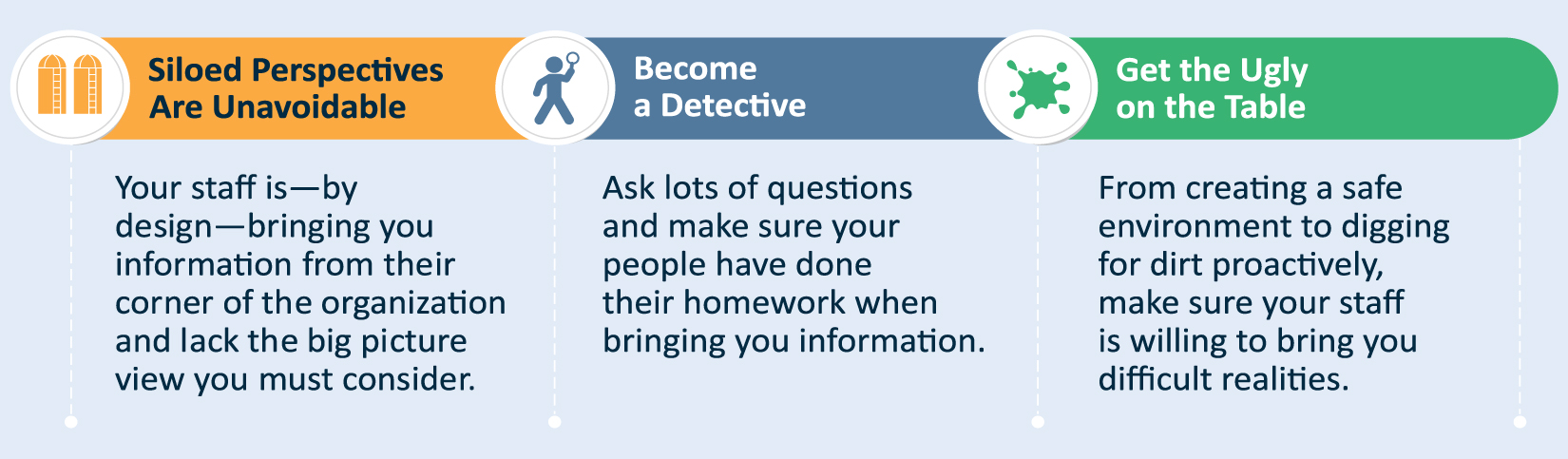
Long Description.
The text in the infographic reads as follows:
1. Siloed Perspectives are Unavoidable: Your staff is—by design—bringing you information from their corner of the organization and lack the big picture view you must consider.
2. Become a Detective: Ask lots of questions and make sure your people have done their homework when bringing you information.
3. Get the Ugly on the Table: From creating a safe environment to digging for dirt proactively, make sure your staff is willing to bring you difficult realities.
Your Team
Approaches to getting information may vary based on who you are working with, including the following:
- Executive team: These are your closest advisors, with whom you need to be ready to bare all to grapple with difficult realities and get to the right decision.
- Leadership team: This group includes division or district heads who are steeped in a specific topic area but serve as a bridge to the executive perspective. Ensure this group knows how to effectively communicate with you for repeated interactions.
- Technical staff: These are staff further down the organization who may not interact with the executive team often. Getting good information may require a concerted effort to cut through too much detail and encourage them to be forthcoming.
Strategies
Be Ready for Staffʼs Unique, but Limited, Perspective
People are bringing you information from their own little cocoon. Be aware of this.
—Vicki Kramer
Director, Nebraska DOT
An executiveʼs job is to consider everything. Everyone else on the team focuses on one particular area, whether that is legal issues, the best engineering solutions, community impact of transportation projects, or financial ramifications. Every time a team member brings you information, it will be driven by the view from their seat in the agency, rather than by the big picture you are looking at as the executive. This is not something to be avoided, as their job is to specialize so you do not
have to, but you must frame what staff tell you in the context of their specialized perspective. Refocusing staff on the global themes of the agency, including its vision, values, and goals, can be an effective method to gain concordance with team members.
Demand Multiple Solutions
Never accept one solution from your staff. In part because of their focused topical perspective, the first option they give you will almost never represent the full story or include the full range of options. Get staff to stretch their thinking beyond their defaults by providing multiple proposals for solutions.
Ask a Lot of Questions
Put on your detective hat and ask lots of follow-up questions about any information being given to you. If they have done the research and are not relying on gut instinct alone, they will be able to give you full answers and explanations.
Who has done their homework? If they canʼt describe to me the ‘why’ in five minutes, Iʼm not sold.
—Joyce Taylor
Chief Engineer, Maine DOT
Have Staff Start with Headlines
Your staff are passionate about what they do, so when you ask them for information on their area of expertise, they will be able to give you a lot of great information. For an executive level decision, however, too much detail can be overwhelming and distracting from the key considerations you need to focus on. Ask for the top three things staff want to tell you when briefing you in advance of a decision. If it is truly complex and requires more than three, ask them to prepare a list of bulleted headlines for the points they think are most important. From this list, determine which are going to be most significant to the final decision outcome on the basis of the considerations you are weighing from the executive perspective and ask the staff for more details on these only.
Create Space for Unvarnished Honesty
Unpleasant or hard information tends to be filtered out as it moves up an organization, and many people may hesitate to share potentially bad information with you. But if there is bad information, you need to know it. Meet with your closest advisors behind closed doors regularly to have them give you the blunt situation. Do not discourage complete honesty in these situations, as it will end up protecting you from a much more public and potentially damaging time in the hot seat. Make sure to never misdirect anger at any staff when they deliver bad news, or it will dampen their inclination to do so in the future. Be on the lookout for passive acceptance, particularly among staff further down the hierarchy. Do what you can to create a sense of safety for staff to bring up conflicts that they see.
Cultivate Curiosity About Your Teamʼs Expertise
Your agency has many smart people; go out into the organization to meet them and ask for different peopleʼs opinions. If you show genuine interest in people and their area of expertise, they will share knowledge with you that can be a huge benefit.

