Advancing the Art and Science of Decision-Making: A Guide (2026)
Chapter: Don't Run from Emotions

Donʼt Run from Emotions
Emotions are an unavoidable part of decision-making. Emotions are contagious. They can lead us astray, but they can also help lead us to the “right” decision more quickly. Understanding how emotions are at play in any situation can help a decision-maker benefit from the valuable information emotions offer without falling victim to their perilous side.
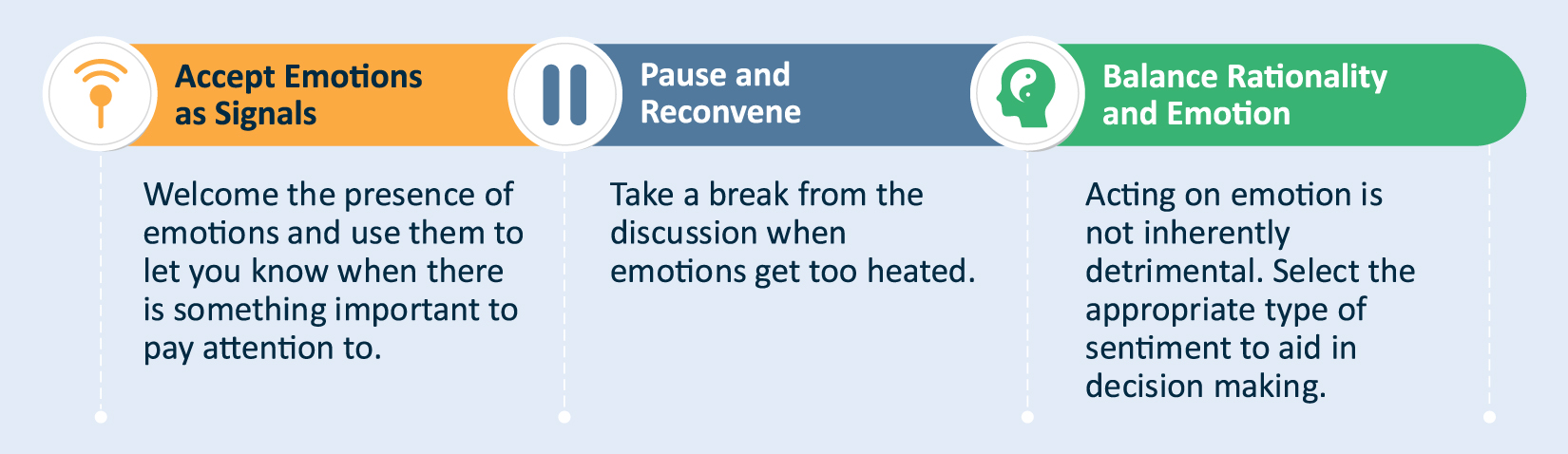
Long Description.
The text in the infographic reads as follows:
1. Accept Emotions as Signals: Welcome the presence of emotions and use them to let you know when there is something important to pay attention to.
2. Pause and Reconvene: Take a break from the discussion when emotions get too heated.
3. Balance Rationality and Emotion: Acting on emotion is not inherently detrimental. Select the appropriate type of sentiment to aid in decision making.
Emotions as Information
- Use the presence of heightened emotions to indicate the magnitude of the decision or that something important has arisen.
- Categorize the type of emotion—helpful information or antagonizing distraction—and “keep the best; lose the rest.” Reduce emotions that do not contribute to successful collaboration.
- Understand the effect emotions have on motivating action and response.
Strategies
Recognize Emotions as Signals
Strong sentiments can be useful indicators during the decision-making process that something in the situation is very important to you. Studies have shown that applying logical, rational thought is not necessarily more advantageous to good decisions than automatic responses such as emotions, and that emotions are, in fact, integral to aligning decisions with values. Use emotional states to help identify the level of impact the impending decision may have. Big responses are typically reserved for big issues.
When emotions start flaring, you know that these are very critical decisions.
—Nancy Daubenberger
Commissioner, Minnesota DOT
Hit the Pause Button
It is easy to become engulfed in the emotional stakes of a situation. This is especially true in cases where team members are closely tied to the decision issue. Advise the team to “hit pause” and take
some time away from problem-solving to allow heads time to catch up to hearts. You may need to stop a meeting without a decision being reached so the group can revisit the topic after cooling off.
Build Emotional Intelligence
Emotional Intelligence may be a trendy buzz word, but that is because it helps with many knotty situations. Those with high emotional intelligence are better able to identify the causes of their own emotions and then separate incidental emotions, or those irrelevant to a decision, from affecting their choices. By consciously acknowledging the source of the emotion, you are better able to separate your mind from being negatively affected by it. Donʼt try to suppress the emotions you are feeling in the hope that they will remain on the sideline—this will eventually backfire. Instead, be curious about what you are feeling and be honest about how it might be affecting you or your thinking.
Reframe Existing Conditions
Reframing is defined as “consciously changing oneʼs way of thinking about the meaning of an emotionally charged situation in order to reduce negative feelings” (Ratson 2023). This can shift agency leadersʼ interpretation of and reaction to an emotionally charged situation. One helpful way to reframe is to imagine the same situation occurring to someone else and consider whether the emotional response would change or what advice you would give them as an outside observer. Reframing the details amid a heated discussion can help reset a room and allow for more productive interactions.
Balance Rational and Emotional Input
Many individuals tend towards logical or emotional decision-making, and when competing interests such as engineering design and communitiesʼ needs are involved, the result can be what feels like an impasse. Explicitly acknowledging these different styles and finding ways to bring them together can help a group reach consensus. The best decisions blend logical reasoning with emotional considerations, so take cues from each side to find the right balance.
In the end, decisions are more resilient when the rational and the emotional overlap.
—Marc Williams
Executive Director, Texas DOT
Dive Deeper: The Impact of Emotions on Decision-Making
It is important to understand that emotions in decision-making are neither good nor bad. They simply are. They play an essential role in helping humans make appropriate decisions for the environment and context we find ourselves in, and we could not stop them from affecting our decisions if we tried. We must therefore become aware of them, understand how they work, and develop the tools and methods to effectively leverage what they are good at while guarding against the situations in which they lead us astray from our goals.
System 1 and System 2 Thinking
Scientists view human decision-making as the product of System 1 thinking and System 2 thinking.
- System 1 thinking is an evolutionarily old form of universal cognition shared with animals that is fast, automatic, instinctive, and innately programmed.
(continued on next page)
The Impact of Emotions on Decision-Making (Continued)
- System 2 thinking enables abstract and hypothetical thinking and is often correlated with general conceptions of intelligence.
System 1 and System 2 mental processes combine to generate a corrective design process. This process begins with the fast, automatic, and parallel assessments of System 1, which relies on an individualʼs past experiences to effortlessly generate impressions, intuitions, intentions, and feelings based on what the individual observes. At this point, System 2 is in “low effort” mode and will remain dormant unless it notices glaring violations of expected occurrences and relationships. As behavioral psychologist Daniel Kahneman puts it, “In that world, lamps do not jump, cats do not bark, and gorillas do not cross basketball courts” (Kahneman 2011). As long as nothing as surprising as a barking cat surfaces, System 2 lets the easy solutions generated by System 1 stand, and they go on to form the beliefs on which the individual will make their decision.
Integral Versus Incidental Emotions
Emotions during decisions fall into two categories to distinguish their impact: integral and incidental emotions. Integral emotions are those relevant to the decision and can help by leading us to constructive social engagement and appropriate decisions. For example, the emotion of having lost a loved one in a motorcycle crash may motivate a transportation leader to support a helmet law. Incidental emotions are those that are irrelevant to the decision at hand, and as such tend to be detrimental to good outcomes when they arise. An example of incidental emotions influencing a decision could be a transportation commissioner who votes against recommended actions more often when they are hungry, tired, or angry.
Goal Activation in Response to Emotional Triggers
Emotions trigger responses, whether they are physiological, behavioral, experiential, or communication based. These responses catalyze action toward addressing problems or seizing opportunities (Lerner et al. 2015). A motherʼs anger spawned by her bicycling child being struck by a vehicle may motivate her to petition for safety improvements near the crash site. Emotions elicit a response, and when contained and directed positively they can propel decision-making and attending action forward.
Emotions as Social Guides
Emotions serve as communication devices and play a critical role in maneuvering social interactions. Emotions help reveal the underlying motives of people. This information on believed intentions informs whether team members pursue cooperation or opposition with each other (Singer and Fehr 2005). Research shows emotions can affect interpersonal decision-making by helping people understand one anotherʼs beliefs, incentivizing or penalizing certain reactions, and inducing reciprocal feelings in others (Keltner and Haidt 1999).


