Advancing the Art and Science of Decision-Making: A Guide (2026)
Chapter: Adapt Your Decisions

Adapt Your Decisions
You made your decision and thought the worst was over, but, before the situation resolves, it becomes clear that the first decision was not the right one. Quickly adapting the decision in such situations is essential. A great decision-maker acknowledges when a decision needs to be changed and can adapt quickly to new information or circumstances.
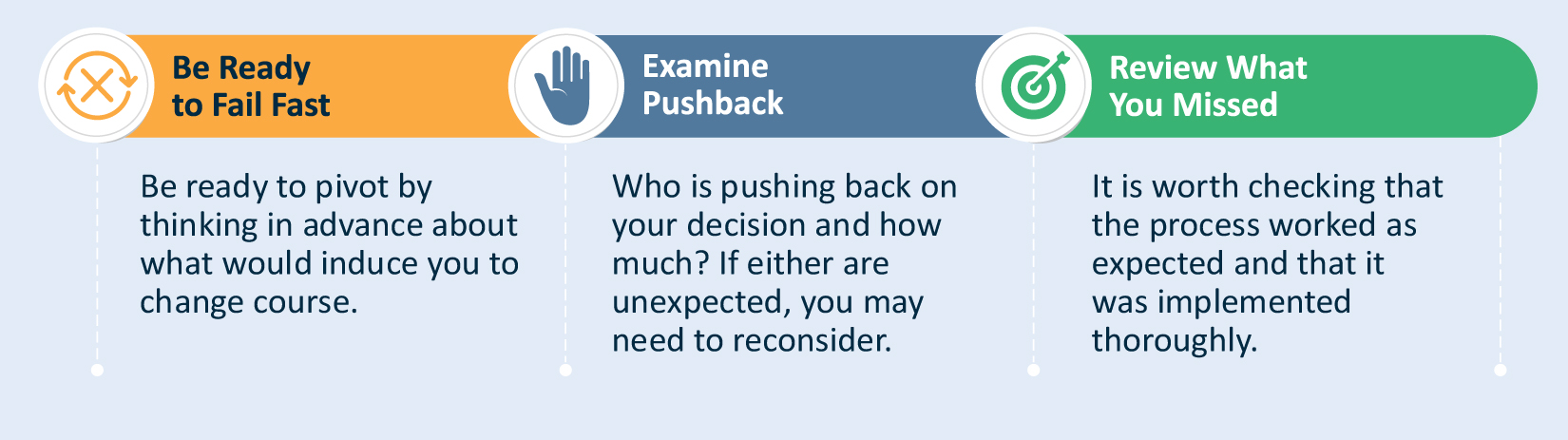
Long Description.
The text in the infographic reads as follows:
1. Be Ready to Fail Fast: Be ready to pivot by thinking in advance about what would induce you to change course.
2. Examine Pushback: Who is pushing back on your decision and how much? If either is unexpected, you may need to reconsider.
3. Review What You Missed: It is worth checking that the process worked as expected and that it was implemented thoroughly.
When to Adapt
Adaptivity is one of the four pillars of a good decision, and there are several valid reasons to change:
- Changing circumstances,
- The arrival of new information that you did not have before making the decision,
- An unexpected negative response from stakeholders, and
- A misreading of the information you had before making the decision.
Strategies
Be Ready to “Fail Fast” . . .
Your decision represents the best thinking at a particular point in time, but you may want to change your mind if circumstances change. Think about what could warrant changing your decision so it is easier to recognize and act. Rapid acknowledgement that things are not working paired with prompt recovery will be more accepted than sustained support for a decision that is failing.
No one can fail as fast as me. Eat that crow warm.—Carlos Braceras
Executive Director, Utah DOT
. . . but Avoid Hair-Trigger Change
There are rarely decisions that make everyone happy, so some grumbling and pushback are to be expected. Let some of this run its course before making changes. Set expectations about the extent and nature of pushback you are likely to receive to compare against.
Review the Reception Among Your Team
What was your teamʼs reaction when you announced your decision? Watch peopleʼs faces for signs of concern or distress and be on the lookout for closed-off body language, such as crossed arms, or verbal cues such as bringing up potential pitfalls. These are your earliest signals that there could be challenges ahead with the decision.
Workshop the Decision
After you have announced the decision, proactively discuss it with people throughout the organization and among close external stakeholders. Stay connected with staff who are doing the implementation work. Are any of these individuals noticing issues? Do they have concerns or questions themselves? This can be valuable information early on.
Consider the Source and Extent of Pushback
If pushback is coming from key staff, stakeholders, or political factions—particularly those who you expected would support you—it may be worth taking a moment to reassess the decision. Is it what you expected or bigger? Is it coming from different people than you expected? If it comes from any person or organization with significant authority or ability to cause a disruption, you will need to take notice fast.
We tried something big. We went back and revised the approach to acknowledge different needs.—Toks Omishakin
Secretary, California State Transportation Agency
Leave a Point of Appeal
Lay out a decision before eliminating points of appeal, or entities people can turn to if they are unhappy with a decision. A point of appeal will generally be the decision-makerʼs superior: a governor or commission for a DOT executive, the DOT executive for a district engineer, and so forth. If you want to prevent having your bosses be appealed to by unhappy stakeholders, have your own staff put out the decision to gauge reception. If stakeholders are unhappy with it, they will appeal to you instead, giving you the chance to change it without it going above you.
Mitigate When a Decision Cannot Be Changed
Some decisions are almost impossible to change. Practical examples of this include modifying a roadway alignment after concrete is poured or attempting to restructure an already ratified new directive. High-visibility or controversial decisions can also be difficult to adjust. In these cases, you may need to make the best of the situation by mitigating for any damaging effects.
Review the Process Behind Changed Decisions
Examine the process that led to the unpopular result to determine whether anything should be done differently. Evaluate the factors that led to the change in direction and whether it should have been foreseen. Adjust your decision process in light of findings, or make sure the process is implemented thoroughly next time. Undesirable outcomes do not mean the process or decision itself were wrong, so it may be that nothing needs to change.


