Advancing the Art and Science of Decision-Making: A Guide (2026)
Chapter: Suspend Protocol Strategically

Suspend Protocol Strategically
Policies and protocols reduce cognitive load and keep organizations out of trouble and running smoothly—most of the time. Occasionally, rigid adherence to protocol gets in the way of reaching the best decision possible. As a leader, you will need to determine when it is most appropriate to suspend normal protocol to expand the options available for the decision and have strategies to minimize and manage potential fallout.
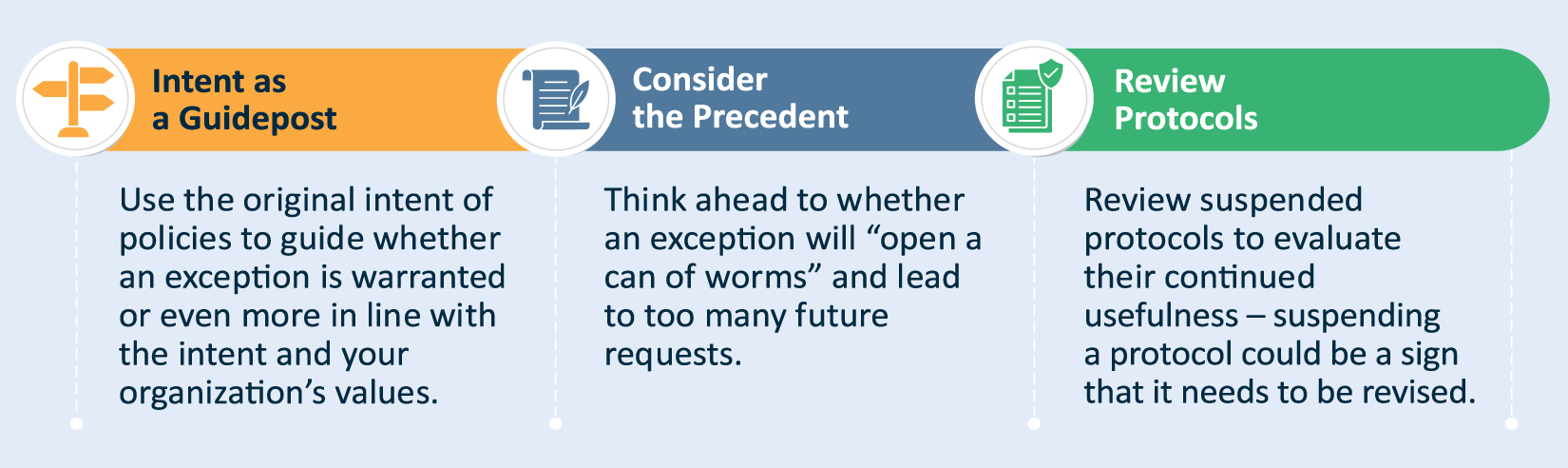
Long Description.
The text in the infographic reads as follows:
1. Intent as a Guidepost: Use the original intent of policies to guide whether an exception is warranted or even more in line with the intent and your organization’s values.
2. Consider the Precedent: Think ahead to whether an exception will “open a can of worms” and lead to too many future requests.
3. Review Protocols: Review suspended protocols to evaluate their continued usefulness—suspending a protocol could be a sign that it needs to be revised.
When You Might Suspend Protocol
- Protocols are outdated or no longer fit day-to-day operations;
- Emergencies require fast, situational decision-making; or
- The policy or protocol does not adequately account for unique circumstances.
Strategies
Consider the Precedent
An important consideration is what an exception will mean for similar situations in the future. Imagine who else might ask for a deviation from standard rules if you offer one now. What arguments might people make, and will you have a sound basis to say no in the future? The question comes down to how you can defend that this situation is different.
What sort of precedent does this set if we make an exception in this case? It comes down to how we can defend that this is different.
—Nancy Daubenberger
Commissioner, Minnesota DOT
Use Organizational Values as a Guide
Strong organizational values and culture can help guide when to override protocols or policies. Ideally, policies will be written with organizational values in mind, but there are always nuances impossible to capture. Ask whether deviating from the protocol is still in line with the agencyʼs core values.
Expect the Unexpected
Situations that rise to the executive level are often those that fall outside the run-of-the-mill, easy-to-answer questions, so requests to make exceptions may be the norm for leaders. Consider principles you might use across situations.
Go Back to the Intent of the Policy
Protocols were established for a reason, and that intent is what matters and should be followed. Think about why a certain policy or protocol was set or see if you can find out anything about its history. If it was for rare, worst-case scenarios, you may be able to more safely set it aside if you know the current situation does not rise to that worst-case level.
Consider Who Set the Protocol
Laws and regulations cannot be suspended by an agency leader. Many policies and procedures, however, are set by the agency or a commission that has the authority to change or temper how such protocols are implemented. Protocols that are merely convention and were set by an office within the agency are often the easiest to suspend, though buy-in from the relevant office staff will go a long way to reducing fallout.
Examine the Emotions and Stakes
Factors such as high emotions or political conflict can be indicators that more needs to be understood about a policy or process. Understand why individuals have strong reactions to either the established policy or to the prospect of suspending it to help determine whether there are underlying factors more important than the policy itself.
Donʼt Use Protocol as a Crutch
DOTs operate in a highly regulated environment, and it can be very easy to rely on rules, policies, and protocol as a crutch to take the easy way out of difficult situations. However, too much focus on adherence to protocol may delay or misdirect actions that could otherwise benefit the organization or the community it serves.
Donʼt Make It a Habit
While exemption requests may surface frequently, be careful not to get a reputation for flouting the rules whenever it suits you. Doing so can begin to alienate staff, who do not have the option to make exceptions, and can damage your credibility with stakeholders.
Review Suspended Protocols
When the decision is made to override a rule, there should be follow-up on why. Was this a one-time occurrence (e.g., for a disaster response) or is it a deviation that appears to be ongoing? Should we incorporate this new situation into the policy formally, or should it be removed or altered altogether? Exemptions should start a discussion on when and whether a policy is still useful for the organization.


