Advancing the Art and Science of Decision-Making: A Guide (2026)
Chapter: Navigate Crisis

Navigate Crisis
Sometimes time or other circumstances prevent application of the ideal decision-making process. This chapter outlines the kinds of situations in which this may happen at a transportation agency and provides advice on both how to prepare for the unexpected, so as to mitigate disruption and negative impacts, as well as on how to navigate these situations once leaders find themselves in the thick of them. Advice is drawn primarily from interviews with leaders and supplemented with content from published best practices.
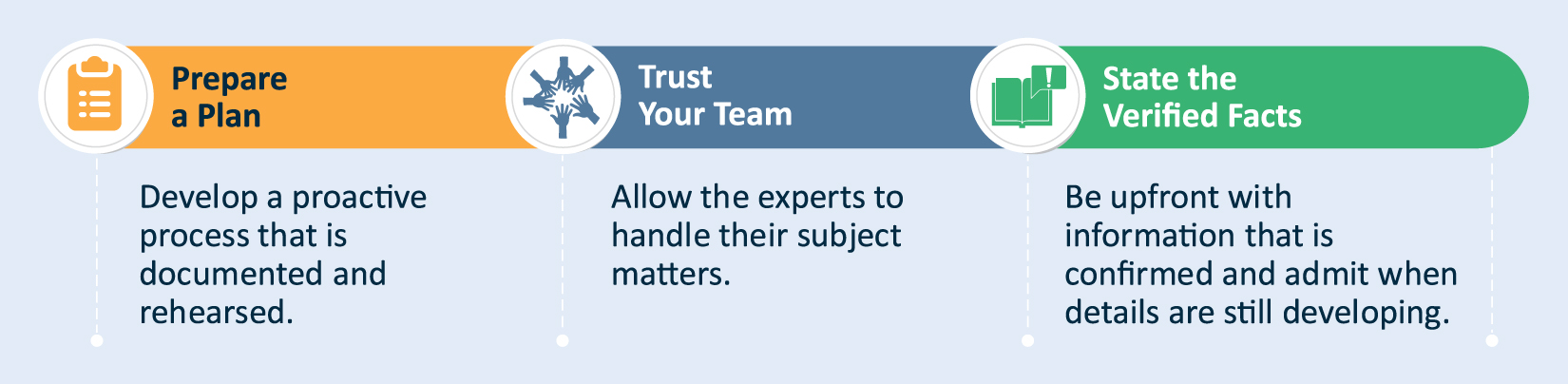
Long Description.
The text in the infographic reads as follows:
1. Prepare a Plan: Develop a proactive process that is documented and rehearsed.
2. Trust Your Team: Allow the experts to handle their subject matters.
3. State the Verified Facts: Be up front with information that is confirmed and admit when details are still developing.
What Constitutes a Crisis?
A crisis develops when emergency situations escalate and overtake typical operations. Types of crises that may affect transportation agencies and questions to consider include
- Natural disaster,
- Infrastructure failure,
- Significant vehicle crash, and
- Adverse impact of actions.
Questions to consider include
- Who is in the room during crisis management?
- What information do you share? With whom? When?
- How can resources be allocated expeditiously?
- How should you balance protocol with expediency?
Strategies
Verify, Verify, Verify Information
Most of the information you get in the first 24 hours is hyped up, unprocessed, and almost certainly wrong.—Joyce Taylor
Chief Engineer, Maine DOT
Often in a crisis, just knowing what is true is a challenge. Find out where information is coming from and try to get it from the source rather than second- or thirdhand. Be very cautious with any information coming out immediately following a crisis—it is often wrong. Donʼt speculate on any
information you have not verified with the media or public officials, particularly your governor. Share what you know, then be up front about what you still do not.
Establish Strong, Centralized Communication
Outline who needs to know what, when they need to know it by, and how that information will be communicated. This will help to establish clear escalation pathways and remove one aspect of uncertainty. Bringing everyone to a central physical location can help to consolidate communication and decision-making processes, thereby enabling everyone to check their assumptions and get on the same page fast.
Create a Plan and Internal Crisis Team
The team would serve to guarantee mechanisms are in place to identify, notify, and address emergency situations. Additionally, the team would facilitate discussion on lessons learned once the situation is handled. Appoint a crisis leader to lead the team and directly report to the agency director. Legal personnel, administrative support, human resources, and project managers are a few potential team members that could provide a diverse skill set within the team. Appoint staff who have a macroscopic understanding of the agency and have the necessary capabilities to lead the recovery of their subject area in the event of a crisis (Strawser 2022). Nurture relationships with these team members in advance to develop trust that will prove invaluable during a crisis.
Slow Down Decisions as Much as Possible
There is very little that must be decided in 15 minutes. The information communicated in the first 24 hours is almost certainly wrong. Resist the urge to get emotionally caught up in the frenzy of a situation. Leaders are responsible for first calming the room to allow the team to process information and then making strategic directives swiftly. The first 24 hours into a crisis is crucial, and knowledge and information rapidly change. Seek details directly from the source rather than accepting second- or thirdhand information where possible, even when time is a limiting factor.
Trust the Experts and Protect the Team
The start of an emergency is NOT the time to get to know your friends in local government. You want them on speed dial.—Russell McMurry
Commissioner, Georgia DOT
Agency leaders should shield staff from media and political pressures by acting as a liaison to those entities. Focus on directing the overall path to tackle the crisis and do not waste valuable time attempting to craft every detail of the recovery plan. For example, the DOT head should tell
the appropriate team lead to create a detour; he or she does not need to be in the room during the discussions on route selection. Protect your team so they can do their work and trust them to handle their areas of expertise.
Have Relationships Built Before Crises Arise
Spend time getting to know the leaders in local and other state agencies when there is not a specific need, ask, or crisis. Build relationships and trust so that you know the right people to call in each region of your state, you have their cell numbers on speed dial, and you can be confident they will pick up the phone when you call.


