Advancing the Art and Science of Decision-Making: A Guide (2026)
Chapter: Expanding Airbags amid Public Outcry

Expanding Airbags amid Public Outcry
Overview
Decision Situation: How to continue expanding the use of airbags as accounts of airbag-induced harm and deaths raised a public outcry.
Decision Type: Crisis; new approach.
Decision-Maker: Ricardo Martinez, M.D. former NHTSA Administrator.
Key Players: Vehicle manufacturers, airbag manufacturers, lawmakers, safety advocates, driving public.
The Stakes: In 1996, NHTSA startled the world by acknowledging that airbags may contribute to killing children and frail adults in some crashes. This announcement led to a public outcry over the potential dangers of airbags. However, airbags were also credited with saving thousands of lives. NHTSA and the auto industry needed to act quickly to both remove the real dangers that airbags posed to some passengers and prevent automakers and the public from resisting the life-saving capabilities of airbags overall.
Decision Situation
The Context
While most people today consider airbags an essential and nonnegotiable part of driving safety, in the days before they were mandatory, this sentiment was not uniformly shared. Airbags were introduced commercially in the 1970s, but vehicle manufacturers resisted adopting them for years on the grounds that they were not cost effective (Saporito 2014). In 1988, only one vehicle manufacturer in the United States, Chrysler, offered airbags as a standard feature in new vehicles (Bellis 2023). It would be a full decade more until airbags became mandatory in cars sold in the United States.
By 1994, when Ricardo Martinez took over as the NHTSA administrator, more than 75% of vehicles driving on U.S. roads had no airbag at all (NHTSA 2001). Airbags were slowly gaining acceptance as evidence mounted that they saved lives, but there were still skeptics. Reports had surfaced throughout the early 1990s that children and frail adults had been killed in low-speed crashes because of airbags. Initially NHTSA maintained that these deaths were due to the passengers being unrestrained, but documented deaths of children who were wearing seatbelts soon dispelled this argument. In 1996, NHTSA released a report formally acknowledging that airbags could kill children who were placed in the front seat (NHTSA 1996).
Martinez knew that something had to be done to address the publicʼs fear of airbags amid these stories. The right course of action had to simultaneously reduce the dangers of the technology in the specific circumstances where it was deadly and maintain the publicʼs trust in airbags to continue expanding their use.
A Doctorʼs Decision-Making Approach
As an emergency trauma doctor, Martinez was asked to continually make urgent, life-or-death decisions in the absence of full information. The approach he often applies to decision-making is therefore grounded in the concept of triage, in which doctors establish an order of priority for which patients and ailments to attend to first on the basis of injury severity and threat to the patient.
People get into trouble because they donʼt make the first decision on what their priority is.
—Ricardo Martinez
Former NHTSA Administrator
He explains that you donʼt know everyoneʼs medical history when they come into the emergency room. To deal with this, you continually take the list of problems that youʼre facing and reprioritize them as new information surfaces. There is a problem list, or all the things going on with a patient, and you rank order them on the basis of severity and threat. For example, low blood pressure from lack of fluids is secondary to an airway constriction, which is acutely threatening to someoneʼs life. Only after you have addressed the acute treatment needs do you move to broader structural problems, develop a care plan, and then implement it for recovery.
Triaging the Airbag Problem
Acute Phase: Deflating the Front Seat Threat to Children
In the case of the national airbag situation, the most acute problem on the list was having children in the front seat in the first place. If NHTSA could quickly convince parents to keep children and infants in the back, the acute threat of the problem would immediately decrease. The first decision Martinez made was therefore to find the quickest way to keep children out of the front seat, which resulted in a national educational campaign.
If you properly engage a broad group, you can convert people from agitators on the outside to part of the solution.
—Ricardo Martinez
Former NHTSA Administrator
He used every media opportunity to urge parents to put kids in the back seat, but even doing this would not reach everyone who needed to hear it. It was the parents of children who died in such crashes who pushed the major action in this arena: putting prominent, colorful warning labels in the front seat of all cars. While this seemed an easy, low-cost, and quick option, there were decisions to be made about the right wording to use. NHTSA proposed language saying that unbelted children and infants in rear-facing child seats may be killed by an airbag (OʼBrien 1996). The Parentsʼ Coalition for Air Bag Warnings, whose members included parents whose children were killed by airbags, wanted a more direct statement about the dangers of airbags to children that would be unmissable: “Do not seat children in the front seat. Airbags can kill or injure children.”
NHTSA officials were concerned that this language would be alarming and make more people afraid of airbags overall. Discussions on the right language continued over many meetings between the interested parties before the proposal could move forward. In the end, the urgency and threat of the situation won out, and NHTSA eventually agreed to the stronger, more direct labels favored by parents. New regulation in November of 1996 began requiring the following text: “Children can be killed or seriously injured by the airbag.”
Addressing Structural Problems: Unavoidable Front Seating
While this fix would reduce the threat of airbags to children on a large scale, it would do nothing for the few remaining situations where children must be in the front seat due to medical conditions or other circumstances. To address this issue, there was discussion about allowing car owners to install an on-off switch on the passenger side that could disable the airbag when they saw a need to do so—for example, if they could not have their child sit in the back seat on a particular trip.
This option had the benefit of allaying the fears of those who were most concerned about airbag safety, but NHTSA officials and car manufacturers worried that people would forget or refuse to turn the airbags back on, thus leaving adult passengers vulnerable to greater risk on an ongoing basis. Once again, the agency was faced with a decision to balance an immediate fix to a known problem at the possible expense of a longer-term risk to public safety through reduced airbag use.
After weighing the risk of reduced airbag use among adults, NHTSA decided to nonetheless move forward with allowing on–off switches to be installed in certain circumstances. Agency staff felt that providing this option was essential to allaying the fears and managing the risks of those who could not have children in a back seat. But for the sake of broader public health outcomes, they had to find a way to avoid rampant use of the switches that could lead to big reductions in general airbag use. Expert opinions were considered to help overcome this hurdle. NHTSA organized the National Conference on Medical Indications for Air Bag Disconnection in July 1997, which convened a panel of esteemed specialized physicians from the major national medical professional societies to provide guidance on the benefits and risks of allowing on–off switches for airbag deployment. The panel found there were little to no benefits associated with providing drivers the ability to deactivate the passenger-side airbag across several conditions considered. This finding served as crucial assurance and guidance on this issue for the public, and related messaging was disseminated by the national media during the educational campaign.
To build in a structural hurdle to airbag deactivation, the NHTSA team would make use of one of the governmentʼs greatest strengths: paperwork. Anyone who wanted to install the switch would have to fill out an application making the case and providing documentation for why they needed to be able to deactivate the airbag. Each application would be reviewed by experts to determine whether the switch was warranted. Including this provision in the process would ensure that only the most urgent cases with a true need for deactivation had the option to turn airbags off, thus reducing the larger public health risk of lowered airbag usage.
Long-Term Care Plan: A New Kind of Airbag
The long-term fix to the situation was to have manufacturers modify airbags within the confines of the law to be less deadly. Martinez met with executives from the big car companies in Detroit to
discuss what a new generation of airbags could look like and to convince the car companies to proactively redesign them.
Just as they did in the seventies and eighties, auto manufacturers initially pushed back. There were concerns over liability should new airbags not always work as hoped, and any new technology would add even more cost to their vehicles. If NHTSA wanted to move forward with this approach, they would have to push hard on auto manufacturers and threaten an already strained relationship between the companies and the countryʼs traffic safety regulator.
NHTSA staff dug in on researching solutions for better airbags to advance the conversation across the industry. Here is where one of Martinezʼs decision-making policies proved helpful: To ensure that all good ideas were considered, he asked his staff to never come forward with only a single solution. “Bring at least four,” he would tell them. Stopping at one solution could limit other good ideas, or even potentially better ones. In this case, the long-term approach that came out of NHTSA relied on two distinct solutions.
The force of current airbags was one immediate issue the agency wanted to address. Early airbags used extreme force to deploy, and it was this initial force that caused so many injuries and deaths. Research using new kinds of crash tests began to show that it would be possible to reduce the force of deployment and still see safety benefits from the airbags. NHTSA moved quickly with this knowledge, and the redesigned airbags were officially allowed in March 1997.
The agency did not stop with this solution. Even as airbag force was reduced, NHTSA pushed for the use of new technology that could circumvent the need for the on–off switches: smart airbags. These were airbags that could automatically sense the weight of the person in the passenger seat and shut off the airbag if the passenger was assessed to be small. The technology was not without its critics. Early models did not operate as seamlessly as desired, turning airbags off in some cases when a seat cover was installed. NHTSA stuck with the approach, however, confident that the new technology would advance and prove its worth.
Recovery
In the end, Martinez led his agency to pursue three major courses of action, each prioritized on the basis of the degree of urgency and threat of the core issue. The result of this strategized set of interventions has been undeniably successful, with airbag-induced deaths of children becoming virtually nonexistent in vehicle models after 2002 (Figure 4). Airbags have become more widespread, smarter, and safer as a result of the focused efforts through this challenging time.
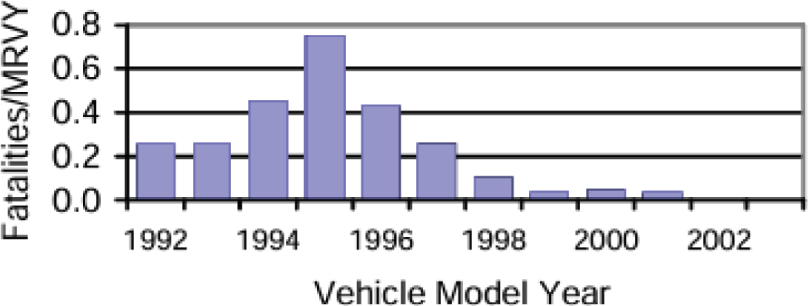
Source: NHTSA (2001).
Note: MRVY = million registered vehicle years
Long Description.
The horizontal axis shows the vehicle model year from 1992 to 2003 in increments of 1. The vertical axis depicts the number of fatalities in million registered vehicle years from 0.0 to 0.8 in increments of 0.2. The data given in the graph are as follows: 1992: 0.21. 1993: 0.21. 1994: 0.42. 1995: 0.78. 1996: 0.41. 1997: 0.23. 1998: 0.15. 1999: 0.01. 2000: 0.002. 2001: 0.01. 2002: 0. Note that the bar values are approximate.


