Advancing the Art and Science of Decision-Making: A Guide (2026)
Chapter: When Is the Information You Have Enough?

When Is the Information You Have Enough?
As an agency leader, you will make hundreds of decisions, the majority of which you will not have perfect information for. So, when do you decide that the information you have is enough to move forward with? Sometimes the circumstances will dictate this for you and force a decision through explicit deadlines or obvious urgency. Other times, the point of no return can come and go quietly unnoticed, and waiting for perfect information will lead to a default decision of inaction. Leaders must learn when enough information is enough.
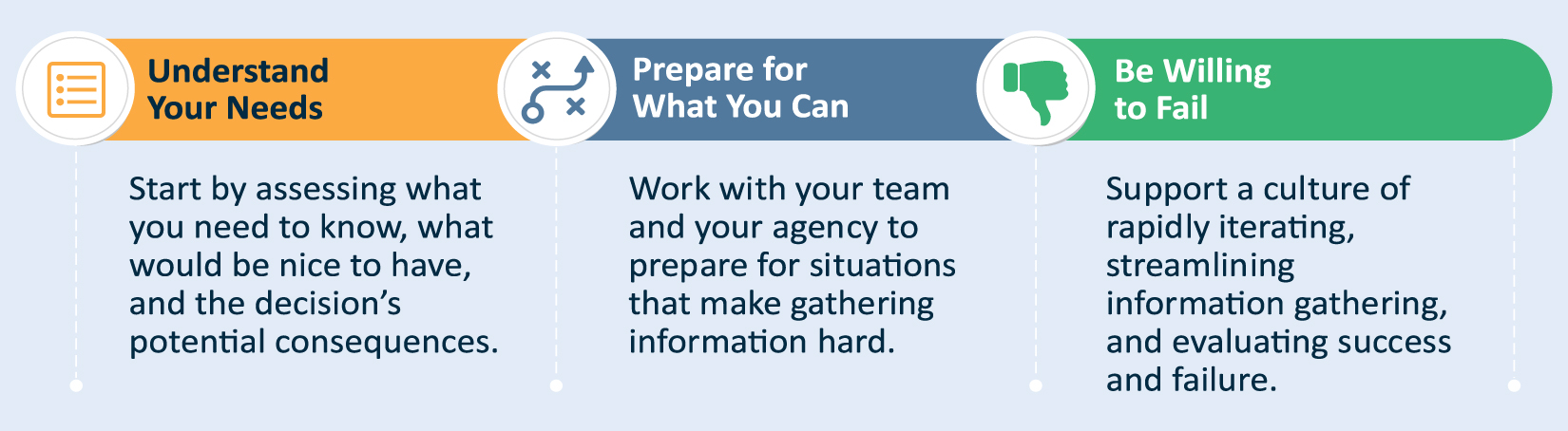
Long Description.
The text in the infographic reads as follows:
1. Understand Your Needs: Start by assessing what you need to know, what would be nice to have, and the decision’s potential consequences.
2. Prepare for What You Can: Work with your team and your agency to prepare for situations that make gathering information hard.
3. Be Willing to Fail: Support a culture of rapidly iterating, streamlining information gathering, and evaluating success and failure.
Information Necessity
Several factors influence how much information you need to confidently move forward:
- Experience level: If you or your team have lots of experience with similar situations, you are better able to “trust your gut” in using more limited information.
- Information quality: A small amount of information from a very reliable source may serve you better than reams of input from armchair experts.
- Importance: The more significant and important the decision, the more legwork needs to go into information gathering.
- Changeability: A decision that is easy to change if it turns out to be wrong can be hazarded with less information than one that cannot be undone.
- Urgency: If there is a point at which no action becomes your default decision, then you must make the call with whatever information is available at that time.
- Risk: If there are big risks associated with an outcome, getting it right is worth gathering extra information. See the chapter “Manage Risk and Uncertainty” in Part IV for more information.
Strategies
Define “Enough”
Describe the minimum threshold of information you would want to have before making the decision in front of you. Is it answering one underlying key question? Or having 75% or a list of questions answered? Perhaps it is whatever you have found out after talking with a defined set of experts and stakeholders. Articulate where the current decision situation is with regard to the characteristics outlined above. Thinking through these things in advance will bring clarity to help you identify the point at which you have arrived at your minimum threshold, and you can move ahead with a decision at any point after this.
You should never be waiting for all the information. Trust your instincts and your people.—Carlos Braceras
Executive Director, Utah DOT
Get Broad Input
Get lots of input from lots of sources. Talk to as many people with knowledge of or a stake in the decision as possible. The same goes for doing research. Check multiple sources on the topic and explore advice from similar situations outside of your field. The more people and sources you have checked in with, the more confident you can feel that you have not left an important stone unturned.
Watch for Patterns
You can begin to trust an option as you see information congealing around a common outcome. If you start asking the same questions in the deliberation process and getting the same kind of responses repeatedly, you have probably covered the bases and can make the decision.
Make an Advance Default Decision
If you know that taking no action is not an acceptable option, take it off the table immediately by setting a default decision that will take effect if another decision does not replace it. This allows a decision-maker to continue gathering information up to the critical point with less pressure.
Build in Flexibility Where You Can
It will not always be possible, but do whatever you can to give yourself flexibility to change course as new information comes in. This may mean establishing the top few decisions and laying any groundwork needed for all of them. If later the decision turns out to be suboptimal, the other options will be ready to be implemented at a momentʼs notice.
Donʼt Let Remaining Uncertainty Hold You Back
Avoiding analysis paralysis requires you to sometimes move ahead even when questions remain. Learn to accept the discomfort of open questions and have faith in the process you have established and information you were able to gather. Sometimes you have to accept the fact that a good decision does not guarantee a good outcome. If you have gone through the process of engaging the right people and checking the right information, you have to become comfortable and confident with just making the decision.
Be Upfront About What You Still Donʼt Know
When uncertainty remains, communication is key. Be clear about what questions remain unanswered and what information is still unknown. Even if something does not turn out well, people will appreciate that you used a clear and reasonable process. That will help others place less blame on people who did the best they could and more on complex situations and challenges.
This page intentionally left blank.


