Advancing the Art and Science of Decision-Making: A Guide (2026)
Chapter: Monitor Group Dynamics

Monitor Group Dynamics
Many decisions at DOTs will involve a group of agency staff or stakeholders. As people take on distinct roles and behaviors when they work in a group, these roles and behaviors influence othersʼ perceptions and actions. The power (or peril) of this is often a different decision than a single member of the group would make on their own.
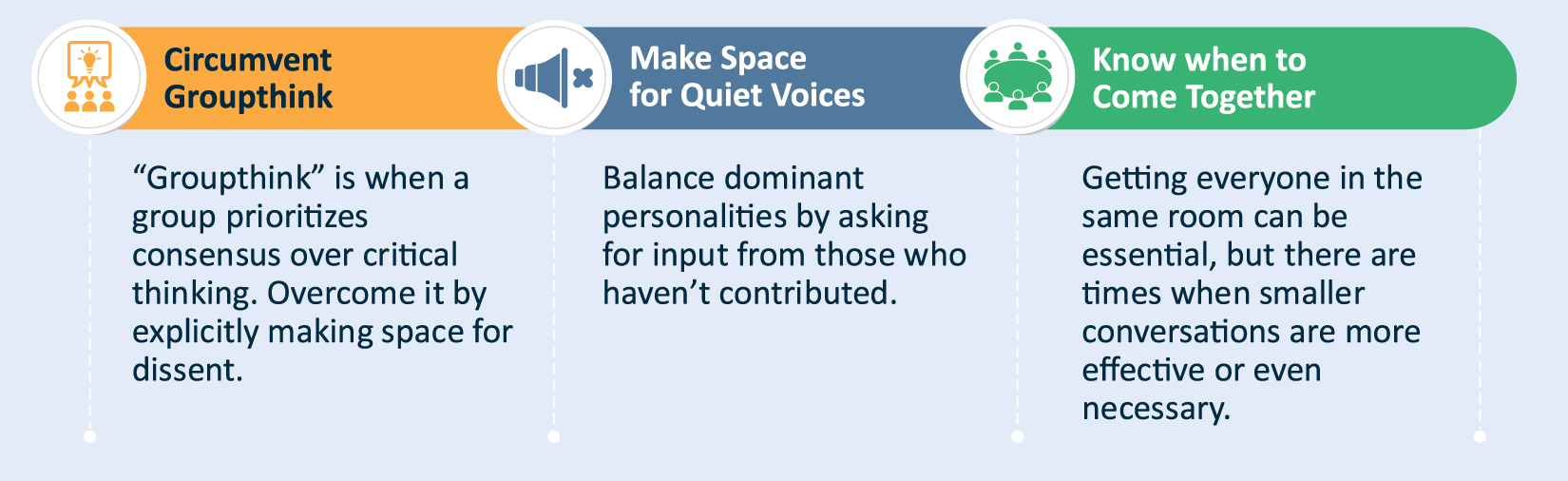
Long Description.
The text in the infographic reads as follows:
1. Circumvent Groupthink: Groupthink is when a group prioritizes consensus over critical thinking. Overcome it by explicitly making space for dissent.
2. Make Space for Quiet Voices: Balance dominant personalities by asking for input from those who haven’t contributed.
3. Know When to Come Together: Getting everyone in the same room can be essential, but there are times when smaller conversations are more effective or even necessary.
Benefits of Group Decision-Making
- Multiple areas of expertise will more effectively identify potential issues or solutions.
- Including many people generates stronger buy-in for final decisions, even among those unhappy with the outcome, which can be helpful for controversial decisions.
Challenges of Group Decision-Making
- Deciding with a group will increase the amount of time needed to go through the decision-making process. Make sure sufficient time is available is for group input.
Strategies
Overcome Groupthink by Welcoming Dissent
One person will say one thing and suddenly the conversation goes in an unexpected direction. It takes a brave person to be the one asking dissenting questions.
—Carlos Braceras
Executive Director, Utah DOT
“Groupthink” occurs when people overvalue consensus and gravitate toward the solution that seems to be gathering momentum, even if it is inferior. Being the one expressing dissent in moments when everyone else is eagerly coalescing toward one direction is a position of psychological risk. However, the early momentum may not have included all the right information or considerations, and skepticism is a healthy means of checking progress down the wrong path because it seems easy and feels good. To make sure such dissent is expressed, discourage snide or joking comments toward people who raise concerns and explicitly ask the group to come up
with an argument against the position gathering support. This way, any dissenter is complying with a group norm rather than being a wet blanket.
Get Everyone in the Same Room
Bringing planning, design, construction, or any other diverse set of teams together can help identify key issues at the start of a decision process and align agency priorities. Doing so is especially important for an issue that touches many different areas of expertise, affects lots of different groups, or will be controversial. Talking together allows for broad information gathering and provides an opportunity for everyone to be a part of working through issues and multiple objectives.
Know When to Kick People Out of the Room
Equally important is knowing when it may be helpful to retreat to a smaller group. When it comes time for you as the leader to make the call and weigh the opposing perspectives you just heard, the dynamic may be more helpful with a few close, trusted advisors. It may also be important to change the grouping or remove some participants if an unhelpful dynamic has cropped up in the larger group.
Deliberately Make Space for Quieter Voices
Every group has a few who do not hesitate to share their opinions or who speak with a particularly loud voice, whether literally or figuratively. Rank effectively serves as a megaphone, meaning that anything a leader says is heard more loudly than the same thing said by someone lower down the ladder. Group dynamics are, by default, often led by the most senior-ranking person in the room. If you truly want to hear from everyone, notice who has not spoken up and ask for their insights. Or “go around the horn” to have everyone speak their mind in turn.
Clarify Roles
Very few decisions will be made by consensus at a public agency. Be clear at the outset who in the group will make the final decision. While one entity may make the final decision, when it has an impact on someone elseʼs sphere, that person needs to be involved. This requires understanding the sphere of responsibility and authority for yourself, your reports, and your peers. Understand the suite of decisions that are expected within each portfolio and how your portfolio fits into the overall organization and the portfolio of others.
Some things are not consensus. I will make the decision. But first I will listen to all sides and air the issues out in front of everyone.—Joyce Taylor
Chief Engineer, Maine DOT
Become an Expert Facilitator
To help manage group discussions for decision-making, senior leaders should be familiar with the skills that good facilitators possess, such as active listening, maintaining impartiality, time management, synthesizing and summarizing what is said, and encouraging participation. When you take on a facilitator role, do your best to maintain impartiality so you do not inadvertently sway the conversation.
Dive Deeper: The Powers and Perils of Group Decisions
Many decisions at DOTs will involve a group of agency staff or stakeholders. The psychologist who coined the phrase “group dynamics” in the 1940s noted that people often take on distinct roles and behaviors when they work in a group (Mindtools n.d.). Furthermore, these distinct roles and behaviors interact in a way that influences othersʼ perceptions and actions and can lead to very different decision outcomes than those from any one individual.
Groupthink: The Tyranny of We
Groupthink, the tendency for groups to prioritize consensus over critical thinking, can be a major roadblock to effective decision-making. It can manifest as an aversion to challenging the status quo or pursuing innovative solutions that deviate from established norms. The pressure to maintain group harmony can lead to overlooking crucial information or potential risks associated with the favored option, which, in turn, can lead to unified decisions rather than the best decisions. Symptoms of groupthink include rationalizing the position, even in the face of strong opposing information; a collective feeling of invulnerability; a sense of moral superiority about the position; stereotyping those with opposing views; and applying pressure to anyone who puts out opposing information.
Top Strategy: Explicitly make space for dissenting opinions and ask about a decisionʼs weaknesses.
Dominant Personalities: When One Voice Steers the Ship
Dominant personalities can significantly skew the course of group decision-making. These individuals, by virtue of their confidence or seniority, may exert undue influence, shutting down opposing viewpoints and limiting the consideration of alternative solutions. This can lead to decisions that reflect the priorities of a single individual rather than the collective wisdom of the group. Furthermore, it can discourage quieter, but equally valuable, contributions from other team members, so that crucial insights are potentially overlooked.
Top Strategy: Pay attention to how much each member of the group contributes and ask for thoughts from those who have spoken up less.
Social Norms: Invisible Rules of the Road
Social norms, the unwritten expectations of how we behave within a group, can have a positive impact on group dynamics (e.g., reinforcing organizational values), but they can also hinder overall productivity. For example, a culture of excessive deference to authority figures might discourage staff from raising concerns about a proposed plan, even if they
have significant reservations. Similarly, a norm of prioritizing expediency over thoroughness could lead to rushing through critical evaluations or overlooking potential problems. Understanding and potentially reshaping social norms within your decision-making team can be instrumental in fostering a culture of open communication and rigorous analysis.
Top Strategy: Interview or survey team members on their perception of organizational strengths.
Process Drag: The Slow Lane to Nowhere
Process drag refers to bureaucratic hurdles and protocols that can bog down decision-making. It manifests in the form of excessive paperwork, lengthy approval chains, and cumbersome procedures that delay critical choices. This can lead to missed opportunities, slow down vital infrastructure projects, and ultimately hinder progress. Additionally, process drag can create frustration and disengagement among team members, who may feel their ability to contribute is hampered by an overly complex system.
Top Strategy: Collectively map processes to identify process blockages and unnecessary steps.


