Advancing the Art and Science of Decision-Making: A Guide (2026)
Chapter: Manage Risk and Uncertainty

Manage Risk and Uncertainty
There will always be forces beyond your control that could derail the most carefully thoughtthrough decision. Leaders must identify what these forces are and then determine the right level of exposure to them given the stakes, circumstances, and risk tolerance of others involved. Uncertainty is innately uncomfortable and exposes us to risks, but it can be managed and even open up new opportunities.
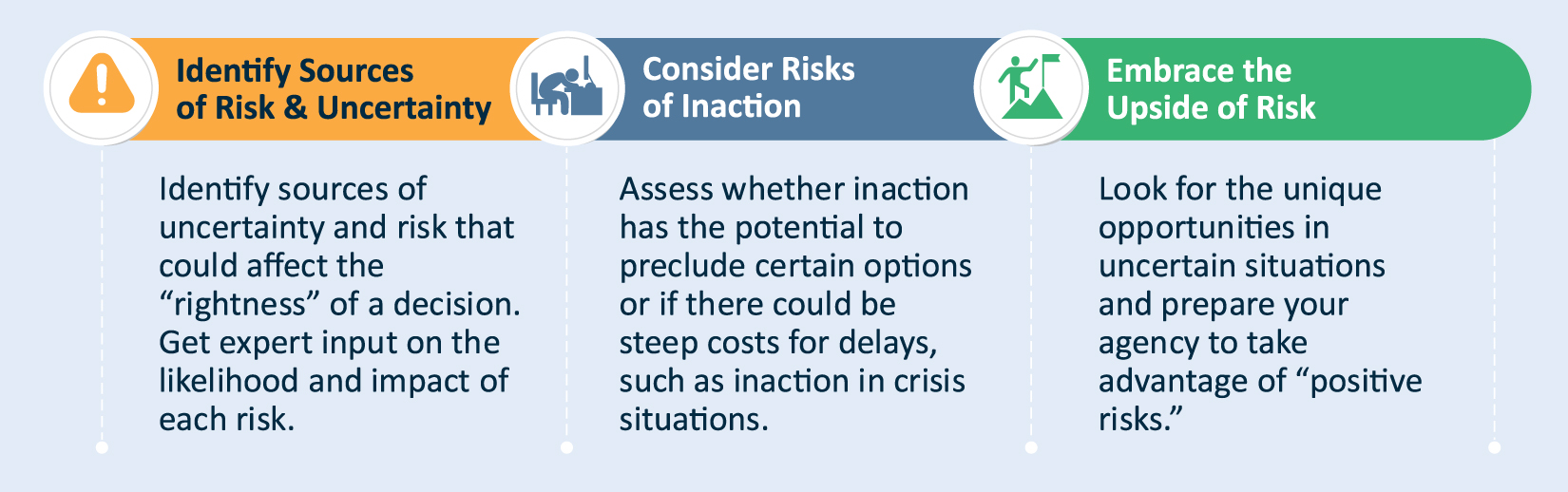
Long Description.
The text in the infographic reads as follows:
1. Identify Sources of Risk and Uncertainty: Identify sources of uncertainty and risk that could affect the “rightness” of a decision. Get expert input on the likelihood and impact of each risk.
2. Consider the Risks of Inaction: Assess whether inaction has the potential to preclude certain options or if there could be steep costs for delays, such as inaction in crisis situations.
3. Embrace the Upside of Risk: Look for the unique opportunities in uncertain situations and prepare your agency to take advantage of “positive risks.”
Uncertainty as Opportunity
- In colloquial usage, “risk” tends to refer to the possibility for negative outcomes. Despite this connotation, remember that risks can be positive in the form of new opportunities.
- Uncertainty primes us for learning and evolution by forcing us out of predictable ways of thinking. Manage known risks as much as possible but remain open to the upsides.
Strategies
Cast a Broad Net for Possible Risks
The greatest risk to any decision is one you did not know to expect. Bring in the top minds in your agency, stakeholders, and external experts to develop a comprehensive set of risks and uncertainties. Individuals with significant institutional knowledge are especially helpful in considering risks that surfaced in past decisions and forecasts. When there are substantial risks, such as loss of life, bodily harm, negative press, or financial consequences, document and formally assess the impact and likelihood with experts.
Have friends outside your organization who can give you a heads-up when issues are arising. These people may be outside the normal alliances of chain of communication.
—Justin Powell
Secretary, South Carolina DOT
Seek Out Technical Expertise and Support Tools
Making decisions under uncertainty has an entire branch of study dedicated to it, with many helpful decision support tools and frameworks for forecasting and contingency planning. Find
those in your agency who regularly conduct forecasts to advise which of these tools and frameworks could help in your situation.
Remember the Upside of Risks
In the absence of catastrophic outcomes, encourage your team to take strategic risks. When decisions can be reversed or adjusted with little physical or financial challenge, they present excellent opportunities for taking advantage of opportunities that can have potential upsides, such as attracting new employees or seeing projects delivered faster.
Sometimes you have to take risks if you want to make progress. Be cautious, but donʼt be so risk averse that you miss out on opportunities.
—Malcolm Dougherty
Director, California Department of Transportation
Understand Risk Tolerances
In determining how much risk to accept for a decision, examine your tolerance for the worst-case scenarios, those of key stakeholders, and those of the organization as a whole. There is no way to determine the acceptability of the risks associated with each course of action without knowing the tolerance of all key individuals and entities involved. Then, examine thresholds for initiating action if and when risk materializes.
Consider the Risk of Inaction
Not acting eventually becomes a default decision, and letting delays set in can affect your ability to move in a certain direction. An extreme example of this is in crisis situations when there is risk to life and limb. In these circumstances, the risk of inaction is so great that decisions can and should be pushed to the lowest levels possible to avoid inaction.
Prepare Others for Possible Fallout
Make sure that everyone understands the possible risks, so people are not caught off guard. This is especially important for senior leadership and public officials, who find surprises particularly unpleasant. There are times when risks should be made public, such as if there would be a huge outcry or if communities needed to prepare for the risky eventuality.
Make the Decision in Pieces
When risk or uncertainty is especially high, break up decisions across time and geographies where possible. Decide on what you can give with the data you already have, assess risks and uncertainties, gather new information, evaluate performance, adjust, and keep iterating.
Track Indicators to Know Whether the Risk Is Materializing
Determine whether there are leading indicators that can alert you that a disruptive event is coming or has become more likely. Leading indicators are those related to the risks that manifest and are measurable earlier. For example, an increase in seatbelt citations could forewarn of an increase in traffic fatalities and serious injuries.
Dive Deeper: Tools and Frameworks for Risk and Uncertainty
Risk Matrix and Tolerance Lines
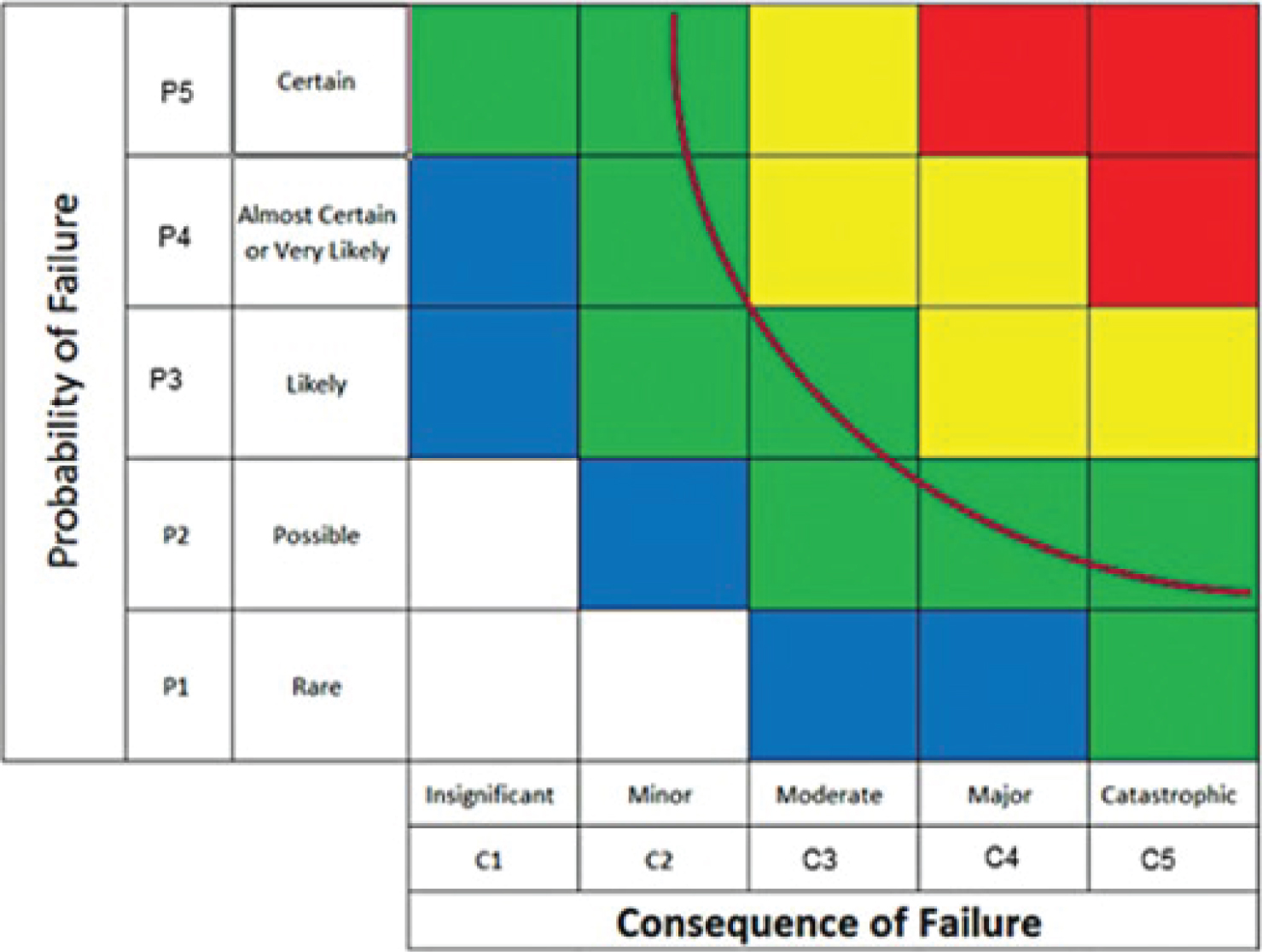
Risk matrices are simple but valuable tools used to guide decision-making when there are known risks to the outcomes.
How to do it: These common tools identify risks and help prioritize decisions on the basis of the level of likelihood and consequences of the risks associated with each decision option through an intuitive visual way. You can map a line representing tolerance of risk level onto the matrix to further clarify decision acceptability.
Scenario Planning
Scenario planning analysis is a strategic means of exploring the impact of different possible futures from changes to key variables. Scenario planning assists decision-makers in recognizing various potential results and consequences, assessing possible reactions, and effectively managing for both favorable and unfavorable possibilities.
How to do it: Identify the set of uncertainties and envision various possible realities that could unfold. Make assumptions about the combinations of variable changes likely to occur together to create a handful of scenarios. Imagine or model how each decision option fares in each scenario.
(continued on next page)
Long Description.
The matrix shows the relationship between the probability of failure (y-axis) and the consequence of failure (x-axis). The probability of failure ranges from P1 at the bottom to P5 at the top, representing rare, possible, likely, almost certain or very likely, and certain, respectively. The consequence of failure ranges from C1 at the left to C5 at the right, representing insignificant, minor, moderate, major, and catastrophic, respectively. The matrix cells are color-coded: Green indicates low risk, blue is low to moderate risk, yellow is moderate to high risk, and red indicates high risk. A curved boundary line separates lower-risk areas (bottom left) from higher-risk areas (top right).
Tools and Frameworks for Risk and Uncertainty (Continued)
Game Theory
Game theory is a branch of mathematics and economics that provides a formal framework for analyzing interactions between multiple decision-makers in competitive or cooperative situations. It can help in strategic planning when the actions and reactions of third-party participants are particularly relevant.
How to do it: Lay out each decision option available to you, and those available for the other actor(s) involved. Create a matrix of each combination of decisions by the different actors and imagine or model the outcome from each combination. Identify which option is optimal for your agency or team and for the other party and which is socially optimal, or best for everyone.
Sensitivity and What-If Analysis
Sensitivity analysis and what-if analysis are techniques for assessing the impact of changing one or more input variables to a scenario or decision outcome. They help in understanding the extent to which each uncertain variable can sway results (i.e., how sensitive the situation is to each).
How to do it: Define a set of inputs to a future scenario or decision. Change each uncertain variable individually. Imagine or quantify how much the outcome of interest changes with each change in uncertain variable.
Robust Decision-Making
Robust decision-making (RDM) is a systematic approach used to make decisions that are resilient and effective under conditions of deep uncertainty. It is a framework for decision-making that aims to identify decisions that perform well across a wide range of possible future scenarios. RDM is particularly useful in long-term planning, infrastructure development, climate change adaptation, resource management, and other complex decision-making contexts.
How to do it: To implement RDM, develop a series of scenarios. Imagine or model how each decision option performs under each scenario and develop a rough ranking or scoring of the options. Average the ranking or score of each decision option across the scenarios. Those options with the highest average performance across all scenarios are considered the most robust.


