Previous Chapter: 15 From Universal Arithmetic to Universal Algebra
Suggested Citation: "Endnotes." John Derbyshire. 2006. Unknown Quantity: A Real and Imaginary History of Algebra. Washington, DC: Joseph Henry Press. doi: 10.17226/11540.

ENDNOTES

Introduction

1.  

Published in 2002 by BarCharts, Inc., of Boca Raton, FL. The author of both is credited as S. B. Kizlik.

2.  

“Invariants,” Duke Mathematical Journal, 5:489–502.

3.  

I shall sometimes use “the 19th century,” as historian John Lukacs does, to refer to the period from 1815 to 1914. Here, however, the ordinary calendrical sense is intended.

4.  

“Mathematical object” means a thing that is of professional interest to mathematicians, which they struggle to understand and develop theorems about. The mathematical objects most familiar to nonmathematicians are (1) numbers and (2) the points, lines, triangles, circles, cubes, etc., that dwell in the two- and three-dimensional spaces of Euclid’s geometry.

5.  

Discovered or invented? My inclination is to take the “Platonic” view that these objects are in the world somewhere, waiting for human ingenuity to discover them. That is the frame of mind in which most mathematics is done by most professional mathematicians most of the time. The point is a nontrivial one, but it is only marginally relative to the history of algebra, so I shall say very little more about it.

Suggested Citation: "Endnotes." John Derbyshire. 2006. Unknown Quantity: A Real and Imaginary History of Algebra. Washington, DC: Joseph Henry Press. doi: 10.17226/11540.

Math Primer: Numbers and Polynomials

6.  

In modern usage, most often includes the number zero. I am philosophically in sympathy with this. If you send me to peer into the next room, count the number of people in the room, and report the answer back to you, “zero” is a possible answer. Therefore zero ought to be included among the counting numbers. However, because my approach in this book is historical, I shall leave zero out of .

7.  

The common proof, first given by Euclid, argues reductio ad absurdum. Suppose the thing is not true. Suppose, that is, that some rational number , with p and q both whole numbers, does indeed have the property that . Assuming we have in its lowest terms (that is, with common factors canceled out top and bottom—a thing that can always be done), either p or q must be an odd number. Since multiplying both sides of the equation by q twice gives p2 = 2q2, and only even numbers have even squares, p must be even, so q must be odd. So p is 2k, for some whole number k. But then p2 = 4k2, so 4k2 = 2q2, so q2 = 2k2, and q must also be even. So q is odd and q is even—an absurdity. The premise, therefore, is false, and there is no rational number whose square is 2. (For a different proof, see Endnote 11 in my book Prime Obsession.)

8.  

Pythagoras’s theorem concerns the lengths of the sides of a plane right-angled triangle. It is a matter of simple observation that the side opposite the right angle must be longer than either of the other two sides. The theorem asserts that the square of its length is equal to the squares of their lengths, added together: c2 = a2 + b2, where a and b are the lengths of the sides forming the right angle and c the length of the side opposite it. Another way to say this, as in Figure NP-4, is .

Chapter 1: Four Thousand Years Ago

9.  

The dating of early Mesopotamian history is still not settled. At the time of this writing, the “middle” chronology is the one most often cited, so that is the one I shall use. Also in play are the low, ultra-low, and high chronologies. An event placed at 2000 BCE in the middle chronology would be dated 2056 BCE in the high chronology, 1936

Suggested Citation: "Endnotes." John Derbyshire. 2006. Unknown Quantity: A Real and Imaginary History of Algebra. Washington, DC: Joseph Henry Press. doi: 10.17226/11540.


BCE in the low, and 1911 BCE in the ultra-low. No doubt friendships are shattered and marriages sundered by these disputes among professional Assyriologists. I have no strong opinion, and precise dates for this period are not important to my narrative. The much earlier dates found in materials written before about 1950 are at any rate now discredited.

10.  

The spelling “Hammurapi” is also common. Older English-language texts use “Khammurabi,” “Ammurapi,” and “Khammuram.” The identification of Hammurabi with the Amraphel of Genesis 14:1 is, however, now out of favor. Abraham’s dates are highly speculative, but no one seems to think he lived as late as Hammurabi’s reign.

11.  

The second is more familiar to the Western tradition. It was by Nebuchadnezzar of the second Babylonian empire that the Jews were dragged off into captivity; Daniel served that same monarch; and the writing on the wall at Belshazzar’s feast presaged the fall of the second Babylon to the Persians. All that was a thousand years later than the time of Hammurabi, though, and is not part of this story.

12.  

Key names here are the Dane Carsten Niebuhr, the German Georg Friedrich Grotefend, and the Englishman Sir Henry Rawlinson. Grotefend, by the way, was from the German state of Hanover and was engaged to the task of deciphering cuneiform by the great Hanoverian university of Göttingen, later famous as a center of mathematical excellence.

13.  

Cuneiform is not actually all that hard to read. The best short guide to cuneiform numeration is in John Conway and Richard Guy’s Book of Numbers.

14.  

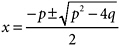
In case it is not familiar: The quadratic equation x2 + px + q = 0 has two solutions, given by taking the ± (“plus or minus”) sign to be either a plus or a minus in the formula

Suggested Citation: "Endnotes." John Derbyshire. 2006. Unknown Quantity: A Real and Imaginary History of Algebra. Washington, DC: Joseph Henry Press. doi: 10.17226/11540.

Chapter 2: The Father of Algebra

15.  

Diophantus wrote his own name as “Diophantos,” in the Greek form. His work became generally known to Europeans in a Latin translation, though, so the Latin form “Diophantus” has stuck.

16.  

So, for example, ψμθ would be 749. The letters used for units can be recycled to show thousands: δψμθ, for example, meaning 4,749. The δ, which normally means 4, is here being used to mean 4,000. To get beyond 9,999, digits were grouped in fours, separated by an M (for “myriad”) or in Diophantus’s notation by a dot. The number δτoβ· , for instance, would be 43,728,907. (That weird-looking letter is one of the obsolete ones, a “san,” here being used to mean 900. Since stands for 7, means 907. Note the absence of any positional zero, since with this method none is needed.)

17.  

The ζ—a “terminal sigma”—had a little cross line at the top when used in this way. I haven’t been able to duplicate this. The Michigan Papyrus dates from the early 2nd century CE, a century or so before the most popularly accepted dates for Diophantus.

Chapter 3: Completion and Reduction

18.  

Of Plotinus, the founder of this theory—another Alexandrian, by the way, and quite likely a contemporary of Diophantus—Bertrand Russell wrote: “Among the men who have been unhappy in a mundane sense, but resolutely determined to find a higher happiness in the world of theory, Plotinus holds a very high place.” Neoplatonists thought very highly of mathematics, as of course did Plato and the original Platonists. Marinus, a later Neoplatonist, remarked: “I wish everything were mathematics.”

19.  

The Jews must have returned, for the Muslim conqueror of the city in 640 CE reported that it contained “forty thousand tributary Jews.”

20.  

“I am ignorant, and the assassins were probably regardless, whether their victim was yet alive,” notes Gibbon (The Decline and Fall of the Roman Empire, Chapter 47). Charles Kingsley, of Water Babies fame, wrote a novel about Hypatia, in which she is still alive when the oyster

Suggested Citation: "Endnotes." John Derbyshire. 2006. Unknown Quantity: A Real and Imaginary History of Algebra. Washington, DC: Joseph Henry Press. doi: 10.17226/11540.


shells are applied. The novel is every bit as melodramatically Victorian as the Charles William Mitchell painting, which was inspired by it.

21.  

Here and in what follows I am using the word “Persian” in a loose way to refer to any of the peoples of present-day Iran and southern Central Asia who speak languages of the Indo-European family, excluding only the Armenians. There is really no satisfactory word here, “Aryan” having unpleasant connotations, “Iranian” belonging properly to a modern nation, not a subset of some language group. Plenty of these peoples would be unhappy to see themselves referred to as “Persians,” and in a different historical context the term would cause confusion, but the poor writer must do his best.

22.  

Heraclius died 50 days later—“of a dropsy,” says Gibbon.

23.  

“Amrou” in Gibbon.

24.  

Monophysites argued that the humanity and divinity of Christ are really just one thing. The opposite heresy—that they are two things—belonged to the Nestorians, who were so thoroughly banished from Christendom they ended up in China. You can see Nestorian crosses in the “forest of steles” in Xi’an city. The orthodox formula, adopted by the Council of Chalcedon in 451 and maintained by all the major Christian churches ever since, is that Christ’s divinity and humanity are one thing and two things at the same time, “two natures without confusion, without change, without division, without separation.”

25.  

The full name translates as “Father of Ja’far, Mohammed, son of Musa, the Khwarizmian.” Khwarizm was an ancient state in what is now Uzbekistan. These Arabic names beginning with “al-” are usually indexed and cataloged under their second part, by the way. Al-Khwarizmi appears in the DSB, for example, among the Ks, not the As.

26.  

The Middle Ages began on Saturday, September 4, 476 CE, when the last emperor of Rome in the West was deposed by Odoacer the Barbarian. They ended on Tuesday, May 29, 1453, with the fall of Constantinople. The precise midpoint of the Middle Ages, if my numbers are right, was therefore at around midnight on Sunday, January 15, in the year 965.

27.  

These two factions of Shiites are sometimes referred to in English as “Twelvers” and “Seveners.” Shiites believe that Ali, the fourth Caliph,

Suggested Citation: "Endnotes." John Derbyshire. 2006. Unknown Quantity: A Real and Imaginary History of Algebra. Washington, DC: Joseph Henry Press. doi: 10.17226/11540.


Mohammed’s cousin and son-in-law, was the first Imam, a spiritual title of enormous authority. Several other Imams followed, the title being passed down from father to son. The line of succession was broken, though, and the split within the Shiites is over whether it was broken after Ismail, the seventh Imam, or Mahdi, the twelfth. The Ismailites are “Seveners.” Most Shiites, nowadays practically all, are “Twelvers.”

28.  

Malik Shah’s names tell us something about the ethnic balance in the Seljuk empire. “Malik” and “Shah” are the Arabic and Persian words for “King.” Malik Shah was actually a Turk, of course. Three ethnies in one person.

29.  

The Assassins were of the Ismailite confession and therefore at odds both with the Sunni rulers of the Seljuk empire and with other Shiites. Practicing a mystical approach to Islam that owed much to older Persian beliefs, they were persecuted by everybody and eventually retreated to a remote mountainous area of northern Iran, whence they carried out their horrible program of political murder. (The Crusaders, who knew them well, called Hasan Sabbah “the Old Man of the Mountains.”) Murder aside, much of what has commonly been said about the Assassins is disputed by historians. There is, for example, no evidence that they fired up their killers with hashish, though they may have used the drug for religious purposes.

30.  

To cast the problem in modern terms: Suppose a sphere of diameter D, standing on a flat horizontal plane, is to have its top sliced off by a parallel horizontal plane at height x, in such a way that the remaining part of the sphere has R percent of the sphere’s original volume. What should x be? The answer is found by solving the following cubic equation:

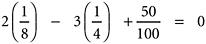
If R is 50 percent, for example, then of course x equal to half of D does the trick (that is, x / D = 1 / 2), since

Suggested Citation: "Endnotes." John Derbyshire. 2006. Unknown Quantity: A Real and Imaginary History of Algebra. Washington, DC: Joseph Henry Press. doi: 10.17226/11540.

31.  

A right-angled triangle with shorts sides 103 and 159 has, by Pythagoras’s theorem (Endnote 8), a hypotenuse of length , which is 189.44656238655…. The length of the perpendicular is 86.44654088049 …, so that if you add 103 to that, you do indeed get the hypotenuse, very nearly.

Math Primer: Cubic and Quartic Equations

32.  

Note that I assume the coefficient of x3 is 1. There is no loss of generality in assuming this. A more general form would be ax3 + bx2 + cx + d = 0. Either a is zero, however, or it isn’t. If it’s zero, the equation isn’t cubic; and if it’s not, I can divide right through by it, reducing the coefficient of x3 to 1.

33.  

You more often hear “reduced cubic” in our prosaic age. I prefer the older term.

34.  

An extremely confusing nomenclature, best restricted to this historical context. In the more general theory of equations, an irreducible equation is one that cannot be factored without enlarging your number field—going to a new “Russian doll.” (See §FT.5 for more on this.) The cubic equation x3 − 7x + 6 = 0 yields q3 + 4p3 / 27 equal to −400 / 27, so this is an “irreducible case.” Yet x3 − 7x + 6 factorizes very nicely, to (x − 1) (x − 2) (x − 3), so it is not irreducible in the proper sense. It is only that intermediate quadratic that is irreducible. Grrrr.

Chapter 4: Commerce and Competition

35.  

To prove this, call the nth term of the Fibonacci sequence un. So u1 is 1, u2 is also 1, u3 is 2, u4 is 3, and so on. Now construct this polynomial using the Fibonacci numbers as coefficients:

Multiply both sides through by x to get xS. Repeat to get x2S. Subtract S and xS from x2S. You will see that, precisely because of the property of the Fibonacci sequence, most of the terms on the right-hand side dis-

Suggested Citation: "Endnotes." John Derbyshire. 2006. Unknown Quantity: A Real and Imaginary History of Algebra. Washington, DC: Joseph Henry Press. doi: 10.17226/11540.


appear. The term in xn−6, for example, will have coefficient 21 − 13 − 8, which is zero. You are left with

Setting x equal to each of the two roots of x2x − 1 = 0 in turn eliminates S, giving you a pair of simultaneous equations in two unknowns, un and un−1. Eliminate un−1 and the result follows.

36.  

The binomial theorem gives a formula for expanding (a + b)N. In the particular case N = 4, it tells us that (a + b)4 = a4 + 4a3b + 6a2b2 + 4ab3 + b4, and that’s what I used here.

37.  

Not, as often written, Liber abaci, at any rate according to Kurt Vogel’s DSB article on Fibonacci, to which I refer argumentative readers. The title translates as “The Book of Computation,” not “The Book of the Abacus.” As with the names of operas, the titles of books in Italian do not need to have every word capitalized.

38.  

He was born, in other words, within a year or two of the famous Leaning Tower, construction on which began in 1173, though it was not finished for 180 years. The lean became obvious almost at once, when the third story was reached.

39.  

Nowadays the town of Bejaïa (written “Bougie” in French) in Algeria, about 120 miles east of Algiers.

40.  

Flos is Latin for “flower,” in the extended sense “the very best work of….”

41.  

The scholar-statesman Michael Psellus, who served Byzantine emperors through the third quarter of the 11th century—he was prime minister under Michael VII (1071–1078)—certainly knew of Diophantus’s literal symbolism.

42.  

Full title Summa de arithmetica, geometria, proportioni et proportionalita—“A Summary of Arithmetic, Geometry, Proportions, and Proportionalities.” Note, by the way, that we have now passed into the era of printed books in Europe. Pacioli’s, printed in Venice, was one of the first printed math books.

43.  

A later book of Pacioli’s enjoyed the highly enviable distinction of having Leonardo da Vinci for its illustrator. Da Vinci and Pacioli were close friends. See Endnote 123 for another distinction of this sort. Yet an-

Suggested Citation: "Endnotes." John Derbyshire. 2006. Unknown Quantity: A Real and Imaginary History of Algebra. Washington, DC: Joseph Henry Press. doi: 10.17226/11540.


other of Pacioli’s claims to fame is that of having coined the word “million.”

44.  

The Italians had just spelled out “plus” and “minus” as piu and meno, respectively; though, like the powers of the unknown, these had increasingly been abbreviated, usually to “p.” and “m.”

45.  

The German algebraists of the 15th and 16th centuries were in fact called Cossists, and algebra “the Cossick art.” The English mathematician Robert Recorde published a book in 1557 titled The Whetstone of Witte, which is the second part of Arithmeticke, containing the Extraction of Roots, the Cossike Practice, with the Rules of Equation. This was the first printed work to use the modern equals sign.

46.  

This book was not published in Cardano’s lifetime. There is a translation of it included as an appendix to Oystein Ore’s biography of Cardano mentioned below (Endnote 48).

47.  

Charles V is the ghostly monk in Verdi’s opera Don Carlos. The title Holy Roman Emperor was elective, by the way. To secure it, Charles spent nearly a million ducats in bribes to the electors. He was the last emperor to be crowned by a pope (in Bologna, February 1530). Most of his contemporaries regarded him as king of Spain (the first such to have the name Charles and therefore sometimes confusingly referred to as Charles I of Spain), though he had been raised in Flanders and spoke Spanish poorly.

48.  

Oystein Ore, Cardano, the Gambling Scholar (1953). Ore’s is, by the way, the most readable book-length account of Cardano I have seen, though unfortunately long out of print. For a very detailed account of Cardano’s astrology, see Anthony Grafton’s Cardano’s Cosmos (1999). There are numerous other books about Cardano, including at least three other biographies.

49.  

They are given in detail in Ore’s book. Ore gives over 55 pages to the Cardano–Tartaglia affair, which I have condensed here into a few paragraphs. It is well worth reading in full. For another full account, though with facts and dates varying slightly from Ore’s (whose I have used here), see Martin A. Nordgaard’s “Sidelights on the Cardan-Tartaglia Controversy, in National Mathematics Magazine 13 (1937–1938): 327–346, reprinted by the Mathematical Association of America in their

Suggested Citation: "Endnotes." John Derbyshire. 2006. Unknown Quantity: A Real and Imaginary History of Algebra. Washington, DC: Joseph Henry Press. doi: 10.17226/11540.


2004 book Sherlock Holmes in Babylon, M. Anderson, V. Katz, and R. Wilson, Eds.

Chapter 5: Relief for the Imagination

50.  

English-speaking mathematicians generally pronounce Viète’s name “Vee-et,” the more stubbornly anglophone tending toward the name of a well-known vegetable-juice drink. The name is sometimes written in the Latinized form “Vieta.”

51.  

Commonly but not altogether accurately. The Huguenots were Calvinists. Not all French Protestants were, and there must have been many who would not have thanked you for referring to them as Huguenots. The name has stuck, though, and for passing reference in a book of this kind, “Huguenot” can be taken as a synonym for “early French Protestant.” The etymology of the word is obscure.

52.  

Though the English, for once, were on good diplomatic terms with France all through this period, the blizzard of anti-French jokes and insults in Shakespeare’s Henry VI Part I (1592) notwithstanding.

53.  

“All of Viète’s mathematical investigations are clearly connected to his astronomical and cosmological work”—H. L. L. Busard in the DSB. The astronomy-trigonometry connection comes from dealing with the celestial sphere, computing and predicting the altitudes of stars, and so on.

54.  

Which was very horrible. Harriot got a cancer in his nose, perhaps from the new habit of smoking tobacco he had picked up in Virginia, and his face was gradually eaten away over the last eight years of his life.

Chapter 6: The Lion’s Claw

55.  

In the old calendar, which was scrapped in 1752. According to the calendar we currently use, his birth date was January 4, 1643. This is why the date is sometimes given as the one year, sometimes as the other.

56.  

A review of Patricia Fara’s book Newton: The Making of Genius, in The New Criterion, May 2003. In saying that Newton had “no interest in public affairs,” I was referring to the momentous political events of his

Suggested Citation: "Endnotes." John Derbyshire. 2006. Unknown Quantity: A Real and Imaginary History of Algebra. Washington, DC: Joseph Henry Press. doi: 10.17226/11540.


time. He was master of the Royal Mint from 1696 onward, carrying out his duties diligently and imaginatively. He was also active in the Royal Society, of which he was elected and reelected president every year from 1703 until his death. And, he stood up courageously for his university against the sectarian bullying of King James II. For all that, I seriously doubt Newton ever spent five minutes together thinking about politics, about national or international affairs.

57.  

Or “Sir Isaac,” if you like. He was knighted by Queen Anne in 1705, the first scientist ever to be so honored. In all strictness he should be referred to as “Newton” for his deeds before that date, “Sir Isaac” afterward. Nobody can be bothered to be so punctilious, though, and I am not going to be the one to set a precedent.

58.  

Neither the Latin original nor the English translation can easily be found. The text of the book, however, is included in volume 2 of The Mathematical Papers of Isaac Newton (D. T. Whiteside, ed., 1967).

59.  

I especially recommend Michael Artin’s textbook Algebra, pp. 527–530 in my edition (1991), which does the whole thing as clearly as it can be done.

60.  

As Gauss, and later Kronecker, pointed out, there are some deep philosophical issues involved here. For a thorough discussion, see Harold Edwards’s book Galois Theory, §§49–61.

Math Primer: Roots of Unity

61.  

The word “cyclotomic” seems to have been first used in this context by J. J. Sylvester in 1879.

62.  

“Primitive nth root of unity” should not be confused with the number-theory term of art “primitive root of a prime number.” A number g is a primitive root of a prime number p if g, g2, g3, g4, …, gp−1, when you take their remainders after division by p, are 1, 2, 3, …, p−1, in some order. For example, 8 is a primitive root of 11. If you take the powers of 8, from the first to the 10th, you get 8, 64, 512, 4096, 32768, 262144, 2097152, 16777216, 134217728, and 1073741824. Taking remainders after division by 11:8, 9, 6, 4, 10, 3, 2, 5, 7, and 1. So 8 is a primitive root of 11. On the other hand, 3 is not a primitive root of 11. The first 10

Suggested Citation: "Endnotes." John Derbyshire. 2006. Unknown Quantity: A Real and Imaginary History of Algebra. Washington, DC: Joseph Henry Press. doi: 10.17226/11540.


powers of 3 are 3, 9, 27, 81, 243, 729, 2187, 6561, 19683, and 59049. Dividing by 11 and taking remainders: 3, 9, 5, 4, 1, 3, 9, 5, 4, and 1. Not a primitive root. This concept of primitive root is in fact related to the one in my main text, but it is not the same. Since 11 is a prime number, every 11th root of unity is a primitive 11th root of unity, but the primitive roots of 11 in a number-theoretic sense are only 2, 6, 7, and 8.

     Incidentally, I can now explain that “more restricted sense” of the term “cyclotomic equation.” It is the equation whose solutions are all the primitive nth roots of unity. So in the case n = 6, it would be the equation (x + ω)(x + ω2) = 0, that being the equation with solutions x = −ω and x = −ω2. This equation multiplies out as x2x + 1 = 0.

Chapter 7: The Assault on the Quintic

63.  

William Dunham’s book Euler, The Master of Us All (1999) manages to do justice to both the man and his mathematics.

64.  

More properly, the Académie des Sciences, founded in Paris in 1666 by Jean-Baptiste Colbert, part of the great awakening of European science in the late 17th century. Compare Britain’s Royal Society, 1660. The Académie used to meet in the Louvre.

65.  

Galois Theory, p. 19.

66.  

Lagrange is one of the greats, with index score 30 in Charles Murray’s scoring (Human Accomplishment, 2003). Euler leads the field with an index score of 100. Newton has 89, Euclid 83, Gauss 81, Cauchy 34. Poor Vandermonde has index score only 1, and that is probably on account of “his” determinant.

67.  

I am simplifying here to the point of falsehood. Instead of “polynomial,” I should really say “rational function.” I’m going to explain that when I get to field theory, though. “Polynomial” will do for the time being.

68.  

Either J. J. O’Connor or E. F. Robertson, joint authors of the article on Ruffini at the indispensable math Web site of the University of St. Andrews in Scotland, www-groups.dcs.st-andrews.ac.uk/~history/index.html.

Suggested Citation: "Endnotes." John Derbyshire. 2006. Unknown Quantity: A Real and Imaginary History of Algebra. Washington, DC: Joseph Henry Press. doi: 10.17226/11540.

69.  

Ruffini was a licensed medical practitioner as well as a mathematician. This fact gives me an excuse to mention another 18th-century algebraist with this same dual qualification, though from the generation before Ruffini. This was the Englishman Edward Waring (1736–1798). Waring took up Isaac Newton’s chair as Lucasian Professor of Mathematics at Cambridge University in 1760. Seven years later, while still holding the chair, he graduated with an M.D. degree He seems not to have practiced medicine much, though. His 1762 book Miscellanea analytica gave a treatment of the relations between symmetric functions of an equation’s solutions, and the equation’s coefficients—the topic I covered in relation to Isaac Newton’s jottings. (The second edition of Waring’s book is confusingly called Meditationes algebraicae.) While I am filling in like this, I may as well note the achievement of Swedish mathematician Erland Bring, who in 1786 figured out that any quintic equation can be reduced to one with no second, third, or fourth power of the unknown, in other words to one like this: x5 + px + q = 0. I should like to call this a “severely depressed quintic.”

70.  

It seems that Cauchy actually believed in the medieval theory of the Divine Right of Kings, often mistakenly thought of as a Protestant doctrine but in fact going back to medieval times and popular in 17th-century France. If this is right, Cauchy must have been the last person of any intellectual eminence to adhere to this theory.

71.  

I have taken this from Peter Pesic’s fine short book Abel’s Proof (2003). E. T. Bell, however, gives the number of Abel children as seven. Bell’s chapter on Abel in Men of Mathematics, by the way, is worth reading just as a piece of 1930s Americana. It is Bell at his best—or, depending on your tolerance for writers chewing the scenery, his worst.

72.  

The spelling was later changed to conform to a more authentically Norwegian orthography: Kristiania.

73.  

You don’t even have to be a mathematician. After the publication of my book about the Riemann hypothesis, I got a steady trickle of letters and e-mails from people claiming to have resolved that very profound mystery. Wishing neither to scrutinize their work nor to appear unkind, I developed a stock response along the following lines: “I am not a working mathematician, only a writer with a math degree. The fact of my having written a book about the Riemann hypothesis does not

Suggested Citation: "Endnotes." John Derbyshire. 2006. Unknown Quantity: A Real and Imaginary History of Algebra. Washington, DC: Joseph Henry Press. doi: 10.17226/11540.


qualify me to pass judgment on work in this area. I once wrote a book about opera, but I cannot sing. I suggest you get in touch with the math department at your local university.”

74.  

A detailed proof takes us deeper than I want to go in this text. I refer curious readers to Peter Pesic’s book Abel’s Proof, which does the thing in as elementary a way as it can be done, I think, and at three different levels: an overview (more detailed than mine), Abel’s actual 1824 paper, and some explanation of missing logic steps in the paper. Van der Waerden’s History of Algebra also gives a neat 2 1/2-page summary, though at a higher level.

Chapter 8: The Leap into the Fourth Dimension

75.  

A great favorite of mine, Dewdney’s book is a wonder and well worth reading as an imaginative exercise. How, for example, does a two-dimensional creature lock his door? And if he has an alimentary canal running through him from one end to the other, what prevents him from falling into two separate pieces?

76.  

This story can be found in Mathenauts, a 1987 anthology of math-related science fiction stories edited by Rucker himself. Of the 23 stories in this collection, more than half make some play on the idea of a fourth dimension—about average for mathematical science fiction, in my experience.

77.  

No conscientious novelist of the 1990s thought his book was complete unless it included a reference to Heisenberg’s uncertainty principle, which Heisenberg first stated in 1927.

78.  

There is a large literature on Hamilton, including at least three full-scale biographies. I have depended mainly on the 1980 biography by Thomas Hankins, supplemented by some references in mathematical magazines, textbooks, and Web sites.

79.  

Claims like this seem to have been common in early 19th-century England and America. The writer George Borrow (The Bible in Spain, Lavengro), born two years before Hamilton, is likewise supposed to have been the master of numerous languages—Dr. Ann Ridler, who has made a study of Borrow’s linguistic skills, lists him as having pos-

Suggested Citation: "Endnotes." John Derbyshire. 2006. Unknown Quantity: A Real and Imaginary History of Algebra. Washington, DC: Joseph Henry Press. doi: 10.17226/11540.


sessed reading competence in 51 languages and dialects. Dr. Ridler also, in this context, mentions the American writer John Neal, born 1793, author of Brother Jonathan, who claimed that: “In the course of two or three years [I] made myself pretty well acquainted with French, Spanish, Italian, Portuguese, German, Swedish, Danish, beside overhauling the Hebrew, Latin, Greek, and Saxon …” The poet Longfellow, born a year and a half after Hamilton, was appointed professor of modern languages at Bowdoin when only 19 years old, provided he actually master some modern languages. He promptly taught himself French, Spanish, Italian, and German to a good degree of reading competency—we have independent confirmations of this—in 9, 9, 12, and 6 months, respectively, between 1826 and 1829. Writing as a person who, in spite of valiant personal struggles and the dogged efforts of several excellent teachers, has failed to master even one foreign language, I am baffled by all this. Perhaps there was something in the water back then.

80.  

It is natural to wonder whether Catherine was related to Walt Disney. Perhaps she was, but I have not been able to find any connection. It is an old family (originally Norman French “D’Isigney”) with a large Irish branch. Walt descended from Arundel Elias Disney, born in Ireland about 1803. The story that Walt was an illegitimate child of Spanish parentage, adopted into the Disneys, is an urban legend.

81.  

In what is now the drab Dublin Industrial Estate, about three miles northwest of the city center.

82.  

We now know that Gauss had conceived of a noncommutative algebra as far back as 1820 but had not bothered to publish his thoughts. You had to get up very early in the morning to be up before Gauss.

83.  

Octonions were independently discovered by Cayley in 1845, and are sometimes called Cayley numbers.

84.  

Well, is it? Not in any simply geometrical sense. There is no “fourth direction” in which, by a supreme effort of will and imagination, you might move yourself, thereby leaving our three-dimensional world. If you did so, you would be destroyed at once, because even the simplest physical laws—the inverse square law, for instance—lead to very unpleasant consequences if you try to embed them in a four-dimensional Euclidean geometry. It is of course true that the space–time of modern

Suggested Citation: "Endnotes." John Derbyshire. 2006. Unknown Quantity: A Real and Imaginary History of Algebra. Washington, DC: Joseph Henry Press. doi: 10.17226/11540.


physics is conveniently described by a four-dimensional geometry, but that geometry is radically non-Euclidean, so you should banish from your mind any thought of taking an ordinary Euclidean trip through it. The human imagination is a very mysterious thing, though. The late H. S. M. Coxeter, in his book Regular Polytopes, notes of his friend John Flinders Petrie that: “In periods of intense concentration he could answer questions about complicated four-dimensional figures by ‘visualizing’ them.”

85.  

There is a counter-argument to be made in respect of continental Europe, where “lines of force” arguments of the kind favored by Faraday were less popular than the older “action at a distance” ideas. Still, reading the mathematics of the time, including the German mathematics, you can see that ideas about directional flows on surfaces and in space are just below the surface of the writers’ minds.

86.  

Quaternions have some minor application in quantum theory. I quote from some notes passed on to me by a helpful physicist friend: “Interestingly, if one formulates the rotation kinematics in terms of quaternions, the resultant 7 × 7 covariance matrix (the solution of the Riccati equation) is singular, because of the linear dependence of the 4-parameter Euler symmetric parameters.” Just so. Conway and Smith’s 2002 book, On Quaternions and Octonions, offers a very comprehensive coverage of Hamilton’s brainchild, but the math is at a high level. Professor Andrew J. Hanson of Indiana University has a book titled Visualizing Quaternions coming out at about the same time as Unknown Quantity, early in 2006. I have not seen this book but it promises a full account of, among many other things, the application of quaternions to computer animation.

Chapter 9: An Oblong Arrangement of Terms

87.  

The regions of the modern People’s Republic not included under Han rule were the southern and southeastern strip of provinces from Fujian to Yunnan; the two outer provinces of Manchuria; and all the western and northwestern territories acquired during the modern period, with non-Chinese (Turkic, Tibetan, Mongolian) base populations.

Suggested Citation: "Endnotes." John Derbyshire. 2006. Unknown Quantity: A Real and Imaginary History of Algebra. Washington, DC: Joseph Henry Press. doi: 10.17226/11540.

88.  

That is one reason the ancient Chinese written language has such a severely abbreviated style. The classical texts were not so much narrative as mnemonic. Shen zhong zhui yuan, Confucius tells us (Analects, 1.ix). James Legge translates this as: “Let there be a careful attention to perform the funeral rites to parents, and let them be followed when long gone with the ceremonies of sacrifice.” That’s four Chinese syllables to 39 English ones.

89.  

This calendar was the work of Luoxia Hong, who lived about 130–70 BCE.

90.  

George MacDonald Ross, Leibniz (Oxford University Press, 1984).

91.  

Bernoulli numbers turn up when you try to get formulas for the sums of whole-number powers, like 15 + 25 + 35 + … + n5. The precise way they turn up would take too long to explain here; there is a good discussion in Conway and Guy’s Book of Numbers. The first few Bernoulli numbers, starting with B0, are: 1, , , 0, , 0, , 0, (yes, again), 0, , 0, , 0, , 0, , 0, , …. Notice that all the odd-numbered Bernoulli numbers after B1 are zero. Bernoulli numbers make another brief appearance in Chapter 12.

92.  

More observations give you better accuracy. Furthermore, the planets are perturbed out of their ideal second-degree curves by each other’s gravitational influence. This accounts for Gauss using six observations on Pallas. Did Gauss know Cramer’s rule? Certainly, but for these ad hoc calculations, the less general elimination method was perfectly adequate.

93.  

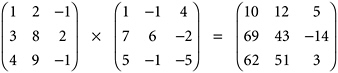
As an undergraduate I was taught to think of this as “diving rows into columns.” To calculate the element located where the mth row of the product matrix meets the nth column, you take the mth row of the first matrix, “tip” it through 90 degrees clockwise, then drop it down alongside the nth column of the second matrix. Multiplying matched-off pairs of numbers and adding up the products gives you the element. Here, for example, is a matrix product, written with proper matrix notation:
Suggested Citation: "Endnotes." John Derbyshire. 2006. Unknown Quantity: A Real and Imaginary History of Algebra. Washington, DC: Joseph Henry Press. doi: 10.17226/11540.


To get that −14 in the second row, third column of the answer, I took the second row from the first matrix (3, 8, 2), then the third column from the second matrix (4, −2, −5), then “dived” the row into the column to calculate 3 × 4 + 8 × (−2) + 2 × (−5) = −14. That’s all there is to matrix multiplication. You might want to try multiplying the two matrices in the other order to confirm that matrix multiplication is not, in general, commutative. To start you off: diving the first row of the second matrix into the first column of the first: 1 × 1 + (−1) × 3 + 4 × 4 = 14, so the top left number in the product matrix will be 14, not 10.

94.  

A matrix need not be square. If you think about that rule of multiplication—a row from the first matrix combining with a column from the second—you can see that as long as the number of columns in the first matrix is equal to the number of rows in the second, the multiplication can work. In fact, a matrix with m rows and n columns can multiply a matrix with n rows and p columns; the product will be a matrix with m rows and p columns. A very common case has p = 1. Any decent undergraduate textbook of modern algebra will clarify the issue. As always, I recommend Michael Artin’s Algebra. Frank Ayres, Jr.’s book Matrices, in the Schaum’s Outline Series, is also very good.

Chapter 10: Victoria’s Brumous Isles

95.  

See Endnote 56.

96.  

Commenting on a different drinking song on a similar theme in his Budget of Paradoxes, De Morgan notes that “in 1800 a compliment to Newton without a fling at Descartes would have been held a lopsided structure.”

97.  

And British affection for it lingered, at least in school textbooks. At a good British boys’ school in the early 1960s, I learned physics and applied mathematics with the Newtonian dot notation.

98.  

The Scot I quoted, Duncan Gregory, only committed himself to mathematics at about the time of that remark and died less than four years later. He was a major influence on Boole, though. In fact, I lifted that Duncan quote not from its original publication (Transactions of the

Suggested Citation: "Endnotes." John Derbyshire. 2006. Unknown Quantity: A Real and Imaginary History of Algebra. Washington, DC: Joseph Henry Press. doi: 10.17226/11540.


Royal Society of Edinburgh, 14:208−216) but from a paper (“On a General Method in Analysis”) that Boole presented to the Royal Society in 1844.

99.  

Not to mention the income tax, which had been brought in as an emergency revenue source during the wars against Napoleon. The wars being over, the reformer Henry Brougham persuaded Parliament that the tax was no longer necessary, and it was duly abolished in 1816, to the horror of the government but to general rejoicing among the people.

100.  

“This place [the University of London] was founded by Jews and Welshmen,” I was told when I first showed up on its doorstep. In fact, James Mill, Thomas Campbell, and Henry Brougham, the moving spirits behind the university’s founding, were all Scottish. Financing for the project, however, was raised from the merchant classes of the city, who were indeed largely Methodists and Jews.

101.  

Two closely related functions, in fact. They are solutions of the ordinary differential equation

and show up in several branches of physics.

102.  

You need to be born in a year numbered N2N to share this distinction. De Morgan was born in 1806 (N = 43). Subsequent lucky birth years are 1892, 1980, and 2070.

103.  

By Jevons, for example. See the article on De Morgan in the 1911 Britannica.

104.  

Which is to say the year of onset of the great and terrible potato famine. I do not believe the words “sensitive” or “intelligent” have ever been truthfully applied to any British government policy on Ireland. In establishing these new colleges, however, it must be said that the British were at least trying. In Ireland, even more than England, there was a clamor for nondenominational universities, open to anyone. The new colleges were a response to that clamor.

105.  

During the 1930s—when she was in her 70s—Alicia worked with the great geometer H. S. M. Coxeter (1907–2002). Coxeter has a long note on her in his book Regular Polytopes: “Her father … died when she was four years old, so her mathematical ability was purely hereditary….

Suggested Citation: "Endnotes." John Derbyshire. 2006. Unknown Quantity: A Real and Imaginary History of Algebra. Washington, DC: Joseph Henry Press. doi: 10.17226/11540.


There was no possibility of education in the ordinary sense, but Mrs. Boole’s friendship with [mystic, physician, eccentric, and social radical] James Hinton attracted to the house a continual stream of social crusaders and cranks. It was during those years that Hinton’s son Howard brought a lot of small wooden cubes, and set the youngest three [Boole] girls the task of memorizing the arbitrary list of Latin words by which he named them, and piling them into shapes. [This] inspired Alice [sic] (at the age of about eighteen) to an extraordinarily intimate grasp of four-dimensional geometry….” That Howard, by the way—full name Charles Howard Hinton—was the author of some speculations on the fourth dimension that may have helped inspire Abbott’s Flatland.

Math Primer: Field Theory

106.  

Not that there aren’t deep and difficult results in field theory, but they don’t lend themselves to directly algebraic methods so easily as group problems do and are usually tackled via algebraic geometry. Unfortunately, the term “field theory” has two utterly different meanings in math. It may mean what it means here: the study of that algebraic object called a “field.” Or it may refer to the study of spaces at each point of which some quantity—a scalar, a vector, or something even more exotic—is defined. If I say “electromagnetic field theory,” you will see what I mean.

107.  

In fact, some textbook authors—Michael Artin is an example—prefer to write the elements of this field not as 0, 1, and 2 but instead as 0, 1, and −1. The arithmetic is then not quite so counterintuitive: Instead of 1 + 2 = 0 you have 1 + (−1) = 0. You are still stuck with (−1) + (−1) = 1, though.

108.  

It is also one much improved with hindsight—a modern treatment, in fact. Galois’s original 1830 memoir—it is reproduced as an appendix in Professor Edwards’s book Galois Theory—does not employ the word “field.” The word did not gain its algebraic sense until 1879, when Richard Dedekind first used it. My example, by the way, shows that F9 can be constructed by appending the solution of an irreducible

Suggested Citation: "Endnotes." John Derbyshire. 2006. Unknown Quantity: A Real and Imaginary History of Algebra. Washington, DC: Joseph Henry Press. doi: 10.17226/11540.


quadratic equation to F3 This is a particular case of a general theorem: If q = pn, Fq can be constructed by appending to Fp some solution of an irreducible equation of the nth degree.

Chapter 11: Pistols at Dawn

109.  

The Web site is dilip.chem.wfu.edu/Rothman/galois.html

110.  

Journal de Mathématiques Pures et Appliquées, though called Journal de Liouville in its early years. Founded in 1836 and still going strong, it boasts itself “the second oldest mathematical journal in the world”—the oldest being Crelle’s, started in 1826.

111.  

Somehow I have forgotten to mention that commutative groups are now called Abelian, in honor of a theorem of Abel’s. Hence the hoary old mathematical joke: “Q—What is purple and commutes? A—An Abelian grape.” It is also customary, when dealing with Abelian groups, to represent the group operation by addition, instead of by the more usual multiplication. The identity element for an Abelian group is therefore often represented by 0 (because 0 + a = a for all a), and the inverse of an element a is written as −a. I shall ignore all this in what follows, to keep things simple.

112.  

Richard Dedekind gave some lectures on Galois theory at Göttingen in the later 1850s.

113.  

More precisely, D3 and S3 are both instances of the same abstract group. The one and only abstract group of order 2, illustrated by my Figure FT-3, has not only D2 and S2 as instances but also C2. Strictly speaking, all such notations as D3, S3, and C2 name particular instances of abstract groups, and we should eschew phrases like “the group S3” in favor of “the group of which S3 is the most familiar instance,” but noone can be bothered to speak that strictly.

114.  

I shall not cover it in any more detail. For a very full and lucid account, see Keith Devlin’s 1999 book, Mathematics, The New Golden Age. For a look at the final tally, though presented at a high level, see The Atlas of Finite Groups by J. H. Conway et al., published by the Clarendon Press, Oxford (1985).

Suggested Citation: "Endnotes." John Derbyshire. 2006. Unknown Quantity: A Real and Imaginary History of Algebra. Washington, DC: Joseph Henry Press. doi: 10.17226/11540.

Chapter 12: Lady of the Rings

115.  

This resemblance between integers and polynomials was first noticed, or at any rate first remarked on, by the Dutch algebraist Simon Stevin around 1585. Stevin, by the way—I am sorry I have not found room for him in my main text—was a great propagandist for decimals and did much to make them known in Europe. His book on the subject inspired Thomas Jefferson to propose a decimal currency for the newborn United States, and it is to him (indirectly) that we owe the word “dime.”

116.  

Howls of outrage from professional algebraists here. Yes, I am oversimplifying, though only by a little. In fact, the algebraic notion of a ring is somewhat broader than is implied by the examples I have given. A ring need not, for instance, have a multiplicative identity—that is, a “one”—which both and the polynomial ring have. And while addition must be commutative, multiplication need not be. This is not a textbook, though; I just want to get the general idea across.

117.  

As an example of the counterintuitive surprises that ring theory throws up, note that in the ring of numbers having the form , where a and b are ordinary integers, the number is a unit. It divides into 1 exactly in this ring. Try it.

118.  

There is no easy way to define regular primes. The least difficult way is as follows. A prime p is regular if it divides exactly into none of the numerators of the Bernoulli numbers B10, B12, B14, B16, …, Bp−3. (I have notes on the Bernoulli numbers in §9.3 and Endnote 91.) For example: Is 19 a regular prime? Only if it does not divide into any of the numerators of the numbers B10, B12, B14, and B16. Those numerators are 5, 691, 7, and 3617, and 19 indeed does not divide into any of them. Therefore 19 is a regular prime. The first irregular prime is 37, which divides exactly into the numerator of B32, that numerator being 7,709,321,041,217.

119.  

At the time of this writing (April 2005), there has just been an anti-Japanese riot in Beijing, over similar indignities inflicted on China by Japan 60 years ago.

120.  

The town is now in western Poland and renamed Zary. Similarly, Breslau is now the city of Wrocslaw in Poland. The entire German-Polish border was shifted westward after World War II.

Suggested Citation: "Endnotes." John Derbyshire. 2006. Unknown Quantity: A Real and Imaginary History of Algebra. Washington, DC: Joseph Henry Press. doi: 10.17226/11540.

121.  

With a dusting of good old Teutonic romanticism. “Poets are we” (Kronecker). “A mathematician who does not at the same time have some of the poet in him, will never be a mathematician” (Weierstrass)—und so weiter.

122.  

Proof. Suppose this is not so. Suppose there is some integer k that is not equal to 15m + 22n for any integers m and n whatsoever. Rewrite 15m + 22n as 15m +(15 + 7)n, which is to say as 15(m + n) + 7n. Then k can’t be represented that way either—as 15 of something plus 7 of something. But look what I did: I replaced the original pair (15 and 22) with a new pair (the lesser of the original pair and the difference of the original pair: 15 and 7). Plainly I can keep doing that in a “method of descent” until I bump up against something solid. It is a matter of elementary arithmetic, proved by Euclid, that if I do so, the pair I shall eventually arrive at is the pair (d, 0), where d is the greatest common divisor of my original two numbers. The g.c.d. of 15 and 22 is 1, so my argument ends up by asserting that k cannot be equal to 1 × m + 0 × n, for any m and n whatsoever. That is nonsense, of course: k = 1 × k + 0 × 0. The result follows from reductio ad absurdum.

123.  

I have depended on the biography by J. Hannak, Emanuel Lasker: The Life of a Chess Master (1959), which I have been told is definitive. My copy—it is Heinrich Fraenkel’s 1959 translation—includes a foreword by Albert Einstein. That is almost as enviable as having Leonardo da Vinci as your book’s illustrator (see Endnote 43).

124.  

There is a Penguin Classics translation by Douglas Parmée. Rainer Werner Fassbinder made a very atmospheric movie version in 1974, with Hanna Schygulla as Effi and Wolfgang Schenck as her husband, Baron von Instetten.

125.  

Aber meine Herren, wir sind doch in einer Universität und nicht in einer Badeanstalt. You can’t help but like Hilbert. The standard English-language biography of him is by Constance Reid (1970).

126.  

To a modern algebraist, “commutative” and “noncommutative” name two different flavors of algebra, leading to different kinds of applications. I can’t hope to transmit this difference of flavor in an outline history of this kind, so I am not going to dwell on the commutative/noncommutative split any more than necessary to get across basic concepts.

Suggested Citation: "Endnotes." John Derbyshire. 2006. Unknown Quantity: A Real and Imaginary History of Algebra. Washington, DC: Joseph Henry Press. doi: 10.17226/11540.

127.  

Though for reasons I do not know it was published as a letter to the editor: “The Late Emmy Noether,” New York Times, May 5, 1935.

Math Primer: Algebraic Geometry

128.  

The words “ellipse,” “parabola,” and “hyperbola” were all given to us by Appollonius.

129.  

Points at infinity were actually introduced into math by the astronomer Johannes Kepler around 1610, though the concept must have occurred to the painters of the Renaissance when they solved the problem of perspective. Kepler conceived of a straight line as being a circle whose center happened to be at infinity, a notion he probably acquired from his work with optics, where it occurs quite naturally.

130.  

Actually, not all authors follow this usage. Miles Reid, for example, in his otherwise excellent book Undergraduate Algebraic Geometry (London Mathematical Society Student Texts #12, Cambridge University Press, 1988), writes the general inhomogeneous quadratic polynomial as ax2 + bxy + cy2 + dx + ey + f .

131.  

The University of Minnesota’s Geometry Center sells a video, Outside In, demonstrating one of the 20th century’s most fascinating discoveries in topology: how to turn a sphere inside out. There is a brief animation on the Internet, but if you want to learn a little topology, I recommend buying the entire video. For a time I used to bring it out and play it to dinner guests as a conversation piece, but this was not an unqualified social success.

132.  

What it gets you is a Riemann sphere, a useful aid in thinking about functions of a complex variable, which acknowledge only one point at infinity.

Chapter 13: Geometry Makes a Comeback

133.  

Kant’s ideas were the ultimate source of the analytic/synthetic dichotomy in geometry. Kant distinguished between analytic facts, whose truth can be demonstrated by pure logic, without any reference to the outside world, and synthetic facts, which are known by some other

Suggested Citation: "Endnotes." John Derbyshire. 2006. Unknown Quantity: A Real and Imaginary History of Algebra. Washington, DC: Joseph Henry Press. doi: 10.17226/11540.


means. Up to Kant, philosophers had assumed that the “other means” meant actual experience of our interacting with the world. Kant, however, denied this. In his metaphysics, there are truths that are not analytic yet are independent of experience. He thought that the facts of Euclidean geometry were of this kind—synthetic yet not derived from experience. Hence the connection between classical Greek math and the “synthetic” geometry of the early 19th century, though I have omitted several intermediate steps in the connection.

134.  

Oh dear. Cissoids, conchoids, epitrochoids, limaçons, and lemniscates are all particular types of curves. A lemniscate, for instance, is a figure-eight shape. Cusps are pointed bits of curves—the number 3, as usually written, has a cusp in its middle. Nodes are places where a curve crosses itself; there is one in the middle of a lemniscate. Cayleyans, Hessians, and Steinerians are curves that can be derived from a given curve by various maneuvers.

135.  

There are in fact a number of ways to “realize” homogeneous coordinates for two-dimensional geometry. One realization is areal coordinates (ronounced “AH-ree-ul”). Pick three lines in the plane forming a triangle. From any point, draw straight lines to the three corners of the triangle. This gives three new triangles, each having your chosen point at one vertex, opposite a side of the base triangle. The three areas of these triangles, appropriately signed, work very well as a system of homogeneous coordinates. Areal coordinates are a tidied-up version of Möbius’s barycentric coordinates, in which a point is defined by the three weights that would need to be placed at the vertices of a base triangle in order for the chosen point to be their center of mass. Similar arrangements can be made in spaces of more than two dimensions, though of course the algebra gets more complicated really fast.

136.  

The 1888 result is properly called Hilbert’s Basis Theorem and can be found under that name in any good textbook of higher algebra or modern algebraic geometry.

137.  

For mathematically well-equipped students, I recommend An Invitation to Algebraic Geometry, by Smith, Kahanpää, Kekäläinen, and Traves (Springer, 2000). This book covers all the essentials in an up-to-date style and has plenty of exercises! The Nullstellensatz is on page 21.

Suggested Citation: "Endnotes." John Derbyshire. 2006. Unknown Quantity: A Real and Imaginary History of Algebra. Washington, DC: Joseph Henry Press. doi: 10.17226/11540.

138.  

“I don’t know the origin of this unattractive term,” says Michael Artin in his textbook. Neither do I, though I don’t find it particularly unattractive—not by comparison with, say, “Nullstellensatz.” Jeff Miller’s useful Web site on the earliest known uses of mathematical terms cites Italian geometer Eugenio Beltrami as the culprit, in 1869. Scanning through papers of that date in Beltrami’s Opere Matematiche (Milano, 1911), I could not find the term. I can’t read Italian, though, so my failure should not be taken as dispositive.

139.  

I have glossed over the fact that, from the mid-19th century on, geometry has embraced complex-number coordinates. This is conceptually hard to get used to at first, which is why I have glossed over it. One consequence, for example, is that if you admit complex numbers into coordinates and coefficients, a line can be perpendicular to itself! (In ordinary Cartesian coordinates, two lines with gradients m1 and m2 are perpendicular when m1 × m2 = −1. A line with gradient i is therefore perpendicular to itself.) Similarly, teachers of higher algebraic geometry relish the say-what? moment when their undergraduate students, fresh from wrestling with the complex-number plane in their analysis course, are introduced to the complex-number line. (That is, a one-dimensional space whose coordinates are complex numbers. If you are confused by this—you should be.)

140.  

Riemann surfaces provided mid-20th-century novelist Aldous Huxley with an item of scenery. Readers of Huxley’s novel Brave New World will recall that the citizens of the year 632 After Ford amused themselves by playing Riemann-surface tennis.

141.  

Gustav Roch (1839–1866) studied under Riemann at Göttingen in 1861. He died very young—not quite 27—four months after Riemann himself.

142.  

Though Stubhaug, at any rate in Richard Daly’s translation, occasionally displays a deft literary touch that tickles my fancy. Of one hiking trip in Lie’s student days, Stubhaug notes: “[I]t was further along the way that they met the three beautiful, quick-witted alpine milkmaids, who, in Lie’s words, were ‘free of every type of superfluous reticence.’ However, the distance they penetrated into Jotunheimen that summer seems uncertain.”

Suggested Citation: "Endnotes." John Derbyshire. 2006. Unknown Quantity: A Real and Imaginary History of Algebra. Washington, DC: Joseph Henry Press. doi: 10.17226/11540.

143.  

Once again I am oversimplifying disgracefully. In fact, as Klein knew, Euclid’s actual propositions remain true if you include dilatations—that is, uniform enlargements or shrinkages of the entire plane, turning figures into other figures of the same shape but different sizes. I am going to ignore this complication. The reader who wants to explore it is referred to Chapter 5 of H. S. M. Coxeter’s 1961 classic textbook Geometry.

144.  

In German, Erlanger Programm, the –en getting inflected to –er. This is often carried over into English, so you will see “Erlanger program.” This seems wrong to me; but it is so commonly done, there is no use complaining.

145.  

In a nutshell, a Lie group is a group of continuous transformations of some general n-dimensional manifold that has important properties of “smoothness.” A Lie algebra is an algebra just as I defined the term in my §VS.6: a vector space with a way to multiply vectors. The vector multiplication in a Lie algebra is of a rather peculiar sort, but turns out to be very useful in certain high-calculus applications, and to arise naturally out of Lie groups.

146.  

Dirk Struik, reviewing Coolidge’s History of Geometrical Methods (1940).

147.  

Asked if he was related to these high-class Brookline Coolidges, the 30th president, whose origins were much humbler, replied with the brevity for which he was celebrated: “They say not.” In fact, practically all American Coolidges are descended from the five sons of John Coolidge of Watertown, 1604–1691. The president was of the eighth generation after the second son, Simon; the mathematician was of the seventh generation from the fifth son, Jonathan; so president and mathematician were seventh cousins once removed. Julian Coolidge’s grandmother was a granddaughter of Thomas Jefferson.

Chapter 14: Algebraic This, Algebraic That

148.  

The business of two objects being “the same”—topologically equivalent—under properly supervised stretching and squeezing fairly cries out for a nice snappy bit of jargon to encompass it. The usual term of

Suggested Citation: "Endnotes." John Derbyshire. 2006. Unknown Quantity: A Real and Imaginary History of Algebra. Washington, DC: Joseph Henry Press. doi: 10.17226/11540.


art is homeomorphic. There is a bit more to be said about that, though, and for simplicity’s sake in a popular presentation I shall go on saying “topologically equivalent.”

149.  

C is named “the infinite cyclic group.” If you use multiplication as the shorthand way of expressing the group composition rule, C consists of all powers, positive, negative, and zero, of one element a: … a−3, a−2, a−1, 1, a, a2, a3, …. Since multiplying two powers of a is done by just adding their exponents (a2 × a5 = a7), another instantiation of C is the group of ordinary integers in with the operation of addition. For this reason, you will sometimes see the fundamental group of the torus given as × or, more meticulously, since names a ring, not a group, as + × +.

150.  

Also, sometimes, a three-sphere. This terminology is, though, hard to keep straight in one’s mind, at least for nonmathematicians. Does “three-sphere” refer to the two-dimensional surface of an ordinary sphere, curved round and dwelling in three-space? Or to the impossible-to-visualize three-dimensional surface of a hypersphere, curved round and dwelling in four-space? To a mathematician it is the latter, ever since Riemann taught us to think about a manifold—a space—from a vantage point within the manifold itself. To a layperson, however, more used to seeing two-dimensional surfaces surrounded by three-dimensional space, the former is just as plausible.

151.  

A related theorem, due to topologist Heinz Hopf (1894–1971), and often confused with Brouwer’s FPT, assures us that at some point on the Earth’s surface at this moment, there is absolutely, though instantaneously, no wind. Or equivalently, imagine a sphere covered with short hair, which you are trying to brush all in one direction. You will fail. No matter how you try, there will always be one (at least) “whorl point” where the hair won’t lie down. This has led to the theorem being referred to rather irreverently by generations of math undergraduates as “the cat’s anus theorem.” (I have bowdlerized slightly.) Thus considered, the theorem states: Every cat must have an anus.

152.  

Though G. T. Kneebone says a thing that needs to be said here: “Kant’s conception of mathematics has long been obsolete, and it would be quite misleading to suggest that there is any close connexion between it and the intuitionist outlook. Nevertheless it is a significant fact that the

Suggested Citation: "Endnotes." John Derbyshire. 2006. Unknown Quantity: A Real and Imaginary History of Algebra. Washington, DC: Joseph Henry Press. doi: 10.17226/11540.


intuitionists, like Kant, find the source of mathematical truth in intuition rather than in the intellectual manipulation of abstract concepts” Mathematical Logic and the Foundations of Mathematics, p. 249.

153.  

Which, like the Poincaré conjecture (§14.2) is one of the problems for which the Clay Institute is offering a million-dollar prize. See Keith Devlin’s 2002 book, The Millennium Problems, for a full account of all seven problems.

154.  

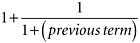
Proof that the limit of the sequence is : By the rule for forming terms, if some term of the sequence is , then the following term is

which is

which is

which is

which is

If the sequence closes in on some limiting number, the terms get closer and closer together, so that term and previous term are well-nigh equal. So after a few trillion terms, it is well-nigh the case that

That is, if you apply some elementary algebra, a quadratic equation, whose only positive root is . Q.E.D. This proof is, of course, not rigorous, its principal weakness being that “If” at the start of the second sentence.

Suggested Citation: "Endnotes." John Derbyshire. 2006. Unknown Quantity: A Real and Imaginary History of Algebra. Washington, DC: Joseph Henry Press. doi: 10.17226/11540.

155.  

Man muss jederzeit an Stelle von „Punkten, Geraden, Ebenen,“ „Tische, Stühle, Bierseidel“ sagen können. Hilbert is very quotable.

156.  

Co-authored by S. Cohn-Vossen and published in 1932, two years after Hilbert retired from teaching.

157.  

Weil, like Lie, had the unhappy distinction of having been arrested as a spy, his mathematical notes and correspondence taken for encrypted communications. That was in Finland, December 1939. Released and sent back to France, he was arrested there for having evaded military service.

Chapter 15: From Universal Arithmetic to Universal Algebra

158.  

Professor Barry Mazur, himself a skillful and lucid popularizer of math, set out to explain the concept of a motive (as in “motivitic”) to non-algebraical readers of the November 2004 Notices of the American Mathematical Society. His article, which I believe does the job as well as it can be done, begins: “How much of the algebraic topology of a connected finite simplicial complex X is captured by its one-dimensional cohomology?”

159.  

By the AMS classification number codes, the 13 are: (06) Order, lattices, ordered algebraic structures; (08) General algebraic systems; (12) Field theory and polynomials; (13) Commutative rings and algebras; (14) Algebraic geometry; (15) Linear and multilinear algebra, matrix theory; (16) Associative rings and algebras; (17) Nonassociative rings and algebras; (18) Category theory, homological algebra; (19) K-theory; (20) Group theory and generalizations; (22) Topological groups, Lie groups; and (55) Algebraic topology.

160.  

Mac Lane argued, with what validity I do not know, that Birkhoff Senior’s policy was motivated at least in part by plain patriotism in the jobless 1930s. Mac Lane: “George Birkhoff at Harvard … felt that we also ought to pay attention to young Americans, so there were relatively few appointments of [European] refugees at Harvard” (from the book More Mathematical People, 1990, Donald J. Albers, Gerald L. Alexanderson, and Constance Reid, Eds.)

Suggested Citation: "Endnotes." John Derbyshire. 2006. Unknown Quantity: A Real and Imaginary History of Algebra. Washington, DC: Joseph Henry Press. doi: 10.17226/11540.

161.  

Professor Swan adds the following interesting historical note: “The homotopy groups were discovered by [Eduard] Cech in 1932, but when he found they were mainly commutative he decided that they were uninteresting, and he withdrew his paper. A few years later, [Witold] Hurewicz rediscovered them, and is usually given the credit.”

162.  

“Pentatope” is the word H. S. M. Coxeter uses for this object in his book Regular Polytopes (Chapter 7). I have not seen the word elsewhere, don’t know how current it is, and do not think it would survive a challenge in Scrabble. As I have shown it, of course, the wire-frame pentatope has been projected down from four dimensions into two, so the diagram is very inadequate.

163.  

A procedure related to the notion of duality that crops up all over geometry. The classic “Platonic solids” of three-dimensional geometry illustrate duality. A cube (8 vertices, 12 edges, 6 faces) is dual to an octahedron (6 vertices, 12 edges, 8 faces); a dodecahedron (20 vertices, 30 edges, 12 faces) is dual to an icosahedron (12 vertices, 30 edges, 20 faces); a tetrahedron (4 vertices, 6 edges, 4 faces) is dual to itself. I ought to say, by the way, in the interest of historical veracity, that it was Emmy Noether who pointed out the advantage of focusing on the group properties here. Earlier workers had described the homology groups in somewhat different language.

164.  

The term “universal algebra” has an interesting history, going back at least to the title of an 1898 book by Alfred North Whitehead, the British mathematician-philosopher of Principia Mathematica co-fame (with Bertrand Russell). Emmy Noether used it, too. My own usage here, though, is only casual and suggestive and is not intended to be precisely congruent with Whitehead’s usage, or Noether’s, or anyone else’s.

165.  

Category theory’s only appearance in popular culture, so far as I know, was in the 2001 movie A Beautiful Mind. In one scene a student says to John Nash: “Galois extensions are really the same as covering spaces!” Then the student, who is eating a sandwich, mumbles something like: “… functor … two categories ….” The implication seems to be that Galois extensions (see my primer on fields) and covering spaces (a topological concept) are two categories that can be mapped one to the other by a functor—quite a penetrating insight.

Suggested Citation: "Endnotes." John Derbyshire. 2006. Unknown Quantity: A Real and Imaginary History of Algebra. Washington, DC: Joseph Henry Press. doi: 10.17226/11540.

166.  

Allyn Jackson quotes some revealing remarks about this by Justine Bumby, with whom Grothendieck was living at the time: “His students in mathematics had been very serious, and they were very disciplined, very hard-working people…. In the counterculture he was meeting people who would loaf around all day listening to music.”

167.  

The Grothendieck Biography Project, at www.fermentmagazine.org/home5.html.

168.  

Both the Lorentz group and the one used by Gell-Mann to organize the hadrons—technically known as the special unitary group of order 3—can be modeled by families of matrices, though the entries in the matrices are complex numbers.

169.  

The precise definition, just for the record, is “A Riemannian manifold admitting parallel spinors with respect to a metric connection having totally skew-symmetric torsion.”

170.  

Yau, winner of both a Fields Medal and a Crafoord Prize, was a “son of the revolution,” born in April 1949 in Guangdong Province, mainland China. Following the great famine and disorders of the early 1960s, his family moved to Hong Kong, and he got his early mathematical education there. He is currently a professor of mathematics at Harvard.

171.  

Printed up as “Mathematics in the 20th Century” in the American Mathematical Monthly, 108(7).

172.  

The sense here is that Newton was the absolute-space man, while Leibniz was more inclined to the view that, as the old ditty explains:

    Space

    Is what stops everything from being in the same place.

173.  

It is a common misconception that Einstein banished all absolutes from physics and hurled us into a world of relativism. In fact, he did nothing of the sort. Einstein was as much of an “absolutist” as Newton. What he banished was absolute space and absolute time, replacing both with absolute space-time. Any good popular book on modern physics should make the point clear. Einstein’s close friend Kurt Gödel was, by the way, a strict Platonist: The two pals were yin and yin.

Next Chapter: Picture Credits
Subscribe to Email from the National Academies
Keep up with all of the activities, publications, and events by subscribing to free updates by email.