Unknown Quantity: A Real and Imaginary History of Algebra (2006)
Chapter: 15 From Universal Arithmetic to Universal Algebra
Chapter 15
FROM UNIVERSAL ARITHMETIC TO UNIVERSAL ALGEBRA
§15.1 AS A GLIMPSE OF ACADEMIC WORK in algebra over recent decades, consider the following fragments extracted from a list of awards of the Frank Nelson Cole Prize in Algebra, given by the American Mathematical Society. (The full list is available on the Internet.)
1960: To Serge Lang for his paper “Unramified class field theory over function fields in several variables,” and to Maxwell A. Rosenlicht for his papers on generalized Jacobian varieties… 1965: To Walter Feit and John G. Thompson for their joint paper “Solvability of groups of odd order.” …2000: To Andrei Suslin for his work on motivitic cohomology …2003: To Hiraku Nakajima for his work in representation theory and geometry.
Surveying that list, the reader might be excused for thinking that I have skimped on my coverage of algebra in this book. Jacobian varieties? Unramified class field theory? Motivitic cohomology? What is this stuff?
Well, it is modern algebra, built up around key concepts such as group, algebra, variety, matrix, all of which I hope I have given some fair account of. Even some of the unexplained terms are only a step or
two removed from these basic 19th-century ideas. Representation, for example, refers to the study of groups and algebras by means of families of matrices that model them, a thing I touched on in §9.6. Class field theory is a very generalized, modernized approach to the problems raised by non-unique factorization, the problems that so vexed Cauchy and Lamé back in §12.4. Solvability refers to matters of group structure, harking all the way back to the solvability of equations … and so on.
It is a fact, though, that algebra has become very abstruse and that topics such as motivitic cohomology simply cannot be made accessible to a reader who does not have a math degree—nor even, I think, to a reader who has one unless he has specialized in the right area.158 Algebra has also become very large, embracing a diversity of topics—13 out of the 63 subject headings in the current (2000) classification system used by the American Mathematical Society.159
At this point, therefore, I am going to exercise author’s privilege and just offer three sketches of topics and personalities from the last few decades, without any claim that this will give a complete picture of recent algebra. The first sketch, §§15.2–15.5, will deal with category theory; the second, §§15.6–15.9, with the life and work of Alexander Grothendieck; and the third, §§15.10–15.11, with applications of modern algebra to physics. I shall postpone discussion of motivitic cohomology to some future book….
§15.2 One of the most popular textbooks for math undergraduates in the later 20th century was Birkhoff and Mac Lane’s A Survey of Modern Algebra. First published in 1941, it brought all the key concepts of mid-20th-century algebra together in a clear, connected presentation, with hundreds of exercises for students to sharpen their wits on. Numbers, polynomials, groups, rings, fields, vector spaces, matrices, and determinants—here it all was. I myself learned algebra from Birkhoff and Mac Lane, and I am sure my book shows the influ-

FIGURE 15-1 Birkhoff and Mac Lane (1941), and Mac Lane and Birkhoff (1967).
ence of theirs. (It actually shows more than that; I have borrowed a couple of their exercises to help make my points.)
In 1967, a completely new edition of the book appeared. The title was changed to just Algebra. The authors were listed in reverse order: Mac Lane and Birkhoff. Most significantly, the presentation was changed. The fourth chapter was entirely new. Titled “Universal Constructions,” it dealt with functors, categories, morphisms, and posets—terms that do not appear at all in the 1941 Survey. A lengthy (39 pages) appendix on “Affine and Projective Spaces” was added.
That an undergraduate math text should have needed such extensive revision just 26 years after first publication is a bit surprising. What had happened? Where did these new mathematical objects, since presumably that is what they are—these functors and posets—where did they suddenly spring from?
Garrett Birkhoff (1911–1996) and Saunders Mac Lane (1909–2005) were both instructors at Harvard in the late 1930s. Birkhoff’s father, George Birkhoff, was himself a professor of mathematics at that university from 1912 until his death in 1944. It was the elder Birkhoff that Albert Einstein famously described as “one of the world’s great anti-Semites,” though Birkhoff Senior’s prejudices, while real, seem not to have been extraordinary in that time and place.160 The younger Birkhoff was appointed instructor at Harvard in 1936. Mac Lane, the son of a Congregational minister in Connecticut, taught at Harvard from 1934 to 1936 and was appointed assistant professor there in 1938.
As university teachers of algebra, both men were strongly influenced by a book published in German in 1930. This was B. L. van der Waerden’s Modern Algebra, the first really clear exposition, at a high mathematical level, of the entirely abstract axiomatic approach to the new mathematical objects that had emerged in the 19th century. Van der Waerden subtitled the book Using the lectures of E. Artin and E. Noether. “E. Noether” is of course the Emmy Noether of my §12.9. Emil Artin was a brilliant algebraist at Hamburg University until the Nazis came to power, after which he taught at various universities in the United States. The original idea, in fact, had been that Artin and van der Waerden should write the book jointly, but Artin backed out of the project under pressure of research work. Van der Waerden’s book brought together all the new mathematical objects—groups, rings, fields, vector spaces—and gave them the abstract axiomatic treatment, as Hilbert, Noether, and Artin had developed it.
Van der Waerden passed on this way of thinking to the mathematical community at large through his 1930 book. Birkhoff and Mac Lane made it accessible to undergraduates with their 1941 book. From that point on, the term “modern algebra” had a distinct meaning in the minds of mathematicians and their students. The essence of that meaning was an approach to algebra that was perfectly abstract and carefully axiomatic, all expressed in the language of set theory, like the definition of “group” that I gave in §11.4.
Was this the last word in abstraction, the end point of the line of thought first voiced by George Peacock in 1830 (§10.1)? By no means!
§15.3 In 1940, while A Survey of Modern Algebra was being prepared for the press, Saunders Mac Lane attended a conference on algebraic topology at the University of Michigan. There he encountered a young Polish topologist, Samuel Eilenberg, who had moved to the United States the previous year and whose published papers Mac Lane was already familiar with. They struck up a friendship and in 1942 produced a joint paper on algebraic topology. The paper’s title was “Group Extensions and Homology.” It deals with homology, about which I ought to say a few words.
In §14.2, I described the fundamental group of a manifold in terms of families of loops—closed paths—embedded in the manifold. This fundamental group of path-families is one instance of a homotopy group. It is possible to work out other homotopy groups associated with a manifold, by generalizing from those paths—those one-dimensional loops, each of which is topologically equivalent to a circle—to two-, three-, or more-dimensional “hyper-loops,” equivalent to spheres, hyperspheres, and so on.
These homotopy groups are interesting and important, but for giving us information about a manifold, they have certain drawbacks. They are, from a mathematical point of view, unwieldy.161
Poincaré uncovered a quite different family of groups that can be associated with any manifold. These are the homology groups. The most straightforward way to construct homology groups for a manifold is to replace the manifold by an approximate one made up entirely of simplexes. You can get the idea by imagining the surface of a sphere deformed into the surface of a tetrahedron (that is, a pyramid on a triangular base; see Figure 15-2). You now have a figure made up of zero-dimensional vertices, one-dimensional edges, and two-dimensional triangular faces. By studying the possible ways to traverse these vertices, edges, and faces, by way of paths that are allowed to
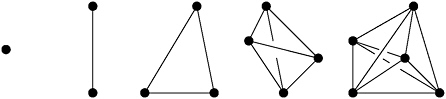
FIGURE 15-2 Left to right: A 0-simplex (or point), a 1-simplex (line segment), a 2-simplex (triangle), a 3-simplex (tetrahedron), and a 4-simplex (pentatope).162
“cancel out” when they traverse in opposite directions (see Figure 15-3), you can extract a family of groups, usually denoted H0, H1, and H2. These are the homology groups and are collectively known as the homology of the surface. Furthermore, there is a way do this whole process in reverse, treating the vertices as faces, the faces as vertices, and the edges as (differently organized) edges.163 You then get a different family of groups, collectively known as the cohomology.
Something similar can be done with any kind of manifold in any number of dimensions. Now, a triangle is the simplest possible plane polygon enclosing any area at all. To a mathematician, it is a 2-simplex. A 3-simplex is a tetrahedron—a triangular pyramid, with four vertices and four triangular faces. A 4-simplex is the equivalent thing in four dimensions, having five vertices and five tetrahedral “faces” (see Figure 15-2). For the sake of completion, we can call a line segment a 1-simplex and a single isolated point a 0-simplex.
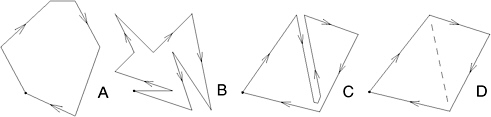
FIGURE 15-3 Paths A and B are homotopically equivalent; paths C and D are homologically equivalent.
Any manifold can be “triangulated” like this into simplexes, though if the manifold has holes going through it, like a torus, you will need to glue several simplexes together to make a “simplicial complex.” Once you have triangulated your manifold in this way, you can work out the homology—the simplicial homology—of the triangulated manifold. This homology, and the corresponding cohomology, carry useful information about the manifold. Furthermore, the groups that comprise the homology are easier to deal with than are homotopy groups. (I note, in passing, the similarity of this procedure to the actual triangulation carried out by mapmakers when surveying a landscape. See §15.9 below.)
We have a glimpse here of a key notion in late 20th-century algebra, the notion of attaching algebraic objects to a manifold. The objects I have mentioned are groups that arise when we conduct topological investigations. In homology theory, however, we can also attach vector spaces and modules (see §12.6, penultimate paragraph) to a manifold. This opens up rich new territory in algebraic topology and algebraic geometry. The most famous explorers of that territory were the French mathematicians Leray, Serre, and Grothendieck, about whom I shall say more later.
Well, this was the background to Eilenberg and Mac Lane’s 1942 paper. Under the inspiration of the “modern algebra” that was in the air everywhere at that time, and about which Mac Lane had just (with Birkhoff) written a brilliant book, they dealt with the topic very abstractly—their treatment is far, far removed in abstraction from the tiny sketch I gave, from triangles and tetrahedrons. Yet in writing the paper it occurred to both of them that a still higher level of abstraction was possible.
Three years later they attained that higher level, in another joint paper titled “General Theory of Natural Equivalences.” This is the paper that launched category theory on the world.
Category theory, which I am going to describe in just a moment, emerged from homology theory in a natural way. In the 40 years since homology groups had been identified in their original topological
context, they had been seen to have deep connections with other branches of algebra, in particular with Hilbert’s work on invariants in polynomial rings that I sketched in §§13.4-5. Via the connection Riemann had established between function theory and topology (§13.6), they also had relevance to analysis—to the higher calculus, the study of functions and families of functions. A little later, in the 1950s, all this blossomed into a field of study called homological algebra. Eilenberg co-authored the first book on homological algebra (with the great algebraic topologist Henri Cartan) in 1955. The level of generality here was so high that category theory was a natural parallel development.
§15.4 The general line of thought underlying category theory is as follows.
Algebraic objects such as groups, rings, fields, sets, vector spaces, and algebras are made up of (a) elements (for example, numbers, permutations, rotations) and (b) a method or methods of combining elements (for example, addition, or addition and multiplication, or compounding of permutations). These objects tend to reveal their structure most clearly when we find (c) ways to transform—to “map”—one of them into another, or into itself. (Recall, for example, how in my primer on vector spaces I mapped a vector space into its own scalar field. Recall also my thumbnail sketch of Galois theory and its central concern with permuting—mapping—a solution field into itself while leaving the coefficient field unaltered.)
Although these are different kinds of objects, with different possibilities for mapping, there are broad similarities of structure and method across the (a), the (b), and the (c) in all cases. Take, for instance, the relationship of an ideal to its parent ring (§12.6), and the relationship of a normal subgroup to its parent group (§11.5). There is something naggingly similar about the two relationships. Is it possible to extract some general principles, a general theory of algebraic structures, so that all these objects, and any others we might come up
with in the future, can be brought under a single set of super-axioms? A sort of universal algebra?164
Eilenberg and Mac Lane gave the answer: Yes, it is possible. Wrap up some family of mathematical objects—groups, perhaps, or vector spaces—with some “well-behaved” family of mappings among them. This is a category, and the mappings in it are called morphisms. You can now go ahead (with care) and set up hyper-mappings from one category (including all its morphisms) to another. This kind of hyper-mapping is called a functor.
By way of illustration, look back to my discussion of p-adic numbers in § 14.4. I constructed a system of 5-adic integers. Then I said, rather glibly: “[J]ust as with the ring  of ordinary integers, you can go ahead and define a ‘fraction field’
  —the rational numbers—so with 5 there is a way to define a fraction field 5 in which you can not only add, subtract, and multiply but also divide.” Hidden in that little bit of sleight of hand is the category-theoretic notion of a functor.
is, in fact, slightly more than a mere ring. It is a rather particular kind of ring, the kind called an integral domain—that is, a ring in which multiplication is commutative (it doesn’t have to be for a ring) and has an identity element “1” for multiplication (a thing rings don’t have to have) and permits a × b = 0 only if a, b, or both, is/are zero (not an essential condition for a ring). The way to get from to is to create a fraction field from an integral domain—a thing that can generally be done, from any integral domain, because it is possible to construct a functor from the category of integral domains with the mappings between them (well, at any rate, a subset of those mappings), to the category of fields and (a similar subset of) their mappings.
Though I really don’t want to get too deep into this, I cannot forbear a mention of my favorite functor: the forgetful functor. That is the one that maps from a category of algebraic objects—groups, say—into the category of bland unvarnished sets, “forgetting” all the structure that exists in the original objects.
§15.5 Can useful math really be done at such a very high level of abstraction? It depends who you ask. To this day (2006), category theory is still controversial. Many professional mathematicians—rather especially, I think, in English-speaking countries—frown and shake their heads when you mention category theory. Only a minority of undergraduate courses teach it. None of the words “category,” “morphism,” or “functor” appears anywhere in the 600-odd pages of Michael Artin’s magisterial 1991 undergraduate textbook Algebra.
When I myself was a math undergraduate in the mid-1960s, the opinion most commonly heard was that while category theory might be a handy way to organize existing knowledge, it was at too high a level of abstraction to generate any new understanding (though I should say that this was in England, where category theory, its American origins notwithstanding, dwelt in the odium of being suspiciously continental).
Saunders Mac Lane, at any rate, was very much taken with his and Eilenberg’s creation. When, in the mid-1960s, the time came to put out a revised edition of the Survey of Modern Algebra, he reworked the entire book to give it a category-theoretic slant. Others have followed him, and if category theory is still not universally accepted, certainly not for the undergraduate teaching of algebra, it has a large and vigorous cheering section in the math world. Adherents are sufficiently confident to make fun of their pet. F. William Lawvere opens his book on the application of categories to set theory by saying: “First, we deprive the object of nearly all content….” Robin Gandy, in The New Fontana Dictionary of Modern Thought, wrote: “Those who like to work on particular, concrete problems refer to [category theory] as ‘general abstract nonsense.’”165
Promoters of category theory make very large claims, some of them going beyond math into philosophy. In fact, category theory from the very beginning carried some self-consciously philosophical flavor. The word “category” was taken from Aristotle and Kant, while “functor” was borrowed from the German philosopher
Rudolf Carnap, who coined it in his 1934 treatise The Logical Syntax of Language.
The philosophical connotations of category theory lie beyond my scope, though I shall make some very general comments about them at the end of this chapter. Certainly, though, there have been working mathematicians who have used the theory to obtain significant results. There has, for example, been Alexander Grothendieck.
§15.6 Grothendieck is the most colorful and controversial character in the recent history of algebra. There is a large and growing literature about his life, by now probably exceeding what has been written about his mathematical work. The most accessible and informative account of both life and work so far produced in English is Allyn Jackson’s “As If Summoned from the Void: The Life of Alexandre Grothendieck,” published in two parts in the October and November 2004 issues of the Notices of the American Mathematical Society, the two parts together running to about 28,000 words. There are also numerous Web sites given over to discussions of Grothendieck. A good starting point for English-speaking readers (though it also contains much in French and German) is www.grothendieck-circle.org, which includes both parts of Allyn Jackson’s aforementioned biographical article.
Grothendieck’s story is compelling because it conforms to archetypes about certain fascinating “outsider” personalities: the Holy Fool, the Mad Genius, the Contemplative Who Withdraws from the World.
To take the genius first: Grothendieck’s years of glory were 1958–1970. The first of those years marked the founding in Paris of the Institut des Hautes Études Scientifiques (IHÉS). This was the brainchild of Léon Motchane, a French businessman of mixed Russian and Swiss parentage who believed that France needed a private, independent research establishment like the Institute for Advanced Study in Princeton. Grothendieck—30 years old at the time—was a founding professor at the IHÉS.
The privacy and independence of the IHÉS were eroded by its constant need for funding. Motchane’s personal resources were not adequate, and from the mid-1960s he began to accept small grants from the French military. Grothendieck was a passionate anti-militarist. When he could not persuade Motchane to give up the military funding, he resigned from the institute in May 1970.
During those 12 years at the IHÉS, Grothendieck was a mathematical sensation. The field in which he worked was algebraic geometry, but he was able to raise the subject to such a level of generality as to take in key parts of number theory, topology, and analysis, too.
Here Grothendieck was following the pioneering work of a French mathematician of the previous generation, Jean Leray. Like Poncelet 130 years before him, Leray had worked out his most important ideas while a prisoner of war. His dates are 1906–1998, the same as André Weil’s. As an officer in the French army, Leray was captured when the nation fell in 1940 and spent the whole of the rest of World War II in a camp near Allentsteig in northern Austria. Up to that point Leray’s specialty had been hydrodynamics. In order to avoid having his expertise conscripted by the Germans for war work, however, he switched his interest to the most abstract field he knew, algebraic topology, and pushed homology theory into the new territory I described in §15.3. This was the territory in which, in the following generation, Grothendieck and his coeval Jean-Pierre Serre at the Collège de France made their names as explorers.
Grothendieck was a charismatic teacher, whose corps of devoted students in the 1960s was thought by some to resemble a cult. His mathematical style was not to everyone’s taste, and disparaging comments about him are not hard to find. By the testimony of many first-class mathematicians who knew and worked with him, though, including some whose own styles are quite non-Grothendieckian, he was, in those glory years, a bubbling fount of mathematical creativity, throwing off startling insights, deep conjectures, and brilliant results nonstop. In 1966, he was awarded the Fields Medal, the highest and
most coveted prize for mathematical excellence. “Built on work of Weil and Zariski and effected fundamental advances in algebraic geometry,” goes the citation.
§15.7 I introduced Grothendieck with the archetypes Holy Fool and Mad Genius. Though I myself cannot understand much of his work, comments on that work by mathematicians such as Nick Katz, Michael Artin, Barry Mazur, Pierre Deligne, Sir Michael Atiyah, and Vladimir Voevodsky (there are three more Fields Medal winners in that list) are sufficient to persuade me of his genius. What about the holiness, folly, and madness?
The holiness and the folly are combined in a kind of childlike innocence, which everyone who has known Grothendieck has remarked on. Not that there is anything childlike about the man physically. He is (or at any rate was, in his prime) large, handsome, and strong and an excellent boxer. At a 1972 political demonstration in Avignon, Grothendieck, who was 44 years old, knocked down two police officers who tried to arrest him.
The intense concentration on his work, though—he seems, by all accounts, to have thought about very little but mathematics all through his 20s and 30s—left him unworldly and grossly ill-informed. IHÉS professor Louis Michel recalls telling Grothendieck, around 1970, that a certain conference was being sponsored by NATO. Grothendieck looked puzzled. Did he know what NATO was? asked Michel. “No.”
His zone of ignorance extended into areas of mathematics he was not interested in—which is to say all mathematics except for the most utterly abstract reaches of algebra. He did not, for example, find numbers interesting. Mathematicians sometimes refer to the number 57—the product of 3 and 19 and therefore not a prime number—as “Grothendieck’s prime.” The story goes that Grothendieck was participating in a mathematical discussion when one of the other par-
ticipants suggested they try out a procedure that had been suggested, applicable to all prime numbers, on some particular prime. “You mean an actual prime number?” Grothendieck asked. Yes, said the other, an actual prime number. “All right,” said Grothendieck, “let’s take 57.”
Grothendieck’s own miserable childhood undoubtedly contributed to his rather patchy understanding of the world and of mathematics. His parents were both eccentric rebels. His father, a Ukrainian Jew named Shapiro, born in 1889, spent all his life in the shadow world of anarchist politics, the world described in Victor Serge’s memoirs. There were several spells in tsarist prisons, and Shapiro lost an arm in a suicide attempt while trying to escape from the tsar’s police. Lenin’s totalitarianism did not suit him any better than the tsar’s authoritarianism had, so he left Russia for Germany in 1921, and made a living as a street photographer so as not to violate his anarchist principles by having an employer.
Alexander’s mother, from whom the boy took his name, was Johanna Grothendieck, a Gentile girl from Hamburg in rebellion against her bourgeois upbringing, living in Berlin and doing occasional writing for left-wing newspapers. Alexander was born in that city, and his first language was German. By the outbreak of World War II the family was in Paris. Both parents, however, had fought on the Republican side in the Spanish civil war and so were regarded by the French wartime authorities as potential subversives. Grothendieck’s father was interned; then, after France fell, he was shipped off to Auschwitz to be killed. Mother and son spent two years in internment camps; then Alexander was moved to a small town in southern France where the Resistance was strong. Life was precarious, and in his autobiography Grothendieck writes of periodic sweeps when he and other Jews would have to hide in the woods for several days at a time. He survived, though, managed to pick up some kind of education at the town schools, and at age 17 was reunited with his mother. Three years later, after some desultory courses at a provincial univer-
sity, Grothendieck was advised by one of his instructors to go to Paris and study under the great algebraist Henri Cartan. Grothendieck did, and his mathematical career was under way.
Grothendieck’s autobiography expresses reverence for both his parents. Certainly the man is, as his father was, absolutely unbending in his convictions. Though he accepted the Fields Medal in 1966, he refused to travel to the International Congress of Mathematicians to receive it, because the Congress was being held in Moscow that year, and Grothendieck objected to the militaristic policies of the Soviet Union. The following year he made a three-week trip to North Vietnam and lectured on category theory in the forests of that country, whither the Hanoi students had been evacuated to escape American bombing.
Eleven years later—he was then 60 years old—Grothendieck was awarded the Crafoord Prize by the Royal Swedish Academy of Sciences. This one he declined altogether. (It carried a $200,000 award—Grothendieck seems never to have paid the slightest attention to money.) In his explanatory letter, soon afterward reprinted in the French daily newspaper Le Monde, Grothendieck railed against the dismal ethical standards of mathematicians and scientists.
All of this was in the true anarchist spirit. None of it was informed by the sour anti-Americanism that was already beginning to be a feature of French intellectual life. Nor, the Vietnam trip notwithstanding, has Grothendieck been any particular fan of communism or the USSR, as a great many French intellectuals have, to their shame. As an anarchist and a political ignoramus, Grothendieck probably thinks that all political systems are equally wicked, all armies mere instruments of murder, all wealthy folk oppressors of the poor. Some of the postmodernist cant of the age seems to have seeped into his brain. In the autobiography he remarks that:
[E]very science, when we understand it not as an instrument of power and domination but as an adventure in knowledge pursued by our species across the ages, is nothing but this harmony, more or
less vast, more or less rich from one epoch to another, which unfurls over the course of generations and centuries, by the delicate counterpoint of all the themes appearing in turn, as if summoned from the void.
That is actually rather beautifully put, once you get past those italicized words (whose italics are mine) from the po-mo phrasebook.
§15.8 Holiness and madness. After resigning from the IHÉS, Grothendieck taught for two years at the Collège de France in Paris, but he had a disconcerting habit of giving over his lectures to pacifist rants. After a couple of attempts to start a commune—unsuccessful for all the usual reasons166—in 1973, he took a position at the University of Montpellier, down on the Mediterranean coast, west of Marseilles. This was, by French academic standards, an extraordinary self-demotion. Most French academics spend years scheming to get a position in Paris and then, having gotten one, would submit to torture rather than give it up. Grothendieck gave Paris up without a blink. Nothing worldly ever seems to have meant much to him.
During his 15 years at Montpellier—he retired in 1988, at age 60—Grothendieck wrote his autobiography, Reaping and Sowing (never published but widely circulated in manuscript), as well as mathematical and philosophical books and articles. He learned to drive, atrociously of course. He became a minor cult figure in Japan, and parties of Buddhist monks came to visit him. He became “green,” hooked into the environmentalist movement, and protested to the authorities on this and numerous other topics.
In July 1990, two years after his retirement, Grothendieck asked a friend to take custody of all his mathematical papers. Soon afterward, early in 1991, he disappeared. Admirers eventually tracked him down to a remote village in the Pyrenees, where he remains to this day. Some sources say he has become a Buddhist, others that he spends his time railing at the Devil and all his works. Roy Lisker, who visited Grothendieck in his hermitage, reported in 2001 that:
Although direct communication with him is next to impossible, his neighbors in the village where he resides look after him. Thus, although he is known to come up with ideas like living on dandelion soup and nothing else, they see to it that he maintains a proper diet. These neighbors also maintain contact with … well-wishers in Paris and Montpellier, so one doesn’t need to worry about him.167
The mathematics of Alexander Grothendieck’s golden years remains, and those who understand it—of whom I cannot claim to be one—speak of it with awe and wonder.
§15.9 It is often said that a nation’s written literary language is sometimes closer to, sometimes further from, the ordinary speech of the people. English was close in Chaucer’s time, was more distant in the Augustan Age of the early 18th century, is closer again in our own era. In an analogous way, algebra has sometimes been closer to, sometimes further from, the practical world of science.
The very earliest algebra arose, as we have seen, from practical problems of measurement, timekeeping, and land surveying. (Though not really significant, there is a pleasing symmetry in my having been able quite naturally to mention land surveying in both the first and the last chapters of this book—see §15.3.) Diophantus and the medieval Muslim mathematicians added a layer of abstraction, departing sometimes from practical matters to deal with algebraic topics for their own intrinsic interest. This attitude was carried forward into the Renaissance and early-modern period, where pure-algebraic inquiries into cubic and quartic equations generated great interest and eventually general solutions.
From the invention of modern literal symbolism in the decades around 1600 to the late 18th-century assault on the general quintic equation, the new symbolism was widely used to tackle practical problems in civil and military engineering, astronomy and navigation, accounting, and the rudimentary beginnings of statistics. Alge-
bra was perhaps closer to the earthbound realm of practical affairs during this period than it had been since its origins in Mesopotamia.
The growth of pure algebra in the 19th century, however, was so abundant that the subject raced ahead of any practical applications to dwell almost alone in a realm of perfect uselessness. Even when practical folk took inspiration from algebra, they did so carelessly and uncomprehendingly. I have already mentioned (§8.7) the highly irreverent attitude of Gibbs and Heaviside to Hamilton’s precious quaternions. By the end of the 19th century, algebra had left science far behind. The young David Hilbert would have laughed out loud if you had asked him, in 1893, to suggest some practical application of the Nullstellensatz.
The 20th century, for all its trend to yet higher abstraction, saw the gap close somewhat. All the new mathematical objects discovered in the 19th century have found some scientific application, if only in speculative theories. This is an aspect of the “miracle” that Eugene Wigner spoke of in his landmark 1960 essay, “The Unreasonable Effectiveness of Mathematics in the Natural Sciences.” Somehow, these products of pure intellection, these groups and matrices, these fields and manifolds, turn out to be pictures of real things or real processes in the real world.
The “unreasonable effectiveness” of algebra has shown up all over the place. Groups, for example, are important in the theory of coding and encryption; matrices are now fundamental to economic analysis; notions from algebraic topology show up in areas from power generation to the design of computer chips. Even category theory has, according to its propagandists, worked wonders in the design of computer languages, though I cannot myself judge the value of this claim.
Undoubtedly, though, the most striking illustrations of Wigner’s “unreasonable effectiveness,” so far as algebra is concerned, have occurred in modern physics.
§15.10 The two great 20th-century revolutions in physics were of course those that go under the heading of relativity and quantum theory. Both depended on concepts from 19th-century “pure” algebra.
Item. In the special theory of relativity, measurements of time and space made in one frame of reference can be “translated” to measurements made in another (traveling, of course, at constant velocity relative to the first) by means of a Lorentz transformation. These transformations can be modeled as rotations of the coordinate system in a certain four-dimensional space—in other words, as a Lie group.
Item. In general relativity this four-dimensional space-time is distorted—curved—by the presence of matter and energy. For the proper description of it we must rely on the tensor calculus, developed by the Italian algebraic geometers out of the work begun by Hamilton, Riemann, and Grassmann.
Item. When the young physicist Werner Heisenberg, in the spring of 1925, was working on the radiation frequencies emitted by an atom that “jumps” from one quantum state to another, he found himself looking at large square arrays of numbers, the number in the nth column of the mth row in an array being the probability that the atom would jump from state m to state n. The logic of the situation required him to multiply these arrays together and suggested the only proper technique for doing so, but when he tried to carry out this multiplication, he found that it was noncommutative. Multiplying array A by array B gave one result; multiplying B by A gave a different result. What on earth was going on? Fortunately, Heisenberg was a research assistant at the University of Göttingen, so he had David Hilbert and Emmy Noether on hand to gently explain the principles of matrix algebra.
Item. By the early 1960s, physicists had uncovered a bewildering zoo of the type of nuclear particles called hadrons. Murray Gell-Mann, a young physicist at Caltech, noticed that the properties of the hadrons, though they did not follow any obvious linear pattern, made sense in the context of another Lie group, one that appears
when we study rotations in a two-dimensional space whose coordinates are complex numbers. Working the data, Gell-Mann then saw that this original impression was superficial. The equivalent Lie group in a space of three complex dimensions had greater explanatory power. It required the existence of particles that had not yet been observed, though. Gell-Mann published his results, experimenters powered up their particle colliders, and the predicted particles were duly observed.168
Now, in the early 21st century, even stranger and bolder physical theories are circulating. None of them could have been conceived without the work of Hamilton and Grassmann, Cayley and Sylvester, Hilbert and Noether. The most adventurous of these theories arise from efforts to unify the two great 20th-century discoveries, relativity and quantum mechanics. They bear names such as string theory, supersymmetic string theory, M-theory, and loop quantum gravity. All draw at least some of their inspiration from 20th-century algebra or algebraic geometry.
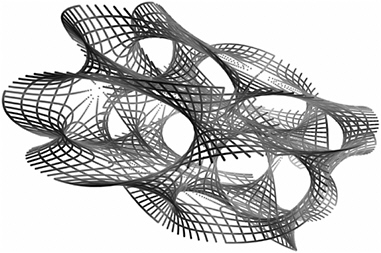
FIGURE 15-4 A Calabi–Yau manifold.
Take, for instance, the Calabi–Yau manifolds that provide the “missing” dimensions demanded by string theory. These are six-dimensional spaces that, according to string theory, lurk in the tiniest regions of space-time, down at the Planck length (that is, a billionth of a trillionth of a trillionth of a centimeter). They were first thought up by the German mathematician Erich Kähler (1902–2000), who, like Oscar Zariski, though a few years later (1932–1933), had studied in Rome with the Italian algebraic geometers.
Working from some ideas of Riemann’s, Kähler defined a family of manifolds with certain general and interesting properties.169 Every Riemann surface, for example, is a Kähler manifold. An American mathematician of the following generation, Eugenio Calabi identified a subclass of Kähler manifolds and conjectured that their curvature should have an interesting kind of simplicity.
Shing-tung Yau, a young mathematician from China, proved the Calabi conjecture in 1977, and these types of spaces are now called Calabi–Yau manifolds.170 The simplicity of their curvature—a certain kind of “smoothness”—makes them ideal for the kinds of string motions that, according to string theory, appear to our instruments as all the many varieties of subatomic particles and forces, including gravitation. The fact of their being six-dimensional is a bit alarming, but these “extra” dimensions are “folded up” out of sight from our vantage point up here in the macroscopic world, just as a thick three-dimensional hawser looks one-dimensional when viewed from sufficiently far away.
§15.11 It seems, therefore, that there are reasons to think that the reaching up to ever higher levels of abstraction that characterized algebra in the 20th century may cease, or at least take a pause, while algebraists occupy themselves with answering puzzles posed by physicists, and while the proper status of hyper-abstract approaches such as category theory are sorted out.
It is also possible that algebra, as a separate discipline within mathematics, may not survive. The 20th century was a period of unification, with algebra invading other areas of math, and they counter-invading it. If I am engaged in the study of families of functions on multidimensional manifolds, those families having a group structure, am I working in analysis (the functions), topology (the manifolds), or algebra (the groups)?
The case for thinking that algebra will survive—a case I favor—rests on the idea that there is a distinctly algebraic way of thinking. We go back here (§14.3 again) to Hamilton’s “Algebra as the Science of Pure Time” and to other speculations on the relationship between mathematical thinking and other kinds of mental activity. The great algebraist Sir Michael Atiyah, in a June 2000 lecture in Toronto, spoke of geometry and algebra as “the two formal pillars of mathematics” and argued that they belong to different regions of our minds.
Geometry is … about space…. If I look out at the audience in this room I can see a lot, in one single second or microsecond I can take in a vast amount of information…. Algebra, on the other hand … is concerned essentially with time. Whatever kind of algebra you are doing, a sequence of operations is performed one after the other, and “one after the other” means you have got to have time. In a static universe you cannot imagine algebra, but geometry is essentially static.171
It is convenient to recall that the “sequence of operations” Sir Michael spoke of is known formally as an algorithm and that this word is (§3.5) a corrupted version of the name of the man who gave us that other word, algebra.
Sir Michael’s train of thought was taken to its furthest extreme, so far as I know, by mathematician Eric Grunwald in the spring 2005 issue of Mathematical Intelligencer. Grunwald, under the essay heading “Evolution and Design Inside and Outside Mathematics,” argues for a broad dichotomy in thinking, a sort of yin–yang binary scheme
I have sketched below. (Some of the entries are additions of my own, for which Grunwald should not be held responsible.)
Yin | Yang |
geometry | algebra |
discover | invent |
sight | hearing |
painting | music |
prescriptive (lexicography) | descriptive |
theory building | problem solving |
security | adventure |
patterns in space | processes through time |
Newton | Leiniz172 |
Poincaré | Hilbert |
Einstein173 | Mach |
design | evolution |
socialism | capitalism |
Platonic (view of mathematics) | “social construction” |
theoretical (physics) | experimental |
One can, of course, play these intellectual parlor games all night without coming to much in the way of conclusions. (I am mildly surprised at myself for having had sufficient power of self-control to leave “Augustinian” and “Pelagian” off the list.)
I do think, though, that Sir Michael and Grunwald are on to something. Mathematics today, at the highest levels, is wonderfully unified, with notions from one traditional field (geometry, number theory) flowing easily into another (algebra, analysis). There are still distinct styles of thinking, though, distinct ways of approaching problems and reaching new insights. We heard much talk a few years ago about whether the End of History had arrived. I can’t recall whether our pundits and philosophers came to any conclusions about that larger matter, but I feel sure that algebra, at least, has not ended yet.