Unknown Quantity: A Real and Imaginary History of Algebra (2006)
Chapter: Introduction
INTRODUCTION
§I.1 THIS BOOK IS A HISTORY OF ALGEBRA, written for the curious nonmathematician. It seems to me that the author of such a book should begin by telling his reader what algebra is. So what is it?
Passing by an airport bookstore recently, I spotted a display of those handy crib sheets used by high school and college students, the ones that have all the basics of a subject printed on a folding triptych laminated in clear plastic. There were two of these cribs for algebra, titled “Algebra—Part 1” and “Algebra—Part 2.” Parts 1 and 2 combined (said the subheading) “cover principles for basic, intermediate, and college courses.”1
I read through the material they contained. Some of the topics might not be considered properly algebraic by a professional mathematician. “Functions,” for example, and “Sequences and Series” belong to what professional mathematicians call “analysis.” On the whole, though, this is a pretty good summary of basic algebra and reveals the working definition of the word “algebra” in the modern American high school and college-basics curriculum: Algebra is the part of advanced mathematics that is not calculus.
In the higher levels of math, however, algebra has a distinctive quality that sets it apart as a discipline by itself. One of the most fa-
mous quotations in 20th-century math is this one, by the great German mathematician Hermann Weyl. It appeared in an article he published in 1939.
In these days the angel of topology and the devil of abstract algebra fight for the soul of each individual mathematical domain.2
Perhaps the reader knows that topology is a branch of geometry, sometimes called “rubber-sheet geometry,” dealing with the properties of figures that are unchanged by stretching and squeezing, but not cutting, the figure. (The reader who does not know this will find a fuller description of topology in §14.2. And for more on the context of Weyl’s remark, see §14.6.) Topology tells us the difference between a plain loop of string and one that is knotted, between the surface of a sphere and the surface of a doughnut. Why did Weyl place these harmless geometrical investigations in such a strong opposition to algebra?
Or look at the list of topics in §15.1, mentioned in citations for the Frank Nelson Cole Prize in Algebra during recent years. Unramified class field theory … Jacobean variety … function fields … motivitic cohomology…. Plainly we are a long way removed here from quadratic equations and graphing. What is the common thread? The short answer is hinted at in that quote from Hermann Wey l : It is abstraction.
§I.2 All of mathematics is abstract, of course. The very first act of mathematical abstraction occurred several millennia ago when human beings discovered numbers, taking the imaginative leap from observed instances of (for example) “three-ness”—three fingers, three cows, three siblings, three stars—to three, a mental object that could be contemplated by itself, without reference to any particular instance of three-ness.
The second such act, the rise to a second level of abstraction, was the adoption, in the decades around 1600 CE, of literal symbolism—that is, the use of letter symbols to represent arbitrary or unknown numbers: data (things given) or quaesita (things sought). “Universal arithmetic,” Sir Isaac Newton called it. The long, stumbling journey to this point had been motivated mainly by the desire to solve equations, to determine the unknown quantity in some mathematical situation. It was that journey, described in Part 1 of my book, that planted the word “algebra” in our collective consciousness.
A well-educated person of the year 1800 would have said, if asked, that algebra was just that—the use of letter symbols to “relieve the imagination” (Leibniz) when carrying out arithmetic and solving equations. By that time the mastery of, or at least some acquaintance with, the use of literal symbolism for math was part of a general European education.
During the 19th century3 though, these letter symbols began to detach themselves from the realm of numbers. Strange new mathematical objects4 were discovered5: groups, matrices, manifolds, and many others. Mathematics began to soar up to new levels of abstraction. That process was a natural development of the use of literal symbolism, once that symbolism had been thoroughly internalized by everyone. It is therefore not unreasonable to regard it as a continuation of the history of algebra.
I have accordingly divided my narrative into three parts, as follows:
Part 1: From the earliest times to the adoption of a systematic literal symbolism—letters representing numbers—around the year 1600.
Part 2: The first mathematical victories of that symbolism and the slow detachment of symbols from the concepts of traditional arithmetic and geometry, leading to the discovery of new mathematical objects.
Part 3: Modern algebra—the placing of the new mathematical objects on a firm logical foundation and the ascent to ever higher levels of abstraction.
Because the development of algebra was irregular and haphazard, in the way of all human things, I found it difficult to keep to a strictly chronological approach, especially through the 19th century. I hope that my narrative makes sense nonetheless and that the reader will get a clear view of all the main lines of development.
§I.3 My aim is not to teach higher algebra to the reader. There are plenty of excellent textbooks for that: I shall recommend some as I go along. This book is not a textbook. I hope only to show what algebraic ideas are like, how the later ones developed from the earlier ones, and what kind of people were responsible for it all, in what kind of historical circumstances.
I did find it impossible, though, to describe the history of this subject without some minimal explanation of what these algebraists were doing. There is consequently a fair amount of math in this book. Where I have felt the need to go beyond what is normally covered in high school courses, I have “set up” this material in brief math primers here and there throughout the text. Each of these primers is placed at the point where you will need to read through it in order to continue with the historical narrative. Each provides some basic concepts. In some cases I enlarge on those concepts in the main text; the primers are intended to jog the memory of a reader who has done some undergraduate courses or to provide very basic understanding to a reader who hasn’t.
§I.4 This book is, of course, a work of secondary exposition, drawn mostly from other people’s books. I shall credit those books in the text and Endnotes as I go along. There are, however, three sources
that I refer to so often that I may as well record my debt to them here at the beginning. The first is the invaluable Dictionary of Scientific Biography, referred to hereinafter, as DSB, which not only provides details of the lives of mathematicians but also gives valuable clues about how mathematical ideas originate and are transmitted.
The other two books I have relied on most heavily are histories of algebra written by mathematicians for mathematicians: A History of Algebra by B. L. van der Waerden (1985) and The Beginnings and Evolution of Algebra by Isabella Bashmakova and Galina Smirnova (translated by Abe Shenitzer, 2000). I shall refer to these books in what follows just by the names of their authors (“van der Waerden says …”).
One other major credit belongs here. I had the great good fortune to have my manuscript looked over at a late stage in its development by Professor Richard G. Swan of the University of Chicago. Professor Swan offered numerous comments, criticisms, corrections, and suggestions, which together have made this a better book than it would otherwise have been. I am profoundly grateful to him for his help and encouragement. “Better” is not “perfect,” of course, and any errors or omissions that still lurk in these pages are entirely my own responsibility.
§I.5 Here, then, is the story of algebra. It all began in the remote past, with a simple turn of thought from the declarative to the interrogative, from “this plus this equals this” to “this plus what equals this?” The unknown quantity—the x that everyone associates with algebra—first entered human thought right there, dragging behind it, at some distance, the need for a symbolism to represent unknown or arbitrary numbers. That symbolism, once established, allowed the study of equations to be carried out at a higher level of abstraction. As a result, new mathematical objects came to light, leading up to yet higher levels.
In our own time, algebra has become the most rarefied and demanding of all mental disciplines, whose objects are abstractions of abstractions of abstractions, yet whose results have a power and beauty that are all too little known outside the world of professional mathematicians. Most amazing, most mysterious of all, these ethereal mental objects seem to contain, within their nested abstractions, the deepest, most fundamental secrets of the physical world.
Math Primer
NUMBERS AND POLYNOMIALS
§NP.1 AT INTERVALS THROUGH THIS BOOK I shall interrupt the historical narrative with a math primer, giving very brief coverage of some math topic you need to know, or be reminded of, in order to follow the history.
This first math primer stands before the entire book. There are two concepts you need to have a good grasp of in order to follow anything at all in the main narrative. Those two concepts are number and polynomial.
§NP.2 The modern conception of number—it began to take shape in the late 19th century and became widespread among working mathematicians in the 1920s and 1930s—is the nested “Russian dolls” model. There are five Russian dolls in the model, denoted by “hollow letters”  ,
,  ,
,  ,
,  , and
, and  and remembered by the nonsense mnemonic: “Nine Zulu Queens Ruled China.”
The innermost doll is the natural numbers, collectively denoted by the symbol . These are the ordinary6 counting numbers: 1, 2, 3, … They can be arranged pictorially as a line of dots extending indefinitely to the right:

FIGURE NP-1 The family of natural numbers, .
The natural numbers are very useful, but they have some shortcomings. The main shortcomings are that you can’t always subtract one natural number from another or divide one natural number by another. You can subtract 5 from 7, but you can’t subtract 12 from 7—not, I mean, if you want a natural-number answer. Term of art: is not closed under subtraction. is not closed under division either: You can divide 12 by 4 but not by 5, not without falling over the edge of into some other realm.
The subtraction problem was solved by the discovery of zero and the negative numbers. Zero was discovered by Indian mathematicians around 600 CE. Negative numbers were a fruit of the European Renaissance. Expanding the system of natural numbers to include these new kinds of numbers gives the second Russian doll, enclosing the first one. This is the system of integers, collectively denoted by (from the German word Zahl, “number”). The integers can be pictured by a line of dots extending indefinitely to both left and right:

FIGURE NP-2 The family of integers, .
We can now add, subtract, and multiply at will, though multiplication needs a knowledge of the rule of signs:
A positive times a positive gives a positive.
A positive times a negative gives a negative.
A negative times a positive gives a negative.
A negative times a negative gives a positive.
Or more succinctly: Like signs give a positive; unlike signs give a negative. The rule of signs applies to division, too, when it is possible. So −12 divided by −3 gives 4.
Division, however, is not usually possible. is not closed under division. To get a system of numbers that is closed under division, we expand yet again, bringing in the fractions, both positive and negative ones. This makes a third Russian doll, containing both the first two. This doll is called the rational numbers, collectively denoted by (from “quotient”).
The rational numbers are “dense.” This means that between any two of them, you can always find another one. Neither nor has this property. There is no natural number to be found between 11 and 12. There is no integer to be found between −107 and −106. There is, however, a rational number to be found between  and
and  , even though these two numbers differ by less than 1 part in 16 trillion. The rational number
  , for example, is greater than the first of those rational numbers, but less than the second. It is easy to show that since there is a rational number between any two rational numbers, you can find as many rational numbers as you please between any two rational numbers. That’s the real meaning of “dense.”
Because has this property of being dense, it can be illustrated by a continuous line stretching away indefinitely to the left and right. Every rational number has a position on that line.

FIGURE NP-3 The family of rational numbers, .
(Note: This same figure serves to illustrate the family of real numbers, .)
See how the gaps between the integers are all filled up? Between any two integers, say 27 and 28, the rational numbers are dense.
These Russian dolls are nested, remember. includes , and includes . Another way to look at this is: A natural number is an
“honorary integer,” and an integer—or, for that matter, a natural number—is an “honorary rational number.” The honorary number can, for purposes of emphasis, be dressed up in the appropriate costume. The natural number 12 can be dressed up as the integer +12, or as the rational number  .
.
§NP.3 That there are other kinds of numbers, neither whole nor rational, was discovered by the Greeks about 500 BCE. The discovery made a profound impression on Greek thought and raised questions that even today have not been answered to the satisfaction of all mathematicians and philosophers.
The simplest example of such a number is the square root of 2—the number that, if you multiply it by itself, gives the answer 2. (Geometrically: The diagonal of a square whose sides are one unit in length.) It is easy to show that no rational number can do this.7 Very similar arguments show that if N is not a perfect kth power, the kth root of N is not rational.
Plainly we need another Russian doll to encompass all these irrationals. This new doll is the system of real numbers, denoted in the aggregate by . The square root of 2 is a real number but not a rational number: It is in but not in (let alone or , of course).
The real numbers, like the rational numbers, are dense. Between any two of them, you can always find another one. Since the rational numbers are already dense—already “fill up” the illustrative line—you might wonder how the real numbers can be squinched in among them. The whole business is made even stranger by the fact that and are “countable,” but is not. A countable set is a set you can match off with the counting numbers : one, two, three, …, even if the tally needs to go on forever. You can’t do that with . There is a sense in which is “too big” to tally like that—bigger than , , and . So however can this superinfinity of real numbers be fitted in among the rational numbers?
That is a very interesting problem, which has caused mathematicians much vexation. It does not belong in a history of algebra, though, and I mention it here only because there are a couple of passing references to countability later in the book (§14.3 and §14.4). Suffice it to say here that a diagram to illustrate looks exactly like the one I just offered for : a single continuous line stretching away forever to the left and right (Figure NP-3). When this line is being used to illustrate , it is called “the real line.” More abstractly, “the real line” can be taken as just a synonym for .
§NP.4 Within we could add always, subtract sometimes, multiply always, and divide sometimes. Within we could add, subtract, and multiply always but divide only sometimes. Within we could add, subtract, multiply, and divide at will (except that division by zero is never allowed in math), but extracting roots threw up problems.
solved those problems but only for positive numbers. By the rule of signs, any number, when multiplied by itself, gives a positive answer. To say it the other way around: Negative numbers have no square roots in .
From the 16th century onward this limitation began to be a hindrance to mathematicians, so a new Russian doll was added to the scheme. This doll is the system of complex numbers, denoted by . In it every number has a square root. It turns out that you can build up this entire system using just ordinary real numbers, together with one single new number: the number  , always denoted by i. The square root of −25, for example, is 5i, because 5i × 5i = 25 × (−1), which is −25. What about the square root of i? No problem. The familiar rule for multiplying out parentheses is (u + v) × (x + y) = ux + uy + vx + vy. So

and since i2 = −1 and  , that right-hand side is just equal to i. Each of those parentheses on the left is therefore a square root of i .
As before, the Russian dolls are nested. A real number x is an honorary complex number: the complex number x + 0i. (A complex number of the form 0 + yi, or just yi for short, y understood to be a real number, is called an imaginary number.)
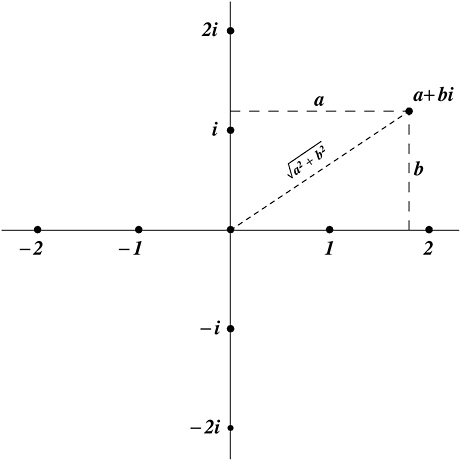
FIGURE NP-4 The family of complex numbers, .
The rules for adding, subtracting, multiplying, and dividing complex numbers all follow easily from the fact that i2 = −1. Here they are:

Because a complex number has two independent parts, can’t be illustrated by a line. You need a flat plane, going to infinity in all directions, to illustrate . This is called the complex plane (Figure NP-4). A complex number a + bi is represented by a point on the plane, using ordinary west-east, south-north coordinates.
Notice that associated with any complex number a + bi, there is a very important positive real number called its modulus, defined to be  . I hope it is plain from Figure NP-4 that, by Pythagoras’s theorem,8 the modulus of a complex number is just its distance from the zero point—always called the origin—in the complex plane.
We shall meet some other number systems later, but everything starts from these four basic systems, each nested inside the next: , , , , and .
§NP.5 So much for numbers. The other key concept I shall refer to freely all through this book is that of a polynomial. The etymology of this word is a jumble of Greek and Latin, with the meaning “having many names,” where “names” is understood to mean “named parts.” It seems to have first been used by the French mathematician François Viète in the late 16th century, showing up in English a hundred years later.
A polynomial is a mathematical expression (not an equation—there is no equals sign) built up from numbers and “unknowns” by the operations of addition, subtraction, and multiplication only, these operations repeated as many times as you like, though not an infinite number of times. Here are some examples of polynomials:
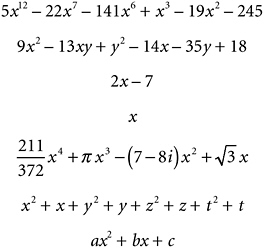
Notice the following things:
Unknowns. There can be any number of unknowns in a polynomial.
Using the alphabet for unknowns. The true unknowns, the ones whose values we are really interested in—Latin quaesita, “things sought”—are usually taken from the end of the Latin alphabet: x, y, z, and t are the letters most commonly used for unknowns.
Powers of the unknowns. Since you can do any finite number of multiplications, any natural number power of any unknown can show up: x, x2, x3, x2y3, x5yz2, …
Using the alphabet for “givens.” The “things given”—Latin data—are often just numbers taken from , , , , or . We may generalize an argument, though, by using letters for the givens. These letters are usually taken either from the beginning of the alphabet (a, b, c, …) or from the middle (p, q, r, …).
Coefficients. “Data” now has a life of its own as an English word, and hardly anyone says “givens.” The “things given” in a polynomial are now called coefficients. The coefficients of that third sample polynomial above are 2 and −7. The coefficient of the fourth polynomial (strictly speaking it is a monomial) is 1. The coefficients of the last polynomial are a, b, and c.
§NP.6 Polynomials form just a small subset of all possible mathematical expressions. If you introduce division into the mix, you get a larger class of expressions, called rational expressions, like this one:

which is a rational expression with three unknowns. This is not a polynomial. You can enlarge the set further by allowing more operations: the extraction of roots; the taking of sines, cosines, or logarithms; and so on. The expressions you end up with are not polynomials either.
Recipe for a polynomial: Take s ome “given” numbers, which you may spell out explicitly  or hide behind letters from the beginning or middle of the alphabet (a, b, c, …, p, q, r, …). Mix in some unknowns (x, y, z, …). Perform some finite number of additions, subtractions, and multiplications. The result will be a polynomial.
Even though they comprise only a tiny proportion of mathematical expressions, polynomials are tremendously important, especially in algebra. The adjective “algebraic,” when used by mathematicians, can usually be translated as “concerned with polynomials.” Examine a theorem in algebra, even one at the very highest level. By peeling off a couple of layers of meaning, you will very likely uncover a polynomial. Polynomial has a fair claim to being the single most important concept in algebra, both ancient and modern.