Unknown Quantity: A Real and Imaginary History of Algebra (2006)
Chapter: 4 Commerce and Competition
Chapter 4
COMMERCE AND COMPETITION
§4.1 A PLEASING LITTLE CURIOSITY in historical writing is The Thirteenth, Greatest of Centuries by James J. Walsh, published in 1907. Much of the book consists of Roman Catholic apologetics (Walsh was a professor at Fordham University, a Jesuit foundation in New York City), but the author makes a good case that the 13th century has, at the very least, been much underestimated as one of progress, cultural achievement, and the recovery of classical learning. The great gothic cathedrals; the early universities; Cimabue and Giotto; St. Francis and Aquinas; Dante (just) and the Romance of the Rose; Louis IX, Edward I, and Frederick II; Magna Carta and the Guilds; Marco Polo and Friar Odoric (who seems to have reached Lhasa)…. There was a great deal going on in the 13th century. It was in the early decades of that century that Leonardo of Pisa, better known as Fibonacci, flourished.
Fibonacci’s is one of the mathematical names best known to nonmathematicians, because of the much-publicized Fibonacci sequence:

Each term in this sequence is the sum of the two to its left: 89 = 34 + 55. This sequence—it is number A000045 in the addictive Online Encyclopedia of Integer Sequences—has so many mathematical and scientific connotations that there is a journal devoted to it: the Fibonacci Quarterly. The August 2005 issue includes articles with titles such as: “p-Adic Interpolation of the Fibonacci Sequence via Hypergeometric Functions.”
It is in fact quite easy, though a bit surprising to the nonmathematician, to show35 that the nth term of the sequence is precisely

If n is equal to 4, for example, this works out, using the binomial theorem,36 to

which can easily be seen to be equal to 3.
The Fibonacci sequence first appeared in a book, Liber abbaci, written by Leonardo of Pisa.37 The context is a number problem about rabbits.
How many pairs of rabbits will be produced in a year, beginning with a single pair, if in every month each pair bears a new pair which becomes productive from the second month on, and no deaths occur?
The only way I have ever been able to think this problem through is to label the months A, B, C, D, etc. The rabbit pair we start with is the A pair. In the second month we still have the A pair but also the AB pair they have begotten, for a total two pairs. In the third month the A pair begets another pair, the AC pair. The AB pair is present but not yet begetting. Total pairs: three. In the fourth month, month D, the A pair is still with us and has begotten another pair, the AD pair.
The AB pair is also with us and has now begotten a pair of its own, the ABD pair. The AC pair is present but not yet begetting. A, AD, AB, ABD, AC—a total of five pairs … and so on.
§4.2 In the preface to Liber abbaci, the author gives us some details of his life up to that point. The modern style of given names plus surname had not yet “settled down” in Western Europe, so the author is formally known only as Leonardo of Pisa, sometimes Italianized to Leonardo Pisano. He belonged to a clan that did have a name for itself, the Bonacci clan, and so he got tagged, or tagged himself, with fi’Bonacci, “son of the Bonaccis,” and it stuck.
Leonardo was born around 1170 in Pisa, hometown of the Bonaccis.38 Pisa, though surrounded by the territories of the German—that is, the Holy Roman—empire, was an independent republic at this point. Leonardo’s father was an official of that republic, and around 1192 he was appointed to represent the merchants in the Pisan trading colony of Bugia,39 on the North African coast. Soon afterward he sent for Leonardo to join him. The idea was that the young man would train to be a merchant.
Bugia was planted on Islamic territory, this stretch of North Africa—as well as the southern third of Spain—being at the time under the rule of a Shi’ite dynasty, the Muwahids (also written “Almohads”), who ruled from Marrakech in the far west. The young Leonardo was thus exposed to all the learning that might be available in a large Muslim city, presumably including the works of medieval Islamic mathematicians such as al-Khwarizmi and Omar Khayyam. His father soon sent him off on business trips all over the Mediterranean—to Egypt and Syria, Sicily (a Norman kingdom until 1194, when the Hohenstaufen dynasty of Germany inherited it), France, and Byzantium.
There must have been many other young men from the trading cities of Italy engaged in similar travels. Leonardo, however, was a born mathematician, and in his travels he skimmed off the best that
was known at that time from the Byzantine Greeks and the Muslims—and, via the Muslims, from Persia, India, and China. When he returned to settle permanently in Pisa around the year 1200, he probably had a wider knowledge of arithmetic and algebra, as those disciplines existed in his time, than anyone in Western Europe—perhaps anyone in the world.
§4.3 Liber abbaci was, by the standards of its time, wonderfully innovative and very influential. For 300 years it was the best math textbook available that had been written since the end of the ancient world. It is often credited with having introduced “Arabic” (that is, Indian) numerals, including zero, to the West. The book begins, in fact, with this:
These are the nine figures of the Indians: 9 8 7 6 5 4 3 2 1. With these nine figures, and with the sign 0 which in Arabic is called zephirum, any number can be written, as will be demonstrated.
The first 7 of the book’s 15 chapters are a primer in computation using these “new” numerals, with many worked examples. The remainder of the book is a collection of problems in arithmetic, algebra, and geometry, some of a type to interest merchants and artisans, some lighthearted recreational puzzles like the rabbit problem described earlier, which appears in Chapter 12 of the book.
While fascinating arithmetically and historically, Liber abbaci is not the most algebraically interesting of Fibonacci’s works. Two later books, written probably in 1225, show his algebraic skills to best effect. I shall pick just the first one because it leads to the main topic of the rest of this chapter: the cubic equation.
§4.4 In or about 1225 the German emperor held court in Pisa. This emperor was Frederick II, one of the most fascinating characters of
his age, sometimes called the first modern man to sit on a European throne. There is a good brief character sketch of him in Volume III of Steven Runciman’s History of the Crusades. Frederick enjoyed the distinction (one cannot help thinking that he did enjoy it) of having been excommunicated twice by the Pope himself, as part of the power game between pope and emperor that raged during this period. He has remained unpopular with Roman Catholics ever since. The aforementioned Professor Walsh, in his paean to the 13th century, mentions Frederick, one of the most intelligent and cultivated rulers of that century, just once in 429 pages.
By this date, Fibonacci’s mathematical talents were well known in Pisa, and he was also on friendly terms with some of the scholars at Frederick’s court. So when Frederick came to Pisa, Leonardo was granted an audience.
Frederick had in his court one Johannes of Palermo (a.k.a. Giovanni da Palermo, John of Palermo), a person about whom I have been able to discover very little. One source says he was a Marrano, that is to say a Spanish Jew who had converted to Christianity. At any rate, Johannes seems to have been knowledgeable in math, and Frederick asked him to set some problems for Fibonacci, to test the man’s abilities.
One of the problems was to solve the cubic equation x3 + 2x2 + 10x = 20. Whether Fibonacci was able to solve this problem on the spot, I do not know. At any rate, he wrote it up in one of those books he issued in 1225, a book with a lengthy Latin title generally shortened to Flos.40 The actual real solution of this equation is 1.3688081078213726…. Fibonacci gave a result very close to this—wrong only in the 11th decimal place.
We don’t know how Fibonacci got his result. He doesn’t tell us. Probably he used a geometric method, like the intersecting curves Omar Khayyam employed for the same purpose. What is notable about his treatment of this cubic is in fact not his solution of it, but his analysis. He first shows, by meticulous reasoning, that the solution cannot be a whole number. Then he shows that it cannot be a
rational number either. Then he shows that it cannot be a square root, or any combination of rational numbers and square roots. This analysis of a cubic is a tour de force of medieval algebra. In its concentration on the nature of the solution rather than its actual value, it might be said to have anticipated the great revolution in thinking about the solutions of equations that took place 600 years later, which I shall describe in due course.
§4.5 Fibonacci did not express his solution of that cubic in our familiar decimal form, but rather in sexagesimal, like an ancient Babylonian, as 1° 22′ 7″ 42′″ 33IV 4V 40VI. This means

which works out to 1.3688081078532235…. This is, as I said earlier, correct to 10 decimal places. The great obstacle to the development of algebra in late medieval times was in fact the absence of good ways to write down numbers, unknown quantities, and arithmetic operations. Fibonacci’s popularization of Hindu-Arabic numerals in Europe was a great advance, but until true decimal positional notation was applied to the fractional part of a number, too, this first “digital revolution” was not complete.
In the matter of expressing the unknown quantity and its powers, the situation was even worse. Outside purely geometrical demonstrations, the Muslim algebraists had, as I have said, done everything with words, commonly using the Arabic words shai (“thing”) or jizr (“root”) to stand for the unknown, with mal (“wealth” or “property”) for the square of the unknown, kab (“cube”) for its cube, and combined forms for higher powers: mal-mal-shai for the fifth power, and so on. Knowledge of Diophantus’s much snappier notation was apparently preserved in the Greek libraries at Constantinople,41 but mathematicians in the Muslim and Western-Christian worlds seem not to have been aware of it or did not feel the need for it.
Early Italian algebraists such as Fibonacci followed the Muslims, translating their words into Latin or Italian: radix (“root”), res, causa, or cosa (“thing”), census (“property”), cubus (“cube”). By the later 14th century these latter three were being abbreviated to co, ce, and cu, a development that was systematized in a book published in 1494 by an Italian named Luca Pacioli and commonly called Pacioli’s Summa.42 Pacioli’s notation was wider in scope than Diophantus’s ζ, ΔY, and KY, but less imaginative. Though there is little original work in the Summa, it proved very handy for commercial arithmeticians and enduringly popular. Pacioli is considered the father of double-entry bookkeeping.43
§4.6 I skipped rather blithely across 269 years there without saying anything about what happened in the interim. This was in part authorial license: I want to get to the solution of the general cubic, and to Cardano, the first real personality in my book. It was also, though, because nothing of much note did happen between Fibonacci and Pacioli.
There were certainly algebraists at work in the 13th, 14th, and early 15th centuries. More technical histories of algebra list some of their contributions. Van der Waerden, for example, gives nearly six pages to Maestro Dardi of Pisa, who tackled quadratic, cubic, and quartic equations in the middle of the 14th century, classified them into 198 types, and used ingenious methods to solve particular types.
While noteworthy to the specialist, these secondary figures added little to what was understood. It was only with the spread of printed books during the second half of the 15th century that the development of algebra really picked up speed.
By no means was all of the action in Italy. The Frenchman Nicolas Chuquet produced a manuscript (it was not actually printed until 1880) titled Triparty en la science des nombres in 1484, introducing the use of superscripts for powers of the unknown (though not quite
in our style: he wrote 123 for 12x3) and treating negative numbers as entities in themselves. The German Johannes Widman gave the first lecture on algebra in Germany (Leipzig, 1486) and was the first to use the modern plus and minus signs in a printed book, published in 1489.44
Except for Chuquet’s superscripts, which were little noticed, all of this work still clung to the late medieval style of notation for the unknown and its powers, the unknown itself being chose in French or coss in German.45 Nor were there any very significant discoveries until the solution of the general cubic equation around 1540. It is to that fascinating story that I now turn.
§4.7 At the center of the story is Girolamo Cardano, who was born at Pavia in 1501, died in Rome in 1576, but was raised and spent most of his life in or near Milan, which he considered his hometown.
Cardano is a large and fascinating personality, “a piece of work,” we might say nowadays. Several biographies of him have been written, the first by himself: De Propria Vita, which he produced near the end of his life. This autobiography contains a list, covering several pages, of his other books. He counts 131 printed works, 111 unprinted books in manuscript form, and 170 manuscripts he claims to have destroyed as unsatisfactory.
Many of these books were Europe-wide best sellers. We know, for example, that Consolation, his book of advice to the sorrowing, first translated into English in 1573, was read by William Shakespeare. The sentiments in Hamlet’s famous “To be, or not to be” soliloquy closely resemble some remarks about sleep in Consolation, and this may be the book that Hamlet is traditionally carrying when he comes on stage to deliver that soliloquy.
Cardano’s first and main interest, and the source of his livelihood, was medicine. His first published book was also about medicine, offering some commonsense remedies and mocking some of the stranger, positively harmful, medical practices of the time.
(Cardano claimed that he wrote the book in two weeks.) By the time he reached 50, Cardano was the second most famous physician in Europe, after Andreas Vesalius. The high society of the time, both lay and clerical, clamored for his services. He seems to have been averse to travel, however, only once venturing far afield—to Scotland in 1552, to cure the asthma of John Hamilton, the last Roman Catholic archbishop of that country. Cardano’s fee was 2,000 gold crowns. The cure seems to have been completely successful: Hamilton lived until 1571, when he was hanged, in full pontificals, on the public gibbet at Stirling for complicity in the murder of Lord Darnley, husband of Mary Queen of Scots.
Before the advent of copyright laws, writing books, even best sellers, was not a path to wealth, except indirectly, by way of self-advertisement. Cardano’s main secondary sources of income were from gambling and the casting of horoscopes. Passing through London on his way home from Scotland, Cardano cast the horoscope of the boy king Edward VI (Henry VIII’s son), predicting a long life despite illnesses the king would suffer at ages 23, 34, and 55. Unfortunately Edward died less than one year later at age 16. Other forms of divination also got Cardano’s attention. He even claimed to have invented one: “metoposcopy,” the reading of character and fate from facial irregularities. A sample from Cardano’s book on this subject: “A woman with a wart upon her left cheek, a little to the left of the dimple, will eventually be poisoned by her husband.”
Cardano’s attraction to gambling probably rose to the level of an addiction and might have ruined him but for the fact that he was a keenly analytical chess player—chess in those days being commonly played for money—and possessed a superior understanding of mathematical probability. He wrote a book about gambling, Liber de ludo aleae (“A Book About Games of Chance”), containing some careful mathematical analyses of dice and card games.46
In the true Renaissance spirit, Cardano excelled in practical sciences as well as theoretical ones. His books are rich in pictures of devices, mechanisms, instruments, and methods for raising sunken
ships or measuring distance. When Holy Roman Emperor Charles V came to Milan in 1548, Cardano had a place of honor in his procession, having designed a suspension device for the emperor’s carriage. (Charles suffered badly from gout and did not enjoy traveling—an unfortunate thing in a man whose European dominions stretched from the Atlantic to the Baltic.47) The universal joint used in automobiles today is still named after Cardano in French (le cardan) and German (das Kardangelenk).
The lowest point of Cardano’s long life was the execution of his son Giambatista, whom he adored and in whom he had invested great hopes. The boy fell in love with a worthless woman and married her. After she had borne three children and taunted Giambatista that none of them were his, he poisoned her with arsenic. (Being poisoned by one’s husband seems to have been an occupational hazard for 16th-century Italian wives.) Quickly arrested, Giambatista was tortured and mutilated before execution. He was not quite 26 years old. This dreadful event haunted the remaining 16 years of Cardano’s life. Then, near the very end of that life, Cardano himself was imprisoned for heresy by the authorities of the Counter-Reformation. We don’t know the charges against him. In his autobiography he does not tell us; presumably he was sworn to silence. After a few months in jail he was released to house arrest, but he was no longer permitted to lecture publicly or to have books published.
For all his adventures and misfortunes, Cardano died peacefully in his bed on September 20, 1576, nearly 75 years old. This was precisely the date he had predicted when casting his own horoscope some years earlier. There were those who said he poisoned himself, or starved to death, just to make the date come out right. It would not have been out of character.
§4.8 Cardano’s prominence in the history of algebra rests on his book Artis magnae sive de regulis algebraicis liber unus—“Of the Great Art, or the First Book on the Rules of Algebra.” This work contains
the general solution of the cubic and quartic equations and also the first serious appearance of complex numbers in mathematical literature. Ars magna, as the book is always called, was first printed in Nuremberg in 1545.
Luca Pacioli, in the Summa, had listed two types of cubics as having no possible solution:
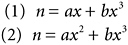
These were known as, respectively, “the cosa and the cube equal to a number” and “the censi and the cube equal to a number.” A third type, not listed by Pacioli as impossible (I don’t know why) was “the cosa and a number equal to a cube”:

This looks to be the same as a type 1 to us, but that’s because we take negative numbers in our stride. In Cardano’s time, negative numbers were only just beginning to be acknowledged as having independent existence.
At some point in the early 16th century, a person named Scipione del Ferro found the general solution to the type-1 cubic. Del Ferro was professor of mathematics at the University of Bologna; his dates are ca. 1456–1526. We don’t know exactly when he got his solution or whether he also solved type 2. He never published his solution.
Before del Ferro died, he imparted the secret of his solution for “the cosa and the cube” to one of his students, a Venetian named Antonio Maria Fiore. This poor fellow has gone down in all the history books as a mediocre mathematician. I don’t doubt the judgment of the historians, but it seems a great misfortune for Fiore to have gotten mixed up—as a catalyst, so to speak—in such a great and algebraically critical affair, so that his mathematical mediocrity echoes down the ages like this. At any rate, having gotten the secret of the cosa and the cube, he decided to make some money out of it. This wasn’t hard to do in the buzzing intellectual vitality of northern Italy
at the time. Patronage was hard to come by, university positions were not well paid, and there was no system of tenure. For a scholar to make any kind of living, he needed to publicize himself, for example, by engaging in public contests with other scholars. If some large cash prize was at stake in the contest, so much better the publicity.
One mathematician who had made a name for himself in this kind of contest was Nicolo Tartaglia, a teacher in Venice. Tartaglia came from Brescia, 100 miles west of Venice. When he was 13, a French army sacked Brescia and put the townsfolk to the sword. Nicolo survived but suffered a grievous saber wound on his jaw, which left him with a speech impediment: Tartaglia means “stutterer”—this was still the age when last names were being formed out of locatives, patronymics, and nicknames. Tartaglia was a mathematician of some scope, author of a book on the mathematics of artillery, and the first person to translate Euclid’s Elements into Italian.
In 1530, Tartaglia had exchanged some remarks about cubic equations with another native of Brescia, a person named Zuanne de Tonini da Coi, who taught mathematics in that town. In the course of those exchanges, Tartaglia claimed to have found a general rule for the solution of type-2 cubics, though he confessed he could not solve type 1.
Somehow Fiore, the mathematical mediocrity, heard of these exchanges and of Tartaglia’s claim. Either believing Tartaglia to be bluffing or confident that he was the only person who knew how to solve type-1 cubics (the secret he had gotten from del Ferro), Fiore challenged Tartaglia to a contest. Each was to present the other with 30 problems. Each was to deliver the 30 solutions to the other’s problems to a notary on February 22, 1535. The loser was to stand the winner 30 banquets.
Having no great regard for Fiore’s mathematical talents, Tartaglia at first did not bother to prepare for the contest. However, someone passed on the rumor that Fiore, though no great mathematician himself, had learned the secret of solving “the cosa and the cube” from a master mathematician, since deceased. Now worried, Tartaglia bent
his talents to finding a general solution of type-1 cubics. In the small hours of the morning of Saturday, February 13, he cracked it. As he had suspected, all of Fiore’s problems were type-1 cubics, the solution of which was Fiore’s sole claim to mathematical ability.
Tartaglia’s questions seem (we only have the first four) to have been a mix of types 2 and 3. It is plain that at this point Tartaglia had mastered all the cubics, of any type, having just one real solution—all the ones, that is, with a positive discriminant. Cubic equations with a negative discriminant (and therefore having three real solutions) can only be solved by manipulating complex numbers, which had not yet been discovered.
At any rate, Tartaglia was able to solve all of Fiore’s problems, while Fiore could solve none of his. Tartaglia took the honor but waived the stake. Comments Cardano’s biographer: “The prospect of thirty banquets face to face with a sad loser may have been rather uninspiring to him.”48
§4.9 Cardano heard of Tartaglia’s triumph from da Coi, that same native of Brescia with whom Tartaglia had exchanged remarks about cubic equations in 1530. Da Coi had moved to Milan after his exchanges with Tartaglia. Teachers of mathematics were not in very plentiful supply in northern Italy, and Cardano engaged da Coi to teach one of his classes. It seems to have been from da Coi that Cardano got a full account of the Fiore–Tartaglia duel and about the Tartaglia–da Coi exchanges of five years earlier. At this time Cardano was writing a book whose title he envisioned as The Practice of Arithmetic, Geometry, and Algebra. Probably he thought that Tartaglia’s solution of the cubic, if he could get it, would go very nicely into the book. He accordingly embarked on a campaign to tease the secret out of Tartaglia.
The exchanges that followed make fascinating reading.49 Cardano plays Tartaglia like a master angler reeling in a fish, alternating from haughty deprecation to sweet seduction, in a correspondence that
lasted through January, February, and March of 1539. The choicest bait on Cardano’s hook was the prospect of his introducing Tartaglia to Alfonso d’Avalos, one of the most powerful men in Italy, governor (that is, under Emperor Charles V) of all Lombardy, and commander of the imperial army stationed near Milan. Tartaglia’s book on artillery had come out not long before, and Cardano claimed to have bought two copies, one for himself and one for his friend the governor. His Excellency (promised Cardano, with what truth we do not know) was anxious to meet the author.
Tartaglia hurried to Milan and stayed for several days at Cardano’s house. To switch metaphors, the fly had made straight for the spider’s web. The governor was unfortunately out of town, but Cardano treated his guest with royal hospitality, and Tartaglia finally yielded the secret of the cosa and the cube on March 25. He insisted, however, that Cardano swear a solemn oath never to reveal it. Cardano duly swore, and Tartaglia wrote down his solution to the cubic as a poem of 25 lines. The poem begins:
Quando che’l cubo con le cose appresso
Se agguaglia a qualche numero discreto …
(When the cube and the cosa together
Are equal to some whole number …)
Tartaglia, by his own account, suffered from (to switch metaphors yet again) post-seduction remorse as soon as he had left Cardano’s house. He went home to Venice and brooded. Cardano wrote to ask for clarification of some points in the poem, but Tartaglia’s response was brusque. He was mollified somewhat when Cardano’s arithmetic book came out in May; his solution of the cubic did not appear in it. That summer, however, he heard that Cardano had started work on another book, to deal specifically with algebra. Some further exchanges followed—angry and suspicious on Tartaglia’s part, soothing on Cardano’s—into 1540.
Ars magna was published in 1545. The five years between that last exchange of letters early in 1540 and the publication of Ars magna were critical in the history of algebra. Cardano, having gotten the secret of the cosa and the cube, proceeded to a general solution of the cubic equation.
From studying the irreducible case, he came to realize that there must always be three solutions. To deal with this, of course, he had to come to terms with complex numbers. He did so hesitantly and incompletely, with many doubts, which should not surprise us. Even negative numbers were still thought of as slightly mysterious. Imaginary and complex numbers must have seemed positively occult. (They still do to many people.)
Here is Cardano in Chapter 37 of Ars magna, struggling with the following problem, which is quadratic, not cubic: Divide 10 into two parts whose product is 40.
Putting aside the mental tortures involved, multiply  by
by  , making 25 − (−15), which [latter] is +15. Hence this product is 40…. This is truly sophisticated….
Indeed it was. Cardano must have labored long and hard to make such a breakthrough. His ideas went off in other directions, too. He found some numerical methods for getting approximate solutions and formed ideas about the patterns of relationship between solutions and coefficients, thereby glimpsing territory that mathematicians did not begin to explore until 150 years later.
Cardano had help in his labors. Back in 1536, he had taken on a 14-year-old lad named Lodovico Ferrari as a servant. He found the boy unusually intelligent, already able to read and write, so he promoted him to the position of personal secretary. Ferrari learned math by proofing the manuscript for the 1540 arithmetic book. We can assume that when Cardano was wrestling with cubic equations, he shared his explorations with his young secretary.
One reason we can assume this is that in 1540, Ferrari worked
out the solution to the general quartic equation. As I mentioned in my primer, this involves solving a cubic; so Ferrari could not publish his result without publishing the solution to the cubic, which he had learned from Cardano and which Cardano had sworn to Tartaglia he would not reveal.
Meanwhile, in the years since Scipione del Ferro’s death in 1526 and the Fiore–Tartaglia duel in 1535, rumors had been going round that Fiore had gotten the solution to the cube and the cosa from the late del Ferro. Spotting a possible escape from their joint moral dilemma, in 1543, Cardano and his secretary Ferrari journeyed to Bologna to talk to del Ferro’s successor at the university, who was also his son-in-law and custodian of his papers. After examining those papers, Cardano and Ferrari knew that Tartaglia had not been the first to solve the cube and the cosa. Thus supplied with a moral loophole, Cardano went ahead and included the full solutions to the cubic and quartic in Ars magna. He credited del Ferro as the one who first found a solution to the cube and the cosa and Tartaglia with having rediscovered it.
Tartaglia, who had spent the five years working quietly on his translations of Euclid and Archimedes, was of course furious. Three years of vituperative feuding followed, though Cardano kept out of it, leaving Ferrari to fight his corner. It all ended with another scholarly challenge-contest between Tartaglia and Ferrari in Milan, on August 10, 1548. We have only a brief and suspect account of the proceedings from Tartaglia’s pen. It seems clear that he got the worst of the contest.
Tartaglia died in 1557, still angry and bitter. He never did publish the solution to the cubic himself, and no unpublished version was found among his papers. There is no doubt that he independently solved the problem of the cube and the cosa, but the glory is commonly divided between del Ferro, who had first cracked one type of cubic, and Cardano, who mastered cubics in all their generality and was godfather to the solution of the quartic.