Unknown Quantity: A Real and Imaginary History of Algebra (2006)
Chapter: 5 Relief for the Imagination
Chapter 5
RELIEF FOR THE IMAGINATION
§5.1 THERE WERE TWO GREAT ADVANCES in algebra across the early modern period in Europe, by which I mean the two centuries from the fall of Constantinople (1453) to the Peace of Westphalia (1648). They were (1) the solution of the general cubic and quartic equations and (2) the invention of modern literal symbolism—the systematic use of letters to stand for numbers.
The first of those advances was accomplished by northern Italian mathematicians from about 1520 to 1540, the period of most concentrated creativity probably being the joint deliberations of Cardano and Ferrari in 1539–1540. That is the story I told in Chapter 4.
The second was largely the work of two Frenchmen: François Viète50 (1540–1603) and René Descartes (1596–1650). It proceeded in parallel with another development: the slow discovery of complex numbers, and their gradual acceptance as part of the standard mathematical toolbox. This latter development was more properly arithmetic (concerned with numbers) than algebraic (concerned with polynomials and equations). As we have seen, though, it drew its inspiration from algebra. If you graph an “irreducible” cubic polynomial (see Figure CQ-6), it plainly has three real zeros; yet if you apply
the algebraic formulas to solve the corresponding equation and disallow complex numbers, there are no real solutions at all!
There are other reasons to offer complex numbers a guest ticket to the history-of-algebra party. They are, for example, the first hint of the key algebraic concept of linear independence, which I shall discuss later and which led to the theories of vectors and tensors, making modern physics possible. If you add 3 to 5, you get 8: the three-ness of the 3 and the five-ness of the 5 have merged and been lost in the eight-ness of the 8, like two droplets of water coalescing. If, however, you add 3 to 5i, you get the complex number 3 + 5i, a droplet of water and a droplet of oil—linear independence.
I shall therefore say what is necessary and interesting to say about the discovery of complex numbers. The first mathematician to take these strange creatures even half-seriously was Cardano, as we have seen. The first to tackle them with any confidence was Rafael Bombelli.
§5.2 Bombelli was from Bologna, where Scipione del Ferro had taught. He was born in 1526, the year del Ferro died. He was therefore a clear generation younger than Cardano. As is often the case, what was a struggle for one generation to grasp came much more easily to the following generation. Bombelli would have been 19 when Ars magna appeared—just the right age to be receptive to its influence.
Bombelli was a civil engineer by trade. His first big commission was land reclamation work, draining some marshes near Perugia in central Italy. This task took from 1549 to 1560. It was a great success and made Bombelli’s name in his profession.
Bombelli admired Ars magna but felt that Cardano’s explanations were not clear enough. At some point in his 20s, he conceived the ambition to write an algebra book of his own, one that would enable a complete beginner to master the subject. The book, titled l’Algebra, was published in 1572, a few months before Bombelli’s death, so presumably he was working on it for a quarter of a century, from his
early 20s to his mid-40s. The work must have gone through many changes and revisions, but one that we know of is particularly noteworthy.
Around 1560, Bombelli was in Rome. There he met and talked math with Antonio Maria Pazzi, who taught the subject at the university in that city. Pazzi mentioned that he had found in the Vatican library a manuscript on arithmetic and algebra by “a certain Diophantus,” a Greek author of the ancient world. The two men examined the text and decided to make a translation of it. The translation was never finished, but there is no doubt Bombelli got much inspiration from studying Diophantus. He included 143 of Diophantus’s problems in l’Algebra, and it was through his book that Diophantus’s work first became known to European mathematicians of the time.
Recall that Diophantus, though he had no conception of negative numbers as mathematical objects in their own right and would not accept them as solutions to problems, nonetheless allowed them a shadowy existence in his intermediate calculations and formulated the rule of signs for this purpose. Cardano seems to have regarded complex numbers in a similar fashion, as having no meaning in themselves but being useful devices for getting from a real problem to a real solution.
Bombelli’s approach to negative and complex numbers was more mature. Negative numbers he took at face value, restating the rule of signs more clearly than had Diophantus:
più via più fa più
meno via più fa meno
più via meno fa meno
meno via meno fa più
Here più means “positive,” meno “negative,” via “times,” and fa “makes.”
In l’Algebra, Bombelli takes on the irreducible cubic, finding a solution of the equation x3 = 15x + 4. Using Cardano’s method, he gets

By some ingenious arithmetic, he works out the cube roots to be  and
and  , respectively. Adding these, he gets the solution x = 4. (The other solutions, which he does not get, are
  and
and  .)
.)
The complex numbers here are like Diophantus’s negative numbers—a sort of internal trick for getting from a “real” problem to a “real” solution. They are, as it were, catalytic. “Sophistic” is what Bombelli actually called them. He accepted them as legitimate working devices, though, and even gave a sort of “rule of signs” for multiplying them:
più di meno via più di meno fa meno
più di meno via meno di meno fa più
meno di meno via più di meno fa più
meno di meni via meno di meno fa meno
Here più di meno, “positive from negative,” means  , while meno di meno, “negative from negative,” means
  , N being some positive number, via and fa as before. So the third line of the jingle means: If you multiply
  by
by  , you will get a positive result. This is quite true: The result will be N. The ordinary rule of signs (− times +) gives us a negative; squaring the square root gives us −N, and the negative of −N is N.
Bombelli’s l’Algebra is a great step forward in mathematical understanding, but he was still held back by lack of a good symbolism. For the formula

he writes
Moltiplichisi, R.c. [2 più di meno R.q.3] per
R.c. [2 meno di meno R.q.3]
Here “R.q.” means a square root, “R.c.” a cube root. Note the use of brackets. As symbolism goes, this is an improvement on Cardano’s generation but not by much.
§5.3 The 16th century was not a happy time to be a French citizen. Much of the reign of Francis I (1515–1547)—and much of the national wealth, too—was consumed by wars against the Emperor Charles V. No sooner were the combatants thoroughly exhausted (Treaty of Cateau-Cambrésis, 1559) than French Catholics and Protestants—the latter commonly called Huguenots51—set to massacring one another.
They continued to do so until the Edict of Nantes (1598) put an end, or at any rate an 87-year pause, to it all. The previous 36 years had seen eight civil wars among the French and a change of dynasty to boot (Valois to Bourbon, 1589). These wars were not purely religious. Elements of regional sentiment, social class, and international politics played their parts. Philip II of Spain, one of the greatest troublemakers of all time, did his best to keep things boiling.52 So far as class was concerned, the Huguenots were strong among the urban middle classes, but much of the nobility—perhaps a half—were Protestant, too. Peasants, by contrast, remained overwhelmingly Catholic in most regions.
François Viète was born in 1540 into a Huguenot family. His father was a lawyer. He graduated with a law degree from the University of Poitiers in 1560. The French wars of religion began less than two years later, with a massacre of Huguenots at Vassy in the Champagne region.
Viète’s subsequent career was shaped by the wars. He gave up lawyering to become tutor to an aristocratic family. Then in 1570, he moved to Paris, apparently in the hope of government employment. The young Charles IX was king at this time, but his mother Catherine de’ Medici (who was also the mother-in-law of Philip II of Spain) was the real power center. Her policy of playing off Huguenots against
Catholics in order to keep the throne strong and independent of all factions determined the course of French history through the 1560s, 1570s, and 1580s, and often produced paradoxical results. Thus Viète was in Paris when Charles authorized the general massacre of Huguenots on St. Bartholomew’s Eve (August 23, 1572); yet the following year, Viète, a Huguenot, was appointed by the king to a government position in Brittany.
Charles died in 1574, to be succeeded by Henry III, Catherine’s third son. Viète returned to Paris six years later to take up a position as adviser to this king. Catherine’s youngest son died in 1584, however, leaving the Valois line without an heir. Henry III, though he was married and only 33 years old, was flamboyantly gay, wont to show up at court functions in drag. It was thought unlikely that he would produce a son. That left his distant relative Henry of Navarre, of the Bourbon family, as lawful heir to the throne. That Henry, however, was a Protestant, a fact that alarmed Catholics both inside and outside France. Infighting at the court became very intense. Viète was forced out and obliged to take a five-year sabbatical in his home district, at the little town of Beauvoir-sur-Mer on the Bay of Bourgneuf. This period, 1584–1589, was Viète’s most mathematically creative—unusual as mathematical creativity goes, for he was in his late 40s. The court politics of France at this point were so convoluted that it is hard for the historian of mathematics to know whom to thank.
Just four months after Viète’s return to court, Henry III was assassinated, stabbed while sitting on his commode. Henry of Navarre became Henry IV, first king of the Bourbon dynasty. The fact of the new king’s being a Protestant suited Viète, who happily joined his entourage. The Catholics, however, were not about to allow Henry IV’s accession without a fight, even though they could not agree on a rival candidate for the throne. Philip of Spain favored his own daughter and intrigued with factions at the French court on her behalf. These intrigues relied on letters written in a code. Finding he had a mathematician at hand, Henry set Viète the task of cracking the Spanish code. Viète, after some months of effort, finally did so. When it
dawned on Philip that his unbreakable code had been broken, he complained to the Pope that Henry was using witchcraft.
§5.4 Viète continued to serve Henry IV until he was dismissed from the court in December of 1602. He then returned to his hometown and died a year later.
Next to Viète’s cryptographic triumph, the mathematical high point of his royal service came in 1593. In that year the Flemish mathematician Adriaan van Roomen published a book titled Ideae mathematicae, which included a survey of all the prominent mathematicians of the day. The Dutch ambassador to Henry IV’s court pointed out to Henry that not a single French person was listed. To drive the point home, he showed the king a problem in Roomen’s book, one for the solution of which the author was offering a prize. The problem was to find numbers x satisfying an equation of the 45th degree, beginning x45 − 45x43 + 945x41 − 12300x39…. Surely, sneered the diplomat (who seems not to have been very diplomatic), no French mathematician could solve this problem. Henry sent for Viète, who found a solution on the spot and came up with 22 more the following day.
Viète knew, of course, that Roomen had not just given any old random equation. It had to be one that Roomen himself knew how to solve. A man of his time, Viète also had his head full of trigonometry, a great mathematical growth point just then.53 His first two books had been collections of trigonometric tables. Trigonometry—the study of numerical relations between the arc lengths and chord lengths of a circle—is full of long formulas involving sines, cosines, and their powers. Some speedy mental arithmetic on the first few coefficients in the equation would have told Viète that he was looking at just such a formula: the polynomial for 2 sin 45α in terms of x = 2 sin α. Trigonometry then gave him the solutions. (At least it gave him the 23 positive solutions. There are also 22 negative ones, which Viète ignored, apparently considering them meaningless.)
§5.5 The fruit of those five years of seaside exile when Viète was in his 40s was a book titled In artem analyticem isagoge (“Introduction to the Analytic Art”). The Isagoge represents a great step forward in algebra and a small step backward. The forward step was the first systematic use of letters to represent numbers. The germ of this idea goes back to Diophantus, but Viète was the first to deploy it effectively, making a range of letters available for many different quantities. Here is the beginning of modern literal symbolism.
Viète’s literal symbolism was not restricted to the unknown quantity, as all previous such schemes had been. He divided quantities into two classes: unknown quantities, or “things sought” (quaesita), and known ones, or “things given” (data). The unknowns he denoted by uppercase vowels A, E, I, O, U, and Y. The “things given” he denoted by uppercase consonants: B, C, D, …. Here, for example, is the equation bx2 + dx = z in Viète’s symbolism:
B in A Quadratum, plus D plano in A, aequari Z solido.
His A, the unknown, is our x. The other symbols are all data.
That “plano” and “solido” show the backward step I mentioned. Viète was strongly influenced by the geometry of the ancients and wanted to base his algebra rigorously on geometrical concepts. This, as he saw it, obliged him to follow a law of homogeneity, obliging every term in an equation to have the same dimension. Unless otherwise specified, every symbol stands for a line segment of the appropriate length. In the equation given above, b and x (Viète’s B and A) therefore have one dimension each. It follows that bx2 has three dimensions. Therefore dx must also have three dimensions, and so must z. Since x is a one-dimensional line segment, d must be two-dimensional—hence, “D plano.” Similarly, z must be three-dimensional: “Z solido.”
You can see Viète’s point, but this law of homogeneity cramps his style and makes some of his algebra difficult to follow. It also seems a little odd that a man so deft with polynomials of the 45th degree
should have rooted himself so firmly in classical geometry and its mere three dimensions.
§5.6 Viète’s treatment of equations was in some ways less “modern” than Bombelli’s. He was, as I have said, averse to negative numbers, which he did not admit as solutions. His attitude to complex numbers was even more retrograde. He did deal with cubic equations, but in a book about geometry, where he offers a trigonometric solution based on the formula for sin 3α in terms of sin α.
In one respect, though, Viète was a pioneer in the study of equations, and lit a candle which, 200 years later, flared into a mighty beacon. This particular discovery was not published in his lifetime. Twelve years after Viète’s death, his Scottish friend Alexander Anderson published two of his papers on the theory of equations. In the second paper, titled De equationem emendatione (“On the Perfecting of Equations”), Viète opened up the line of inquiry that led to the study of the symmetries of an equation’s solutions, and therefrom to Galois theory, the theory of groups, and all of modern algebra.
Consider the quadratic equation x2 + px + q = 0. Suppose the two solutions of this equation—the actual numbers that make it true—are α and β. If x is α or x is β, and never otherwise, the following thing must be true:

Since α and β, and no other values of x at all, make this equation true, it must be just a rewritten form of the equation we started with. Now, if you multiply out those parentheses in the usual way, this rewritten equation amounts to

Comparing this equation with the original one, it must be the case that

Here we have relationships between the solutions of the equation and the coefficients. You can do a similar thing for the cubic equation x3 + px2 + qx + r = 0. If the solutions of this equation are α, β, and γ, then
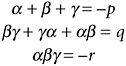
It works for the quartic x4 + px3 + qx2 + rx + s = 0, too:

And for the quintic x5 + px4 + qx3 + rx2 + sx + t = 0:
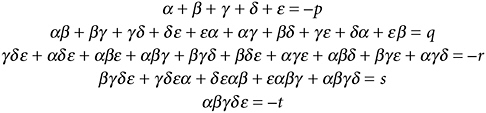
The correct way to read those lines is:
All possible singletons added together = −p
All possible products of pairs added together = q
All possible products of triplets added together = −r
etc.
These things were first written down by Viète, for these first five degrees of equations in a single unknown. A French mathematician of the following generation, Albert Girard, generalized them to an equation of any degree in his book New Discoveries in Algebra, pub-
lished in 1629, 14 years after Anderson’s publication of Viète’s paper. Sir Isaac Newton picked them up, and … but I am getting ahead of my story.
§5.7 René Descartes needs, as emcees say, no introduction. Soldier and courtier (he survived the first but not the second), philosopher and mathematician, a French subject under the first three Bourbon kings, his adult life was spent in the time of the Thirty Years War, the English Civil War, and the Pilgrim fathers; the time of Cardinal Richelieu of France and King Gustavus Adolphus of Sweden, of Milton and Galileo. He is one of the national heroes of France, though he preferred to live in the Netherlands. His birthplace, at that time named La Haye, was renamed Descartes in his honor after the French Revolution. (It is 30 miles northeast of Poitiers.) He started out in the world with a law degree from Poitiers University, just as Viète had 56 years earlier.
Descartes is popularly known for two things: for having written Cogito ergo sum (“I think, therefore I am”) and for the system named after him that identifies all the points of a plane by numbers. In Cartesian—Descartes’ Latin name was Cartesius—geometry, the numbers that identify a point are the perpendicular distances of that point from two fixed lines drawn across the plane at right angles to each other. The west-east distance is conventionally called x, the south-north distance y. These are the Cartesian coordinates of a point (see Figure 5-1).
In fact, although Descartes did write Cogito ergo sum, he did not precisely invent the Cartesian system of coordinates. The main idea of it is there in his work La géométrie (1637), but the baselines he uses are not at right angles to each other.
The ideas contained in La géométrie did, however, suffice to revolutionize both algebra and geometry—to algebraize geometry, in fact. Recall Viète’s law of homogeneity from §5.5, which rested on the idea that numbers are, fundamentally, the thought-shadows of geometri-
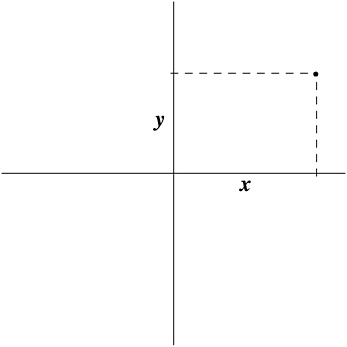
FIGURE 5-1 Cartesian coordinates.
cal objects. Even when presented with a 45th power, Viète’s mind turned at once to a geometrical notion—a circular arc divided into 45 equal parts. Descartes stood this on its head. Geometrical objects, he showed, might just be convenient representations of numbers. The product of two line segment lengths need not be thought of as the area of some rectangle; it can be represented by another line segment—Descartes gave a convincing example.
This was not an especially original thought in itself, but by proceeding to build his entire scheme of geometry on it, Descartes chopped through the last hawsers connecting algebra to classical geometry, allowing his new “analytic geometry” to soar up into the heavens. It was further enabled to do so by Descartes’ adoption of a clearer and more manageable system of algebraic notation. He took up the plus and minus signs from the German Cossists of the
previous century, and also their square root sign (to which he added the overbar, turning √ into √). He used superscripts for exponentiation, though not for squares, which he mostly wrote as aa, instead of a2—a practice some mathematicians continued into the late 19th century.
Perhaps most important, Descartes gave us the modern system of literal symbolism, in which lowercase letters from the beginning of the alphabet are used to stand for numbers given, the data, and letters from the end of the alphabet for numbers sought, the quaesita. Art Johnson, in his book Classic Math, has a story about this.
The predominant use of the letter x to represent an unknown value came about in an interesting way. During the printing of La géométrie … the printer reached a dilemma. While the text was being typeset, the printer began to run short of the last letters of the alphabet. He asked Descartes if it mattered whether x, y, or z was used in each of the book’s many equations. Descartes replied that it made no difference which of the three letters was used to designate an unknown quantity. The printer selected x for most of the unknowns, since the letters y and z are used in the French language more frequently than is x.
Reading La géométrie, in fact, you feel that you are looking at a modern mathematical text. It is the earliest book for which this is true, I think. The only real oddity is the absence of our modern equals sign: Descartes used a little symbol like an infinity sign with the left end cut off.
The introduction of a good workable literal symbolism was a great advance in mathematics. It was not Descartes’ alone—we have seen how Viète began the systematic use of letters for numbers, and in the case of unknowns the original inspiration goes back to Diophantus.
It would be unjust not to mention the Englishman John Harriot here, too. Harriot, who lived from 1560 to 1621, was of the genera-
tion between Viète and Descartes. He spent many years in the service of Sir Walter Raleigh, traveling on at least one of Raleigh’s expeditions to Virginia. He was a keen mathematician and, likely under the inspiration of Viète, used letters of the alphabet for both data and quaesita. Fluent in the theory of equations, Harriot considered both negative and complex solutions. Unfortunately, none of this came to light until some years after his death,54 as he published no math while alive. Historians of math like to debate how much Descartes borrowed from Harriot—La géométrie appeared six years after Harriot’s algebraic work was published (in a clumsily edited form). So far as I know, however, no one has been able to reach a firm conclusion on the matter of Descartes’ debt to Harriot.
It was, at any rate, Descartes who first made widely known and available a system of literal symbolism robust enough to need no substantial changes over the next four centuries. Not only was this a boon to mathematicians, it inspired Leibniz’s dream of a symbolism for all of human thought, so that all arguments about truth or falsehood could be resolved by calculation. Such a system would, said Leibniz, “relieve the imagination.” When we compare Descartes’ mathematical demonstrations with the wordy expositions of earlier algebraists, we see that a good literal symbolism really does relieve the imagination, reducing complex high-level thought processes to some easily mastered manipulations of symbols.
In 1649, Queen Christina of Sweden, Gustavus Adolphus’s daughter, persuaded Descartes to teach her philosophy. She sent a ship to fetch him, and Descartes took up residence with the French ambassador in Stockholm. Unfortunately, the queen was an early riser, while Descartes had been accustomed since childhood to lie in bed until 11 a.m. Trudging across the windy palace squares at 5 a.m. through the bitter Swedish winter of 1649–1650, Descartes caught pneumonia and died on February 11 that latter year. Isaac Newton was just seven years old.