Unknown Quantity: A Real and Imaginary History of Algebra (2006)
Chapter: 10 Victoria's Brumous Isles
Chapter 10
VICTORIA’S BRUMOUS ISLES
§10.1 HERE IS ENGLISH MATHEMATICIAN George Peacock in his Treatise on Algebra, published in 1830:
[Arithmetic] can only be considered as a Science of Suggestion, to which the principles and operations of Algebra are adapted, but by which they are neither limited nor determined.
(My italics.) Here, 10 years later, is the young (he was 27 at the time) Scottish mathematician Duncan Gregory, who had studied under Peacock:
There are a number of theorems in ordinary algebra, which, though apparently proved to be true only for symbols representing numbers, admit of a much more extended application. Such theorems depend only on the laws of combination to which the symbols are subject, and are therefore true for all symbols, whatever their nature may be, which are subject to the same laws of combination.
And here is another Englishman, Augustus De Morgan, in his Trigonometry and Double Algebra (1849):
Given symbols M, N, +, and one sole relation of combination, namely that M + N is the same as N + M. Here is a symbolic calculus: how can it be made a significant one? In the following ways, among others. 1. M and N may be magnitudes, and + the sign of addition of the second to the first. 2. M and N may be numbers, and + the sign of multiplying the first by the second. 3. M and N may be lines, and + the direction to make a rectangle with the antecedent for a base, and the consequent for an altitude. 4. M and N may be men and + the assertion that the antecedent is the brother of the consequent. 5. M and N may be nations, and + the sign of the consequent having fought a battle with the antecedent.
Plainly algebra was cutting loose from the world of numbers in the second quarter of the 19th century. What was driving this process? And why were those declarations all uttered by mathematicians from the British Isles?
§10.2 As the 18th century progressed, British mathematics lagged further and further behind developments on the continent. In part this was Sir Isaac Newton’s fault; or rather, it was a by-product of the swelling self-regard of the British, for most of whom Sir Isaac was a national hero. This swelling action had, in the proper Newtonian manner, an equal and opposite reaction: The great continental nations set up their own culture heroes in opposition to Newton. Descartes served this purpose for the French. The aforementioned book by Patricia Fara95 records a patriotic British drinking song from around 1760:
The atoms of [Des]Cartes Sir Isaac destroyed
Leibnitz [sic] pilfered our countryman’s fluxions;
Newton found out attraction, and prov’d nature’s void
Spite of prejudiced Plenum’s constructions.
Gravitation can boast,
In the form of my toast,
More power than all of them knew, Sir.
The Germans in fact had two anti-Newton icons: not only Leibniz but also Goethe, who was a bitter critic of Newton’s optical theories. “Goethe’s house in Weimar is still decorated with a defiantly anti-Newtonian rainbow,” Ms. Fara tells us.96
All this was unfortunate for British mathematics because the notation Newton had devised for the operations of the calculus was definitely inferior to the one promoted by Leibniz and then taken up all over the continent. Patriotic Britons stuck with Newton’s “dot” notation instead of taking up Leibniz’s d’s—that is, writing, for example,  where the continentals wrote

This had an isolating and retarding effect on British calculus.97 It made British papers tiresome for continental mathematicians to read and obscured the fact, whose significance was now dawning, that x (here a function of t) is being acted on by an operator,

that could be detached and considered a mathematical object in its own right.
Even allowing for the Newton factor, though, it is hard to avoid the impression that stiff-necked national pride and insularity were independently working to hold British mathematics back. Complex numbers, for example, had long since “settled in” to European mathematics. In Britain, by contrast, even negative numbers were still scorned by some professional mathematicians, as witness the following, taken from the preface to William Frend’s Principles of Algebra (1796):
[A number] submits to be taken away from a number greater than itself, but to attempt to take it away from a number less than itself is ridiculous. Yet this is attempted by algebraists who talk of a number less than nothing; of multiplying a negative number into a negative
number and thus producing a positive number; of a number being imaginary…. This is all jargon, at which common sense recoils; but from its having been once adopted, like many other figments, it finds the most strenuous supporters among those who love to take things upon trust and hate the colour of a serious thought.
Frend was no lone crank, either. He had been Second Wrangler—that is, second in the year’s mathematics examination—at Christ’s College, Cambridge, in 1780. He became one of Britain’s first actuaries. Later he struck up a friendship with that Augustus De Morgan I quoted from in the previous section, and De Morgan married one of his daughters.
By the early years of the 19th century, the younger generation of British mathematicians had become dissatisfied with this state of affairs. The long wars against Napoleon had had the double effect of forcing Britons to pay attention to continental ideas more than formerly and of bringing home to mathematicians of the offshore nation (a single United Kingdom since the 1801 Act of Union) how very good French mathematics was.
In 1813, three young scholars at Trinity College, Cambridge—Sir Isaac Newton’s old college—took action, founding what they called the Analytical Society. These three scholars, all born in 1791 or 1792, were John Herschel, son of the astronomer who had discovered Uranus; Charles Babbage, later famous for his “calculating engine” (a sort of mechanical computer); and the George Peacock I quoted above. The main purpose of their society was to reform the teaching of calculus, promoting, as Babbage punned, “the principles of pure d-ism as opposed to the dot-age of the university.”
The Analytical Society does not seem to have lasted very long, and none of the three founders attained the first rank in mathematics, but the spirit the society embodied was carried forward by Peacock, an energetic and idealistic reformer, very much in the style of his time. After graduating he became a lecturer at Trinity and then, in 1817, an examiner in mathematics. His first act on being appointed
examiner was to switch the calculus teaching from Newton’s dot-age to Leibniz’s d-ism.
Peacock went on to become a full professor and was instrumental in the establishment of several learned societies, notably the Astronomical Society of London, the Philosophical Society of Cambridge, and the British Association for the Advancement of Science. All these new societies were open to any person of ability and accomplishment, a break with the older idea of a learned society as a sort of gentlemen’s club that carefully excluded self-educated working people and “rude mechanicals.” The technocratic lower-middle classes of the early Industrial Revolution were flexing their muscles. Peacock ended his days happily as dean of Ely cathedral in eastern England.
This general spirit of reform is the background to British mathematics in this period. Its fruits can be seen in the next generation of British mathematicians, most especially algebraists. I have already described the work of Hamilton, born in 1805. Close behind came De Morgan (born 1806), J. J. Sylvester (1814), George Boole (1815), and Arthur Cayley (1821). These men rescued their country’s mathematical reputation, at least in algebra. To them we owe all or part of the theory of groups, the theory of matrices, the theory of invariants, and the modern theory of the foundations of mathematics.98
§10.3 Augustus De Morgan is the least mathematically consequential of the four men I just named but in many ways the most interesting. He also has a special place in this author’s heart, having served as the very first professor of mathematics at my own alma mater: University College, London—“the godless institution on Gower Street.”
The great old English universities of Oxford and Cambridge entered the 19th century still cumbered with much religious, social, and political baggage left over from their earlier histories. Neither accepted women, for example; both required a religious test—basically, a declaration of loyalty to the Church of England and its doctrines—for masters and fellows. (Oxford actually required it for graduation.)
These restrictions99 had come to seem absurd to a great many people, and once the Napoleonic Wars were done with and a spirit of reform was in the air, there was a rising sentiment in the British intellectual classes for a more progressive institution of higher education. This sentiment found practical expression at last in the founding of the University of London, which admitted its first students in 1828.
The new university was the first institution of higher education in England to accept students of any sex, religion, or political opinion.100 Other colleges quickly came up in other parts of the city. The University of London is now, in the early 21st century, multicollegiate, like the older universities, and the original Gower Street establishment is known as University College.
The founding of this new university was very timely for Augustus De Morgan. He had taken his bachelor’s degree at Trinity College, Cambridge. Peacock had been one of his teachers; another had been George Airy, who later became Astronomer Royal, and who has a mathematical function named after him.101 On graduating fourth in the mathematical exams in 1826, De Morgan contemplated taking a master’s degree. However, that religious test was required. De Morgan seems to have been of a naturally (“deeply” says his biographer W. S. Jevons) religious disposition, but his religion was personal, and he was no friend of any organized church, certainly not the Church of England.
Always a man of strong principle, De Morgan declined to take the tests, went home to London, and, like Cayley 20 years later, resigned himself to becoming a lawyer. He had barely registered at Lincoln’s Inn, however, when the new university opened, and he was offered the chair of mathematics. He took it, delivering his first lecture—“On the Study of Mathematics”—in Gower Street at the age of 22. De Morgan then held the professorship until 1866, when he resigned on a point of principle.
A bookish and good-natured man, De Morgan strikes the reader of his biographies as a person one would like to have invited to dinner. A great popularizer of science, he contributed eagerly to the many
societies and little magazines that catered to the rising technical and commercial classes of late-Georgian, early-Victorian Britain. (“His articles of various length cannot be less in number than 850”—Jevons.) He was a bibliophile and a good amateur flautist. His wife ran an intellectual salon, in the old French style, from their home at 30 Cheyne Walk, Chelsea. His daughter wrote fairy tales. A particularly creepy one, “The Hair Tree,” haunted my own childhood.
De Morgan had a puzzler’s mind, with a great love of verbal and mathematical curiosities, some of which he collected in his popular book A Budget of Paradoxes (printed posthumously by his widow in 1872). He was especially pleased to know that he was x years old in the year x2, a distinction that comes to very few,102 and that his name was an anagram of: “O Gus! Tug a mean surd!”
§10.4 De Morgan’s importance for the history of algebra is his attempt to overhaul logic and improve its notations. Logic had undergone very little development since its origins under Aristotle. As taught up to De Morgan’s time, it rested on the idea that there were four fundamental types of propositions, two affirmative and two negative. The four types were:
Universal, affirmative (“All X is Y”)
Particular, affirmative (“Some X is Y”)
Universal, negative (“No X is Y”)
Particular, negative (“Some X is not Y”)
Such propositions can be combined in sets of three, called syllogisms, two premises leading to a conclusion:
All men are mortal
Socrates is a man
Socrates is mortal
There was in De Morgan’s time a Sir William Hamilton, professor of logic and metaphysics at Edinburgh, not the same person as the Sir William Rowan Hamilton of my Chapter 8, though the two are often confused.103 In some 1833 lectures on logic, this “other Hamilton” suggested an improvement to the Aristotelian scheme. He thought it wrong of Aristotle to have quantified the subjects of his propositions (“All X …,” “Some X …”) but not the predicates (“… is Y,” … is not Y”). His suggested improvement was the quantification of the predicate.
De Morgan took up this idea and ran with it, eventually producing a book titled Formal Logic, or the Calculus of Inference, Necessary and Probable (1847). He followed the book in subsequent years with four further memoirs on the subject, intending all these writings to stand as a vast new system of logic built around an improved notation and the quantification of the predicate. Sir William Hamilton, who had supplied the original idea, was not much impressed. He referred to De Morgan’s system as “horrent with spiculae” (that is, bristling with spikes). It is nowadays only a historical curiosity, since De Morgan merely improved the traditional way of writing out logical formulas. What was really needed for progress in logic was a fully modern algebraic symbolism. That was supplied by George Boole.
§10.5 Boole was one of the “new men” of early 19th-century Britain, from humble origins and self-taught, financed by no patron and with nothing but his own merit and energy to help him rise. The son of a small-town cobbler and a lady’s maid, Boole got such learning as his parents could afford, supplementing it with intensive studies of his own. At age 14, he was producing translations of Greek verse. When George was 16, however, his father’s affairs collapsed, and George had to take a job as a schoolmaster to support the family. He continued schoolmastering for 18 years, running his own schools for the most part. He opened his first when he was just 19.
Meanwhile he had taken up the serious study of mathematics, from about age 17. He quickly taught himself calculus. By his mid-20s he was publishing regularly in the Cambridge Mathematical Journal, with the encouragement of Duncan Gregory, the journal’s first editor, whom I quoted earlier in this chapter. He began a correspondence with De Morgan in 1842, and De Morgan helped Boole to get a paper on differential equations published by the Royal Society.
When, in 1846,104 the British government announced an expansion of higher education in Ireland, Boole’s admirers—among them De Morgan, Cayley, and William Thomson (later Lord Kelvin, after whom the temperature scale is named)—agitated for Boole to be given a professorship at one of the new colleges. They were successful, and in 1849 Boole became professor of mathematics at Queen’s College, Cork. He served in that position for 15 years, until a November day in 1864 when he walked the two miles from his house to the college in pouring rain, lectured in wet clothes, and caught a chill. His wife believed that a disease should be treated by methods resembling the cause, so she put George in bed and threw buckets of icy water over him. The result, as mathematicians say, followed.
I have been unable to find any source with an unkind word to say about George Boole. Even after discounting for the hyperbole of sympathetic biographers, he seems to have been a good man, to near the point of saintliness. He was happily married to a niece of Sir George Everest, the man the Himalayan mountain was named after. They had five daughters, the middle one of whom, Alicia Boole Stott, became a self-taught mathematician herself, did important work in multidimensional geometry, and lived to be 80, dying in World War II England.105
Boole’s great achievement was the algebraization of logic—the elevation of logic into a branch of mathematics by the use of algebraic symbols. To illustrate Boole’s method, here is an algebraized version of that syllogism I showed above.
Let us restrict our attention to the set consisting of all living things on Earth. This will be our “universe of discourse,” though
Boole did not use this term, which was only coined in 1881, by John Venn. Denote this universe by 1. In the same spirit, use 0 to denote the empty set, the set having no members at all. Now consider all mortal living things, and denote this set by x. (Possibly x = 1; it makes no difference to the argument.) Similarly, use y to denote the set of all men and s the set whose only member is Socrates.
Two more notations: First, if p is a set of things and q is a set of things, I shall use the multiplication sign to show their intersection: p × q represents all things that are in both p and q. (There may be no such things. Then p × q = 0.) Second, I shall use the subtraction sign to remove that intersection: p − q represents all the things that are in p but not also in q.
Now I can algebraize my syllogism. The phrase “all men are mortal” can be restated as: “the set of living things that are a man AND not mortal is the empty set.” Algebraically: y × (1 − x) = 0. Multiplying out the parenthesis and applying al-jabr, this is equivalent to y = y × x. (Translating back: “The set of all men is just the same as the set of all men who are mortal.”)
“Socrates is a man” similarly algebraizes as s × (1 − y) = 0, equivalent to s = s × y. (“The set consisting just of Socrates is identical to the set whose members are at one and the same time Socrates and men.” If Socrates were not a man, this would not be so; the latter set would be empty!)
Substituting y = y × x in the equation s = s × y, I get s = s × (y × x). By the ordinary rules of algebra, I can reposition the parentheses like this: s = (s × y) × x. But s × y I have already shown to be equal to s. Therefore s = s × x, equivalent to s × (1 − x) = 0. Translation: “The set of living things that are Socrates AND not mortal is empty.” So Socrates is mortal.
In a much-quoted remark that first appeared in a 1901 paper, Bertrand Russell said: “Pure mathematics was discovered by Boole, in a work which he called The Laws of Thought (1854).” Russell goes on to let a little of the air out of that remark: “[I]f his book had really contained the laws of thought, it was curious that no one should ever
have thought in such a way before….” Russell was also speaking from a point of view he himself had arrived at about the relationship between mathematics and logic: that mathematics is logic, a belief no longer widely held today.
Most modern mathematicians would respond to Russell’s remark by saying that what Boole had actually invented was not pure mathematics but a new branch of applied mathematics—the application of algebra to logic. The subsequent history of Boole’s ideas bears this out. His algebra of sets was turned into a full logical calculus later in the 19th century by the succeeding generation of logicians: Hugh McColl, Charles Sanders Peirce (son of the Benjamin mentioned in §8.9), Giuseppe Peano, and Gottlob Frege. This logical calculus then flowed into the great stream of 20th-century inquiry known on math department lecture timetables as “Foundations,” in which mathematical techniques are used to investigate the nature of mathematics itself.
Since that stream is not commonly considered to be a part of modern algebra, I shall not follow it any further. A history of algebra would not be complete without some account of Boolean algebra, though; so there he stands, George Boole of Lincoln, the man who married algebra to logic.
§10.6 Of the great generation of British mathematicians born in the first quarter of the 19th century, I have already given passing mention to Arthur Cayley in connection with the theory of matrices. That was by no means Cayley’s only large contribution to algebra, though. He has a fair claim to having been the founder of modern abstract group theory, the topic of my next chapter. It is therefore convenient, as well as fair, to cover that aspect of Cayley’s work here, before heading back to the European mainland.
The English word “group,” in its modern algebraic meaning, first appears in two papers Cayley published in 1854, both under the same title: “On the Theory of Groups, as Depending on the Symbolic Equation θn = 1.” I am going to give a fuller account of early group theory
in the next chapter. Here I only want to bring out a very useful feature of Cayley’s 1854 presentation, as a sort of introduction to the topic.
Back in §9.2, when discussing determinants, I did some ad hoc work on the permutations of three objects and listed the six possibilities for such permutations. To explain Cayley’s advance, I need to say much more about permutations and to introduce a good way of writing them. Three or four different ways to denote permutations have been in favor at one time or another, but modern algebraists seem to have definitely settled into the cycle notation, and that is the one I shall use from now on.
Cycle notation works like this. Consider three objects—apple, book, and comb—in three boxes labeled 1, 2, and 3. Consider this to be a “starting state”: apple in box 1, book in box 2, comb in box 3. Define the “identity permutation” to be the one that changes nothing at all. If you apply the identity permutation to the starting state, the apple will stay in box 1, the book will stay in box 2, and the comb will stay in box 3.
Note—this is a point that often confuses beginning students—that a permutation acts on the contents of boxes, whatever those might be at any point. The permutation: “switch the contents of the first box with the contents of the second” is written in cycle notation as (12). This is read: “[The object in box] 1 goes to [box] 2; [the object in box] 2 goes to [box] 1.” As the square brackets indicate, what a mathematician actually thinks when he sees that cycle notation is: “1 goes to 2, 2 goes to 1.” Note the wraparound effect, the last number listed in the parentheses permuting to the first. That’s why the notation is called cyclic!
Suppose we apply this permutation to the starting state. Then the apple will be in box 2, the book in box 1. If I then apply the do-nothing identity transformation, the apple remains in box 2, the book remains in box 1, and of course the comb remains in box 3. Using a multiplication sign to indicate the compounding of permutations, (12) × I = (12).
Suppose I did the (12) permutation from the starting state and then did it again. Doing it the first time, the apple goes to box 2 and the book to box 1. Doing it the second time, the book goes to box 2 and the apple to box 1. I am back at the starting state. In other words, (12) × (12) = I.
Working like this, you can build a complete “multiplication table” of permutations on three objects. Consider the more complex permutation written as (132) in cycle notation. This is read: “[The object in box] 1 goes to [box] 3; [the object in box] 3 goes to [box] 2; [the object in box] 2 goes to [box] 1.” Well, this permutation, applied to the starting state, would put the apple in box 3, the comb in box 2, and the book in box 1. (“1 goes to 3, 3 goes to 2, 2 goes to 1.”) And if I then apply the (12) permutation, the comb would be in box 1, the book in box 2, and the apple in box 3—just as if, from the starting state, I had applied the permutation (13). To put it algebraically: (132) × (12) = (13).
As I said, you can build up an entire multiplication table this way. Here it is. To see the result of applying first a permutation from the list down the left-hand side, then one from the list along the top, just look along the appropriate row to the appropriate column.
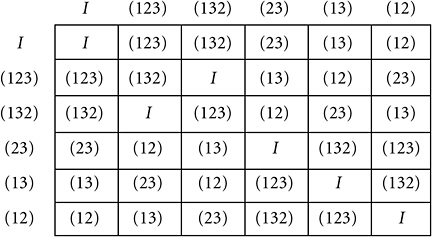
FIGURE 10-1 The Cayley table for the group S3.
This is called a Cayley table. In fact, there is a table that closely resembles this one on page 6 of the first of those 1854 papers. Note that the compounding of permutations is noncommutative, as can be seen from the fact that this table is not symmetrical about the lead diagonal (top left to bottom right).
These six permutations of three objects, together with the rule for combining the permutations as defined by that table, are an example of a group. This particular group is important enough to have its own symbol: S3.
S3 is not the only group with six elements. There is another one. Consider the sixth roots of unity. Using ω, as usual, to denote the first cube root of unity, the sixth roots are: 1, −ω2, ω, −1, ω2, and −ω. (See §RU.5 for a reminder.) An ordinary multiplication table for these six numbers looks like this:

FIGURE 10-2 The Cayley table for the group C6.
That one is commutative, as you would expect, since I am just multiplying ordinary (I mean, ordinary complex) numbers. Its name is C6, the cyclic group with six elements.
Those are examples of the two groups that have six elements—groups of order 6, to use the proper term of art. What makes them groups? Well, certain features of the multiplication tables are critical.
Note, for instance, that the unity (I in the case of the first group, 1 in the second) appears precisely once in each row and once in each column of the multiplication table.
The most important word in that last paragraph is the third one: “examples.” In the minds of mathematicians, S3 and C6, the two groups of order 6, are perfectly abstract objects. If you were to replace the symbols for the six permutations of three objects with 1, α, β, γ, δ, and ε, and go through the Cayley table replacing each symbol with its appropriate Greek letter, that table would stand as a definition of the abstract group, with no reference to permutations at all. That is, in fact, precisely how Cayley does it in his 1854 papers. The group of permutations on three objects is an instance of the abstract group S3, just as the justices of the United States Supreme Court are an instance of the abstract number 9. Similarly for the sixth roots of unity. With the operation of ordinary multiplication, they form an instance of C6. You could replace them by 1, α, β, etc., make appropriate replacements in the second table above, and there is a perfectly abstract definition of C6, without any reference to roots of unity.
That was Cayley’s great achievement, to present the idea of a group in this purely abstract way. For all Cayley’s insight, though, and fully acknowledging the great conceptual leap these 1854 papers represent, Cayley could not detach his subject completely from its origins in the study of equations and their roots. In a sort of backward glance to those origins, he appended this footnote on the second page of the first paper:
The idea of a group as applied to permutations or substitutions is due to Galois, and the introduction of it may be considered as marking an epoch in the progress of the theory of algebraic equations.
Cayley was quite right. It is now time to go back a little, to take another pass at the middle quarters of the 19th century, and to meet algebra’s only real romantic hero, Évariste Galois.