Unknown Quantity: A Real and Imaginary History of Algebra (2006)
Chapter: Part 1 The Unknown Quantity -1 Four Thousand Years Ago
Chapter 1
FOUR THOUSAND YEARS AGO
§1.1 IN THE BROAD SENSE I defined in my introduction, the turn of thought from declarative to interrogative arithmetic, algebra began very early in recorded history. Some of the oldest written texts known to us that contain any mathematics at all contain material that can fairly be called algebraic. Those texts date from the first half of the second millennium BCE, from 37 or 38 centuries ago,9 and were written by people living in Mesopotamia and Egypt.
To a person of our time, that world seems inconceivably remote. The year 1800 BCE was almost as far back in Julius Caesar’s past as Caesar is in ours. Outside a small circle of specialists, the only widespread knowledge of that time and those places is the fragmentary and debatable account given in the Book of Genesis and thereby known to all well-instructed adherents of the great Western monotheistic religions. This was the world of Abraham and Isaac, Jacob and Joseph, Ur and Haran, Sodom and Gomorrah. The Western civilization of that time encompassed all of the Fertile Crescent, that nearly continuous zone of cultivable land that stretches northwest from the Persian Gulf up the plains of the Tigris and Euphrates, across the Syrian plateau, and down through Palestine to the Nile delta and Egypt. All the peoples of this zone knew each other. There was con-
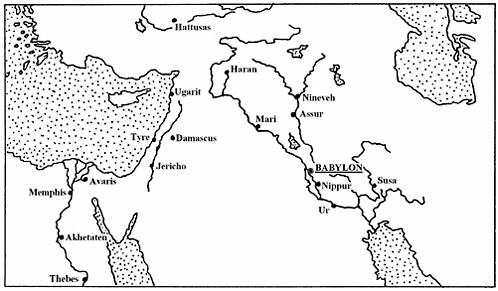
FIGURE 1-1 The Fertile Crescent.
stant traffic all around the Crescent, from Ur on the lower Euphrates to Thebes on the middle Nile. Abraham’s trek from Ur to Palestine, then to Egypt, would have followed well-traveled roads.
Politically the three main zones of the Fertile Crescent looked quite different. Palestine was a provincial backwater, a place you went through to get somewhere else. Peoples of the time regarded it as within Egypt’s sphere of influence. Egypt was ethnically uniform and had no seriously threatening peoples on her borders. The nation was a millennium and a half old—older than England is today—before she suffered her first foreign invasion, of which I shall say more later. In their self-sufficient security the Egyptians settled early on into a sort of Chinese mentality, a centralized monarchy ruling through a vast bureaucratic apparatus recruited by merit. Almost 2,000 official titles were in use as early as the Fifth Dynasty, around 2500 to 2350 BCE, “so that in the wondrous hierarchy everyone was unequal to everyone else,” as Robert G. Wesson says in The Imperial Order.
Mesopotamia presents a different picture. There was much more ethnic churning, with first Sumerians, then Akkadians, then Elamites,
Amorites, Hittites, Kassites, Assyrians, and Aramaeans ascendant. Egyptian-style bureaucratic despotism sometimes had its hour in Mesopotamia, when a powerful ruler could master enough territory, but these imperial episodes rarely lasted long. The first and most important of them had been Sargon the Great’s Akkadian dynasty, which ruled all of Mesopotamia for 160 years, from 2340 to 2180 BCE, before disintegrating under assault by Caucasian tribes. By the time of which I am writing, the 18th and 17th centuries BCE, the Sargonid glory was a fading memory. It had, however, bequeathed to the region a more or less common language: Akkadian, of the Semitic family. Sumerian persisted in the south and apparently also as a sort of prestige language known by educated people, rather like Greek among the Romans or Latin in medieval and early-modern Europe.
The normal condition of Mesopotamia, however, was a system of contending states with much in common linguistically and culturally but no central control. These are the circumstances in which creativity flourishes best: Compare the Greek city-states of the Golden Age, or Renaissance Italy, or 19th-century Europe. Unification was occasional and short lived. No doubt the times were “interesting.” Perhaps that is the price of creativity.
§1.2 One of the more impressive of these episodes of imperial unification in Mesopotamia ran from about 1790 to 1600 BCE. The unifier was Hammurabi, who came to power in the city-state of Babylon, on the middle Euphrates, around the earlier of those dates. Hammurabi10 was an Amorite, speaking a dialect of Akkadian. He brought all of Mesopotamia under his rule and made Babylon the great city of the age. This was the first Babylonian empire.11
This first Babylonian empire was a great record-keeping civilization. Their writing was in the style called cuneiform, or wedge-shaped. That is to say, written words were patterns made by pressing a wedge-shaped stylus into wet clay. These impressed clay tablets and cylinders were baked for permanent record-keeping. Cuneiform had
been invented by the Sumerians long before and adapted to Akkadian in the age of Sargon. By Hammurabi’s time this writing method had evolved into a system of more than 600 signs, each representing an Akkadian syllable.
Here is a phrase in Akkadian cuneiform, from the preamble to Hammurabi’s Code, the great system of laws that Hammurabi imposed on his empire.

FIGURE 1-2 Cuneiform writing.
It would be pronounced something like En-lil be-el sa-me-e u er-sce-tim, meaning “Enlil, lord of heaven and earth.” The fact that this is a Semitic language can be glimpsed from the word be-el, related to the beginning of the English “Beelzebub,” which came to us from the Hebrew Ba’al Zebhubh—“Lord of the flies.”
Cuneiform writing continued long after the first Babylonian empire had passed away—down to the 2nd century BCE, in fact. It was used for many languages of the ancient world. There are cuneiform inscriptions on some ruins in Iran, belonging to the dynasty of Cyrus the Great, around 500 BCE. These inscriptions were noticed by modern European travelers as long ago as the 15th century. Beginning in the late 18th century, European scholars began the attempt to decipher these inscriptions.12 By the 1840s a good base of understanding of cuneiform inscriptions had been built up.
At about that same time, archeologists such as the Frenchman Paul Émile Botta and the Englishman Sir Austen Henry Layard were beginning to excavate ancient sites in Mesopotamia. Among the discoveries were great numbers of baked clay tablets inscribed with cuneiform. This archeological work has continued to the present day, and we now have over half a million of these tablets in public and private collections around the world, their dates ranging from the very beginning of writing around 3350 BCE to the 1st century BCE.
There is a large concentration of excavated tablets from the Hammurabi period, though, and for this reason the adjective “Babylonian” gets loosely applied to anything in cuneiform, although the first Babylonian empire occupied less than 2 of the 30-odd centuries that cuneiform was in use.
§1.3 It was known from early on—at least from the 1860s—that some of the cuneiform tablets contained numerical information. The first such items deciphered were what one would expect from a well-organized bureaucracy with a vigorous mercantile tradition: inventories, accounts, and the like. There was also a great deal of calendrical material. The Babylonians had a sophisticated calendar and an extensive knowledge of astronomy.
By the early 20th century, though, there were many tablets whose content was clearly mathematical but which were concerned with neither timekeeping nor accounting. These went mainly unstudied until 1929, when Otto Neugebauer turned his attention to them.
Neugebauer was an Austrian, born in 1899. After serving in World War I (which he ended in an Italian prisoner-of-war camp alongside fellow-countryman Ludwig Wittgenstein), he first became a physicist, then switched to mathematics, and studied at Göttingen under Richard Courant, Edmund Landau, and Emmy Noether—some of the biggest names in early 20th-century math. In the mid-1920s, Neugebauer’s interest turned to the mathematics of the ancient world. He made a study of ancient Egyptian and published a paper about the Rhind Papyrus, of which I shall say more in a moment. Then he switched to the Babylonians, learned Akkadian, and embarked on a study of tablets from the Hammurabi era. The fruit of this work was the huge three-volume Mathematische Keilschrift-Texte (the German word keilschrift means “cuneiform”) of 1935–1937, in which for the first time the great wealth of Babylonian mathematics was presented.
Neugebauer left Germany when the Nazis came to power. Though not Jewish, he was a political liberal. Following the purging
of Jews from the Mathematical Institute at Göttingen, Neugebauer was appointed head of the institute. “He held the famous chair for exactly one day, refusing in a stormy session in the Rector’s office to sign the required loyalty declaration,” reports Constance Reid in her book Hilbert. Neugebauer first went to Denmark and then to the United States, where he had access to new collections of cuneiform tablets. Jointly with the American Assyriologist Abraham Sachs, he published Mathematical Cuneiform Texts in 1945, and this has remained a standard English-language work on Babylonian mathematics. Investigations have of course continued, and the brilliance of the Babylonians is now clear to everyone. In particular, we now know that they were masters of some techniques that can reasonably be called algebraic.
§1.4 Neugebauer discovered that the Hammurabi-era mathematical texts were of two kinds: “table texts” and “problem texts.” The table texts were just that—lists of multiplication tables, tables of squares and cubes, and some more advanced lists, like the famous Plimpton 322 tablet, now at Yale University, which lists Pythagorean triples (that is, triplets of numbers a, b, c, satisfying a2 + b2 = c2, as the sides of a right-angled triangle do, according to Pythagoras’s theorem).
The Babylonians were in dire need of tables like this, as their system for writing numbers, while advanced for its time, did not lend itself to arithmetic as easily as our familiar 10 digits. It was based on 60 rather than 10. Just as our number “37” denotes three tens plus seven ones, the Babylonian number “37” would denote three sixties and seven ones—in other words, our number 187. The whole thing was made more difficult by the lack of any zero, even just a “positional” one—the one that, in our system, allows us to distinguish between 284, 2804, 208004, and so on.
Fractions were written like our hours, minutes, and seconds, which are ultimately of Babylonian origin. The number two and a
half, for example, would be written in a style equivalent to “2:30.” The Babylonians knew that the square root of 2 was, in their system, about 1:24:51:10. That would be 1 + (24 + (51 + 10 ÷ 60) ÷ 60) ÷ 60, which is accurate to 6 parts in 10 million. As with whole numbers, though, the lack of a positional zero introduced ambiguities.
Even in the table texts, an algebraic cast of mind is evident. We know, for example, that the tables of squares were used to aid multiplication. The formula

reduces a multiplication to a subtraction (and a trivial division). The Babylonians knew this formula—or “knew” it, since they had no way to express abstract formulas in that way. They knew it as a procedure—we would nowadays say an algorithm—that could be applied to specific numbers.
§1.5 These table texts are interesting enough in themselves, but it is in the problem texts that we see the real beginnings of algebra. They contain, for example, solutions for quadratic equations and even for certain cubic equations. None of this, of course, is written in anything resembling modern algebraic notation. Everything is done with word problems involving actual numbers.
To give you the full flavor of Babylonian math, I will present one of the problems from Mathematical Cuneiform Texts in three formats: the actual cuneiform, a literal translation, and a modern working of the problem.
The actual cuneiform is presented in Figure 1-3. It is written on the two sides of a tablet, which I am showing here beside one another.13
Neugebauer and Sachs translate the tablet as follows: Italics are Akkadian; plain text is Sumerian; bracketed parts are unclear or “understood.”

FIGURE 1-3 A problem text in cuneiform.
(Left of picture)
[The igib]um exceeded the igum by 7.
What are [the igum and] the igibum?
As for you—halve 7, by which the igibum exceeded the igum, and (the result is) 3;30.
Multiply together 3;30 with 3;30, and (the result is) 12;15.
To 12;15, which resulted for you,
add [1,0, the produ]ct, and (the result is) 1,12;15.
What is [the square root of 1],12;15? (Answer:) 8;30.
Lay down [8;30 and] 8;30, its equal, and then
(Right of picture)
Subtract 3;30, the item, from the one,
add (it) to the other.
One is 12, the other 5.
12 is the igibum, 5 the igum.
(Note: Neugebauer and Sachs are using commas to separate the “digits” of numbers here, with a semicolon to mark off the whole number part from the fractional part of a number. So “1,12;15” means  , which is to say,
  .)
.)
Here is the problem worked through in a modern style:
A number exceeds its reciprocal by 7. Note, however, that because of the place-value ambiguity in Babylonian numerals, the “reciprocal” of x may mean  , or
, or  , or
, or  … in fact, any power of 60 divided by x. It seems from the solution that the authors have taken “reciprocal” here to mean
  . So
. So

What are x and its “reciprocal”? Since the equation simplifies to

we can apply the familiar formula14 to get
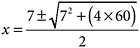
This delivers solutions x = 12 and x = −5. The Babylonians knew nothing of negative numbers, which did not come into common use until 3,000 years later. So far as they were concerned, the only solution is 12; and its “reciprocal” (that is,  ) is 5. In fact, their algorithm does not deliver the two solutions to the quadratic equation, but is equivalent to the slightly different formula
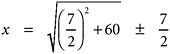
for x and its “reciprocal.” You might, if you wanted to be nitpicky about it, say that this means they did not, strictly speaking, solve the quadratic equation. You would still have to admit, though, that this is a pretty impressive piece of early Bronze Age math.
§1.6 I emphasize again that the Babylonians of Hammurabi’s time had no proper algebraic symbolism. These were word problems, the quantities expressed using a primitive numbering system. They had taken only a step or two toward thinking in terms of an “unknown quantity,” using Sumerian words for this purpose in their Akkadian text, like the igum and igibum in the problem above. (Neugebauer and Sachs translate both igum and igibum as “reciprocal.” In other contexts the tablets use Sumerian words meaning “length” and “width,” that is, of a rectangle.) The algorithms supplied were not of universal utility; different algorithms were used for different word problems.
Two questions arise from all this. First: Why did they bother? Second: Who first worked this all out?
Regarding the first question, the Babylonians did not think to tell us why they were doing what they were doing. Our best guess is that these word problems arose as a way to check calculations—calculations involving measurement of land areas or questions involving the amount of earth to be moved to make a ditch of certain dimensions. Once a rectangular field had been marked out and its area computed, you could run area and perimeter “backward” through one of these quadratic equation algorithms to make sure you got the numbers right.
To the second, the proto-algebra in the Hammurabi-era tablets is mature. From what we know of the speed of intellectual progress in remote antiquity, these techniques must have been cooking for centuries. Who first thought them up? This we do not know, though the use of Sumerian in these problem tablets suggests a Sumerian origin. (Compare the use of Greek letters in modern mathematics.) We have texts going back before the Hammurabi era, deep into the third millennium, but they are all arithmetical. Only at this time, the 18th and 17th centuries BCE, does algebraic thinking show up. If there were “missing link” texts that show an earlier development of these algebraic ideas, they have not survived, or have not yet been found.
Nor do the Hammurabi-era tablets tell us anything about the people who wrote them. We know a great deal about Babylonian math, but we don’t know any Babylonian mathematicians. The first person whose name we know, and who was very likely a mathematician, lived at the other end of the Fertile Crescent.
§1.7 While the Hammurabi dynasty was consolidating its rule over Mesopotamia, Egypt was enduring its first foreign invasion. The invaders were a people known to us by the Greek word Hyksos, a corruption of an Egyptian phrase meaning “rulers of foreign lands.” Moving in from Palestine, not in a sudden rush, but by creeping annexation and colonization, they had established a capital at Avaris, in the Eastern Nile delta, by around 1720 BCE.
During the Hyksos dynasty there lived a man named Ahmes, who has the distinction of being the first person whose name we know and who has some definite connection with mathematics. Whether Ahmes was actually a working mathematician is uncertain. We know of him from a single papyrus, dating from around 1650 BCE—the early part of the Hyksos dynasty. In that papyrus, Ahmes tells us he is acting as a scribe, copying a document written in the Twelfth Dynasty (about 1990–1780 BCE). Perhaps this was one of the text preservation projects that we know were initiated by the Hyksos rulers, who were respectful of the then-ancient Egyptian civilization. Perhaps Ahmes was a mathematical ignoramus, blindly copying what he saw. This, however, is unlikely. There are few mathematical errors in the papyrus, and those that exist look much more like errors in computation (wrong numbers being carried forward) than errors in copying.
This document used to be called the Rhind Papyrus, after A. Henry Rhind, a Scotsman who was vacationing in Egypt for his health—he had tuberculosis—in the winter of 1858. Rhind bought the papyrus in the city of Luxor; the British Museum acquired it when he died five years later. Nowadays it is thought more proper to name
the papyrus after the man who wrote it, rather than the man who bought it, so it is now usually called the Ahmes Papyrus.
While mathematically fascinating and a great find, the Ahmes Papyrus contains only the barest hints of algebraic thinking, in the sense I am discussing. Here is Problem 24, which is as algebraic as the papyrus gets: “A quantity added to a quarter of itself makes 15.” We write this in modern notation as

and solve for the unknown x. Ahmes adopted a trial-and-error approach—there is little in the way of Babylonian-style systematic algorithms in the papyrus.
§1.8 “A considerable difference of opinion exists among students of ancient science as to the caliber of Egyptian mathematics,” wrote James R. Newman in The World of Mathematics. The difference apparently remains. After looking over representative texts from Babylonia and Egypt, though, I don’t see how anyone could maintain that these two civilizations, flourishing at opposite ends of the Fertile Crescent in the second quarter of the second millennium BCE, were equal in mathematics. Though both were working in arithmetical styles, with little evidence of any powers of abstraction, the Babylonian problems are deeper and more subtle than the Egyptian ones. (This was also Neugebauer’s opinion, by the way.)
It is still a wonderful thing that with only the most primitive methods for writing numbers, these ancient peoples advanced as far as they did. Perhaps even more astonishing is the fact that they advanced very little further in the centuries that followed.