Unknown Quantity: A Real and Imaginary History of Algebra (2006)
Chapter: Math Primer: Cubic and Quartic Equations
Math Primer
CUBIC AND QUARTIC EQUATIONS
§CQ.1 THE FIRST GREAT ADVANCE in algebra after the Middle Ages was the general solution of the cubic equation, immediately followed by a solution for the quartic. I tell the full story in the next chapter. There, however, I shall be looking at the topic through 16th-century eyes. Here I just want to give a brief modern account of the underlying algebra to clarify the issues and difficulties.
It is important to understand what is being sought here. It is not difficult to find approximate numerical solutions to cubic equations, or equations of any degree, to any desired accuracy. Sometimes you can just guess a correct solution. Drawing a graph will often get you very close. More sophisticated arithmetic and geometric methods were known to the Greeks, Arabs, and Chinese. Medieval European mathematicians were familiar with these methods too and could generally figure out a numerical value for the real solution of a cubic equation to good accuracy.
What they did not have was a properly algebraic solution—a universal formula for the solutions of a cubic equation, like the one for the quadratic equation in Endnote 14. A formula of that general kind was what early-modern mathematicians sought. Only when it was found could the cubic equation be considered solved.
§CQ.2 Here is a general cubic equation32 in one unknown: x3 + Px2 + Qx + R = 0. The first thing we can do is drop the term in x2, just by noticing the following simple algebraic fact:

To put it another way,

where X = x + P/3. So by dint of a simple substitution, any cubic equation can be converted to one with no x2 term, and if we can solve the simpler equation by finding X, we can then easily get x by simply subtracting P/3. This kind of cubic, one with no x2 term, is technically known by the rather charming name depressed cubic.33
The long and short of it is that we need only bother with depressed cubic equations, ones that look like this:

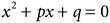
§CQ.3 So far, so good, but what is the general solution of that depressed cubic? Cast your mind back to the general quadratic equation
with its two solutions

Since negative numbers do not have real-number square roots, if p2 − 4q is negative, the solutions are complex numbers. If p2 − 4q is precisely zero, then the two solutions are the same; so from a numerical point of view there is only one solution. And, of course, if p2 − 4q is positive, there are two real-number solutions.
All of this can easily be illustrated by plotting graphs of quadratic polynomials. If we plot the graph y = x2 + px + q, the solutions of the quadratic equation are where y = 0, that is, where the curve cuts the horizontal axis. The three cases I covered above—no real solutions, one real solution, two real solutions—are shown in Figures CQ-1, CQ-2, and CQ-3.
To see what we might expect from the cubic, we could start from the graphical picture. There are three basic situations, illustrated in Figures CQ-4, CQ-5, and CQ-6. Notice that in all three cubics the curve starts in the far southwest and ends up in the far northeast. This is because when x is very big (positive or negative), the x3 term in x3 + px + q “swamps” the other terms. For “big enough” values of x, x3 + px + q “looks like” x3. (The precise size involved in “big enough” depends on how big p and q are.) Now, the cube of a negative num-

FIGURE CQ-1
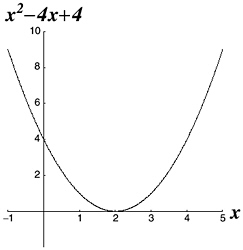
FIGURE CQ-2

FIGURE CQ-3
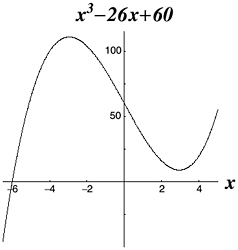
FIGURE CQ-4

FIGURE CQ-5

FIGURE CQ-6
ber, by the rule of signs, is negative, and the cube of a positive number is positive. So the graph of a cubic polynomial will always go southwest to northeast. It follows, since the curve must cross the horizontal axis somewhere, that there must always be at least one real solution to x3 + px + q = 0.
As the graphs show, in fact, there can be one, two, or three solutions of a cubic equation, but there cannot be none, and there cannot be more than three. On the basis of our experience with the quadratic equation, you might suspect that, in most of the cases where there is only one real solution, there are two complex solutions hidden away out of sight. That is correct.
§CQ.4 Here, in fact, are the general three solutions of the cubic equation x3 + px + q = 0:
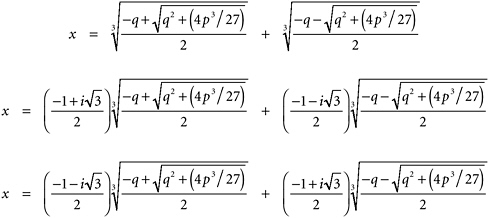
That needs a little explanation. In fact, it needs a lot of explanation.
First note that the two things under the cube root on each line differ by only a sign, plus or minus. If you look more closely, in fact, you will see that they are the two solutions of the quadratic equation
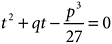
(I switched from x to t as my “dummy variable” to avoid confusion with the main topic.) Let’s call these two numbers α and β for convenience.
Next, what are those complex numbers in the second and third lines? Well, they are cube roots of 1. In the world of real numbers, of course, the number 1 has only one cube root, namely itself, since 1×1×1 = 1. In the world of complex numbers, however, it has two more, and there they are. If you glance forward to §RU.1 in my primer on the roots of unity, between Chapters 6 and 7, you will see that the first of these complex numbers, as they appear above, is commonly denoted by ω, the second by ω2, and that each is the square of the other.
Now I can write down the solutions of the general cubic equation very succinctly. They are
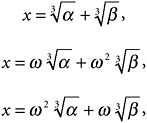
where ω and ω2 are the complex cube roots of 1, and α and β are the solutions of the quadratic equation t2 + qt − (p3/27) = 0.
§CQ.5 Just looking at the three solutions like that, it seems that the first is a real number and that the second and third are complex numbers. How can that be, since we know that a cubic equation can have three real solutions (Figure CQ-6)?
The snag is that both α and β may be complex numbers themselves. Both of them contain the square root of q2 + (4p3/27), and this might be negative. If it is, then α and β are both complex; if it is not, α and β are both real. The case where they are both complex is the so-called irreducible case.34 Then you are stuck with finding the cube
root of a complex number—no easy matter. This makes the general solution of the cubic, while intellectually very satisfying, not very practical.
The actual status of the three solutions, in relation to the sign of q2 + (4p3/27), which I am going to refer to (rather loosely, I am afraid) as the discriminant of the equation, is summarized in the following table. The bottom row represents the irreducible case.
| 1st solution | 2nd solution | 3rd solution |
Discriminant positive | Real | Complex | Complex |
Discriminant zero | Real | Real and equal | |
Discriminant negative | Real | Real | Real |
If the discriminant is zero, then α and β are equal; so the three solutions boil down to  ,
,  ,
,  . The second two are of course equal, and (ω + ω2), as you can very easily verify, is −1.
§CQ.6 I gave the solution of the general cubic without a proof. The proof, with modern symbolism, is not difficult. To solve x3 + px + q = 0, first express x as the sum of two numbers: x = u + v. This can, of course, be done in an infinity of ways. The cubic equation now looks like this: (u + v)3 + p(u + v) + q = 0. This can be rearranged to the following:

So if, from the infinity of possibilities for u and v, I pick the particular values such that

then I shall have a solution. Extracting v in terms of u and p from the second of those equations, and feeding it back into the first, I get this:

That is just a quadratic equation in the unknown u3. Since I could just as easily have extracted u instead of v, getting the identical equation with v as variable, u3 and v3 are the solutions of this quadratic equation. Then u and v are the cube roots of those solutions, or the cube roots multiplied by a cube root of 1. So possible solutions are u + v, ωu + ω2v, and ω2u + ωv. (Note that combinations like u + ωv are not possible because of the condition 3uv = −p, which means that multiplying together the numbers on each side of the plus sign must yield a real number. ωu times ω2v is a real number when uv is, because ω3 = 1.)
§CQ.7 The solution of the general quartic equation

is something of an anticlimax after all that. As before, we usually simplify, or “depress,” the equation to this form:

By some straightforward substitutions, this can be rewritten as a difference of two squared expressions. In solving those, you end up with a cubic equation: The quartic reduces to a cubic in much the same way the cubic reduces to a quadratic.
The four solutions are expressions in square and cube roots involving p, q, and r. To write all four out in full would take more space than I can justify, but here is one of them:

where t=p2 + 12r and

This is fearsome looking, but it’s just arithmetic, with square and cube roots and combinations of p, q, and r. Given the step up in complexity between the general solution of the quadratic equation and the general solution of the cubic, this is another step up of similar magnitude.
You might suppose that a general solution for the quintic equation—that is, an equation of the fifth degree—would be more complicated yet, perhaps filling a page or more, but that it would consist of nothing but square roots, cube roots, and probably fifth roots, though perhaps nested inside each other in various ways. Given our experience with the quadratic, cubic, and quartic equations, this is an entirely reasonable supposition. Alas, it is wrong.