Human Factors Guidelines for Road Systems: Third Edition (2025)
Chapter: 8 Tangent Sections and Roadside (Cross Section)

CHAPTER 8
Tangent Sections and Roadside (Cross Section)
Task Analysis of Lane Changes on Tangent Sections
Overview of Driver Alertness on Long Tangent Sections
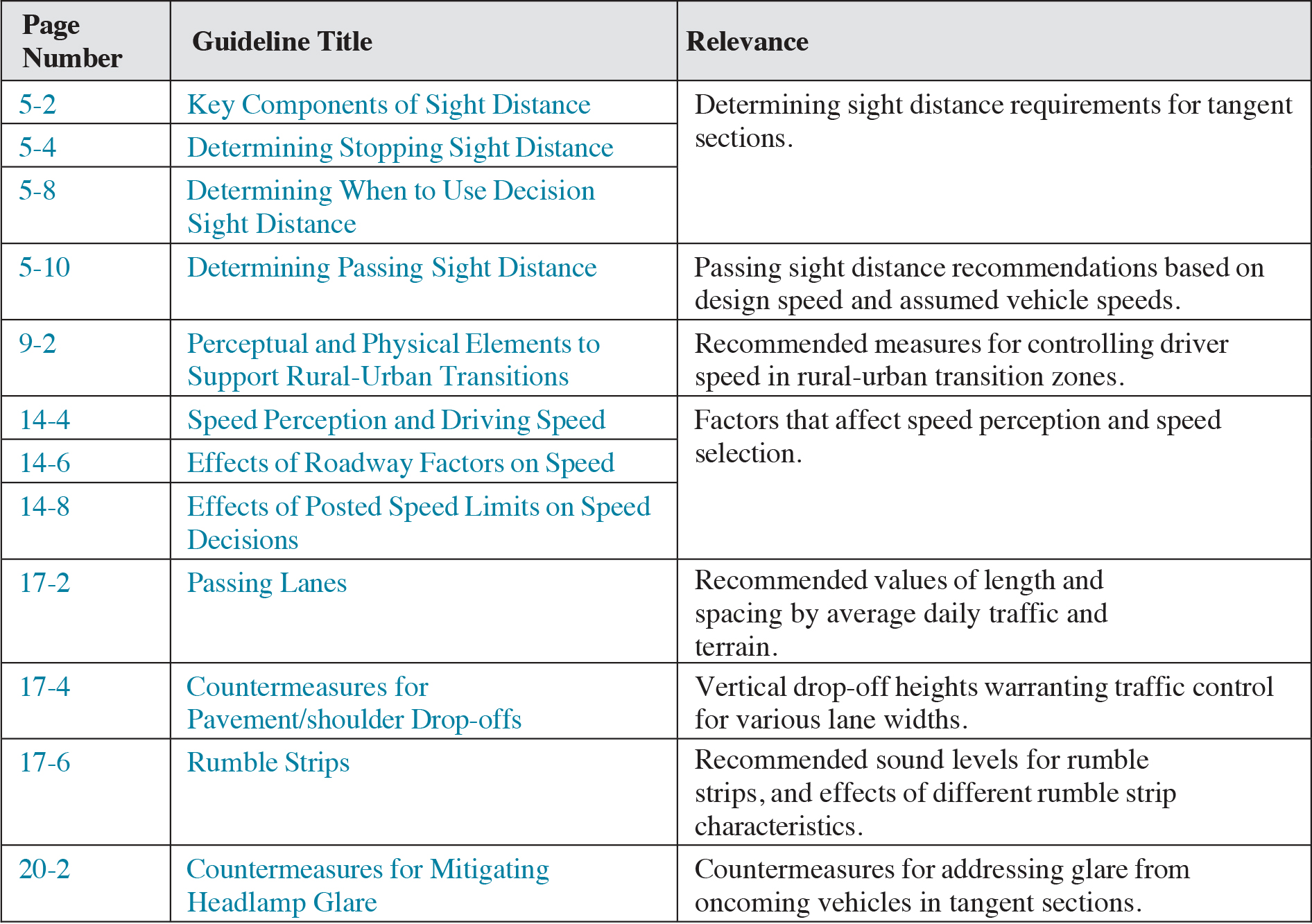
Tangent sections and related design aspects are not topics that are typically examined separately in human factors or driver behavior research. Consequently, this chapter only has two guidelines on this topic. However, as a basic roadway element, tangents are often a relevant contributing aspect to a variety of driver factors. The HFG reflects this in other chapters with several guidelines directly relevant to tangent sections. The table below provides an index of where to find these guidelines within the HFG.
Long Description.
The relevant guidelines for determining sight distance requirements for tangent sections include the following: Key Components of Sight Distance, page 5-2; Determining Stopping Sight Distance, page 5-4; and Determining When to Use Decision Sight Distance, page 5-8.The relevant guidelines for passing sight distance recommendations based on design speed and assumed vehicle speeds includes Determining Passing Sight Distance, page 5-10. The relevant guidelines for factors that affect speed perception and speed selection include Speed Perception and Driving Speed, page 14-4; Effects of Roadway Factors on Speed, page 14-6; and Effects of Posted Speed Limits on Speed Decisions, page 14-8. The relevant guidelines for recommended values of length and spacing by average daily traffic and terrain include Passing Lanes, page 17-2. The relevant guidelines for vertical drop-off heights warranting traffic control for various lane widths includes Countermeasures for Pavement/Shoulder Drop-Offs, page 17-4. The relevant guidelines for recommended sound levels for rumble strips, and effects of different rumble strip characteristics include Rumble Strips, page 17-6. The relevant guidelines for countermeasures for addressing glare from oncoming vehicles in tangent sections include Countermeasures for Mitigating Headlamp Glare, page 20-2.
TASK ANALYSIS OF LANE CHANGES ON TANGENT SECTIONS
Introduction
This guideline provides a general description of the tasks involved with making a lane change on a tangent section of roadway. These tasks are primarily perceptual, cognitive, psychomotor, or some combination thereof. The tasks apply to many roadway conditions, but the likelihood of their occurrence and the manner in which drivers perform them vary based on the individual driver. This task overview has implications for interchange design, and particularly sign placement.

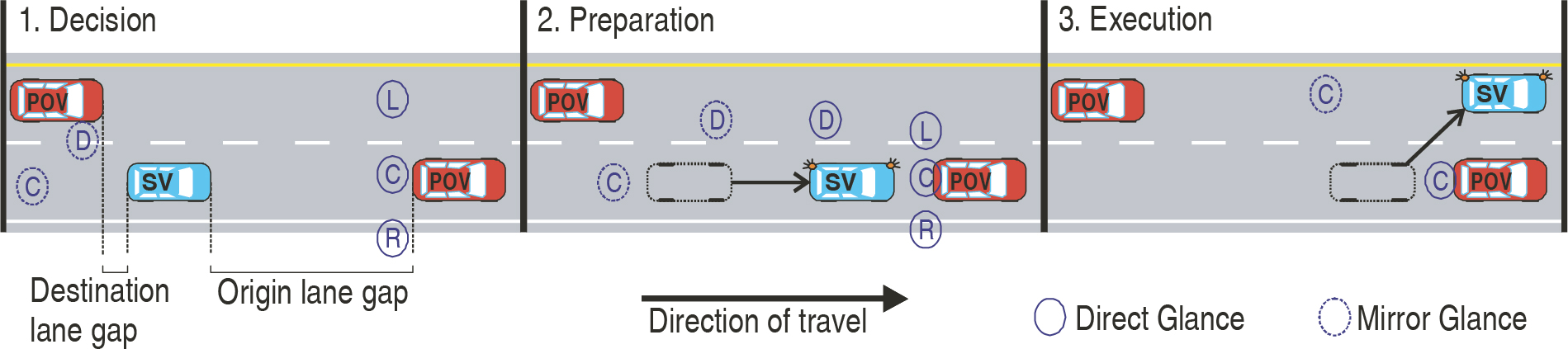
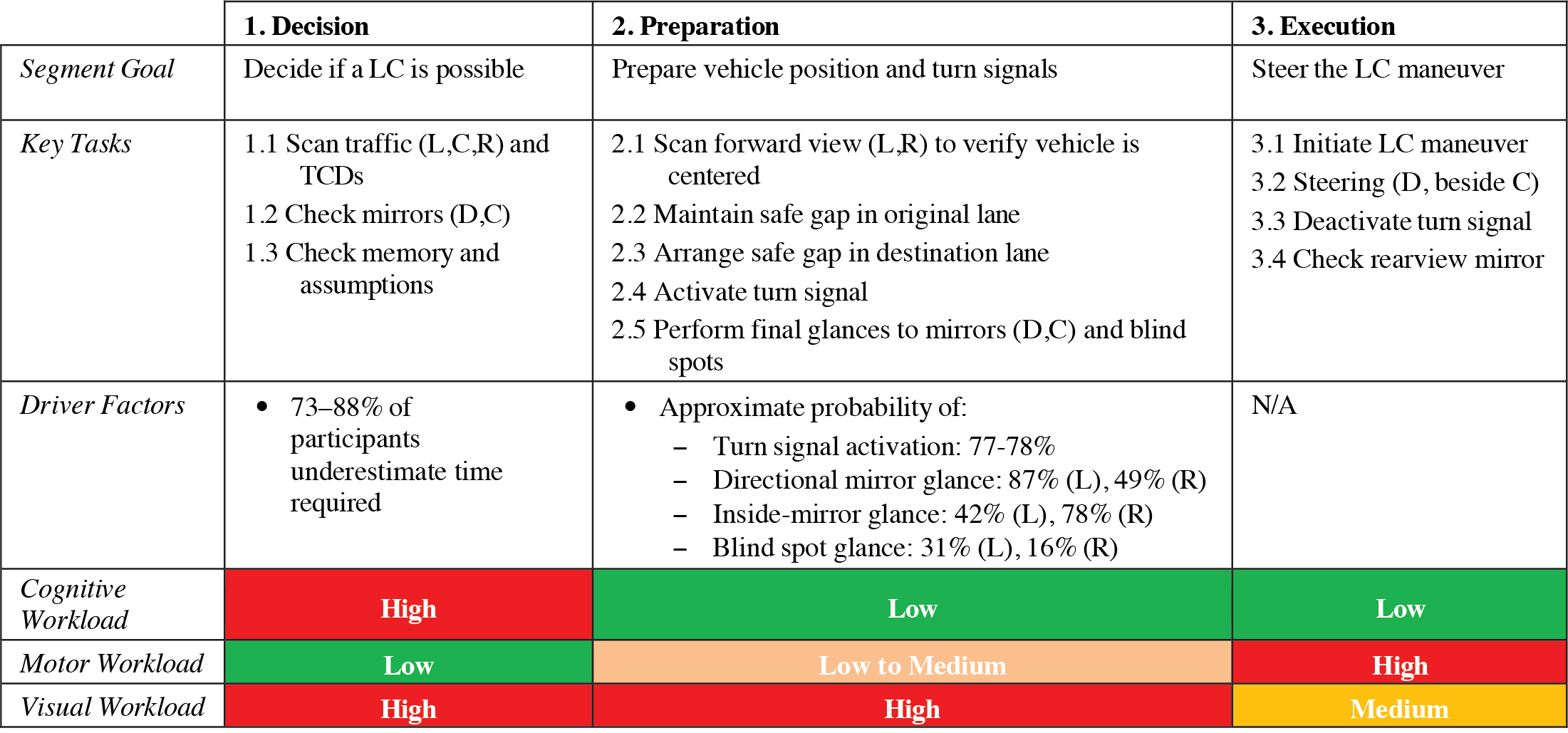
The figure and table below show the different segments in a lane change as well as the cognitive, motor, and visual workloads (demands placed on the driver by the roadway elements) associated with the tasks [adapted from Lee, Olsen, and Wierwille (1)].
Long Description.
The direction of travel is from left to right. The first stage is Decision. The destination lane gap and the origin lane gap are marked. The second stage is Preparation. The third stage is Execution. Points of direct glance and mirror glance are marked at each stage.
Long Description.
The table has 3 columns, with the following headings: Column 1: Decision, Column 2: Preparation, Column 3: Execution. The table has 6 rows, with the following headings: Row 1: Segment Goal, Row 2: Key Tasks, Row 3: Driver Factors, Row 4: Cognitive Workload, Row 5: Motor Workload, Row 6: Visual Workload. The data by row are as follows: Row 1, Column 1: Decide if a L C is possible. Column 2: Prepare vehicle position and turn signals. Column 3: Steer the LC maneuver Row 2, Column 1: 1.1 Scan traffic (L, C, R) and T C Ds 1.2 Check mirrors (D,C) 1.3 Check memory and assumptions 2.1 Scan forward view (L,R) to verify vehicle is centered Column 2: 2.2 Maintain safe gap in original lane 2.3 Arrange safe gap in destination lane 2.4 Activate turn signal 2.5 Perform final glances to mirrors (D,C) and blind spots. Column 3: 3.1 Initiate LC maneuver 3.2 Steering (D, beside C) 3.3 Deactivate turn signal 3.4 Check rearview mirror Row 3, Column 1: 73–88% of participants underestimate time required Column 2: • Approximate probability of: – Turn signal activation: 77-78% – Directional mirror glance: 87% (L), 49% (R) – Inside-mirror glance: 42% (L), 78% (R) – Blind spot glance: 31% (L), 16% (R) Column 3: N/A Row 4, Column 1: High. Column 2: Low. Column 3: Low Row 5, Column 1: Low. Column 2: Low to Medium. Column 3: High Row 6, Column 1: High. Column 2: High. Column 3: Medium.
Discussion
The key tasks outlined in the table on the previous page (1) depict a general progression of tasks as drivers execute lane changes. The tasks are shown in a vertical column, corresponding to the lane change segment in which they occur. Each segment also has driver factors, which are relevant behavioral information, further described below. The cognitive, motor, and visual workloads are rated and color-coded depending on the demand of those resources during the corresponding segment.
The first segment is the decision of whether a lane change is possible. This segment places the highest demands on cognitive activity, mainly related to the decision to initiate the lane change. One subtask for drivers involves checking their memory and assumptions related to the lane change task. In an on-road study, most drivers underestimated the amount of time that a freeway lane change actually takes (2). The underestimation was more common for lane changes to the right (88% of drivers) than to the left (73% to the left).
After deciding that a lane change is possible, the preparation for the lane change begins. In this second segment, visual and motor tasks dominate. The tasks are centered around arranging a safe gap for the maneuver and preparing for the actual movement. In a study of driver-side blind alert systems, the probability of turn signal activation was 77% and 78% for left and right lane changes, respectively (3). In the same study, for left lane changes, the approximate probability of drivers performing a left-mirror glance was 87%, an inside-mirror glance was 42%, and an over-the-left-shoulder glance was 31%. For right lane changes, the approximate probability of drivers executing a right-mirror glance was 49%, an inside-mirror glance was 78%, and an over-the-right-shoulder glance was 16%. In their study of naturalistic lane changes, Lee, Olsen, and Wierwille (1) found somewhat lower probabilities for the driver glance and turn signal behaviors; however, their analysis was of a set of critical and urgent lane changes, during which drivers may be less inclined to take the time to perform their usual routine. Once the driver has prepared the vehicle and its position to allow for the lane change, they execute the motor/lane change component. In this segment, drivers perform the actual steering involved in the maneuver. Following this step, drivers return to their normal driving behaviors.
The distribution of driving tasks has implications for interchange design, particularly for sign placement. Some interchanges are more likely to systematically involve a higher frequency of lane changes due to interchange-specific features such as entrances, exits, merge/weave sections, and upcoming lane changes. From this task analysis, it appears that the cognitive load is highest at the beginning of the lane change. This is followed by a series of uninterruptable visual activities to arrange appropriate gaps and monitor surrounding traffic. Since the traffic flow is dynamic, drivers need to resolve these visual activities at the point when motor activities are initiated (i.e., if interrupted, they may need to visually re-check their surroundings to determine if the conditions have changed).
One of the important implications of these conditions is that signs near high-frequency merge locations may be less likely to be read by merging drivers who are otherwise occupied with visual activities. Therefore, key signs should not be located in such locations, and acceptable alternative locations should be identified.
Design Considerations
None.
Cross References
Determining Passing Sight Distance
Key References
1. Lee, S. E., Olsen, E. C. B., and Wierwille, W. W. (2004). A Comprehensive Examination of Naturalistic Lane-Changes (DOT HS 809 702). Washington, DC: NHTSA.
2. Lerner, N. D., Steinberg, G. V., and Hanscom, F. R. (2000). Development of Countermeasures for Driver Maneuver Errors (FHWA-RD-00-022). McLean, VA: FHWA.
3. Kiefer, R. J., and Hankey, J. M. (2008). Lane change behavior with a side blind zone alert system. Accident Analysis and Prevention, 40(2), 683–690.
OVERVIEW OF DRIVER ALERTNESS ON LONG TANGENT SECTIONS
Introduction
This guideline addresses driver fatigue and alertness on long segments of straight roadways. Driver fatigue is defined as a general psycho-physiological state that diminishes an individualʼs ability to perform the driving task by reducing alertness and vigilance (1). Since long monotonous tangents have low levels of physical driving demand and reduced visual stimulation, they may induce driver fatigue and boredom, and reduced alertness. The key design issue in this case is that these types of roads may be “fatigue inducing” because they demand drivers do relatively little in terms of vehicle control and visual scanning, and this very low demand may lead to reduced levels of driver vigilance and engagement.

EXAMPLES OF COUNTERMEASURES FOR LONG TANGENT SECTIONS
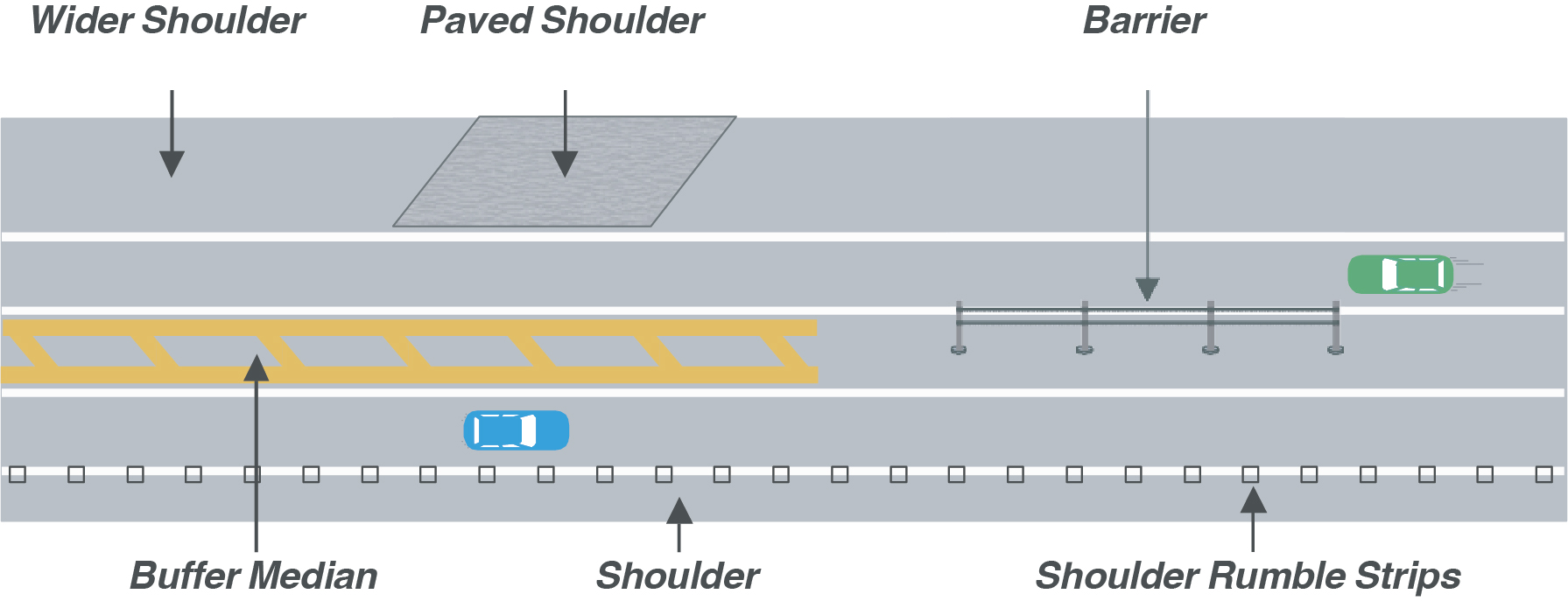
Long Description.
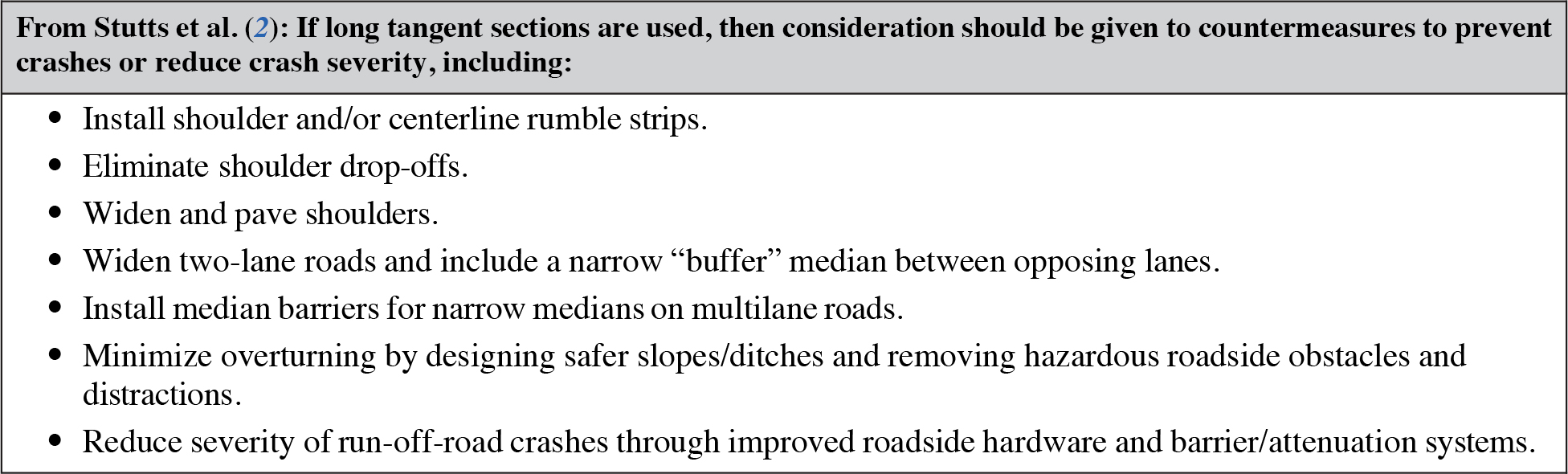
The illustration shows a wider shoulder, paved shoulder, barrier, buffer median, shoulder, and shoulder rumble strips on the road.
Discussion
NCHRP Report 500, Volume 14 provides a helpful overview of the issues associated with drowsy drivers, as well as several roadway design strategies that can be used to reduce the problem (2). The guidelines presented here primarily reflect this data source.
There is a lack of on-road or crash data studies that directly examine the link between tangent length/monotony with fatigue-related safety risk. The issue of tangent length and fatigue is difficult to parse out from general fatigue related to more driver-specific causes, such as sleep disruption, time of day, etc. Overall, the empirical data are not definitive regarding the relationship between the length or monotony of a tangent and fatigue-related crash risk. Nonetheless, in addition to countermeasures aimed at reducing the negative consequences of fatigue-related crashes, another logical type of countermeasure involves increasing driver stimulation, such as adding visual complexity or vehicle control requirements (e.g., a horizontal curve). Most of the pertinent data on this topic have been generated from driving simulator research. For example, in an exploratory study, drivers were found to be more likely to make large steering wheel movements on a visually monotonous roadway, which was interpreted as being fatigue-related (1). In another study, the most apparent fatigue symptoms occurred on straight roads or straight sections of roads with a mix of straight and curved elements (3). Tying these findings in with on-road data, a 100-car naturalistic driving study found that 56% of run-off-road events occurred on straight segments of roadway (4), suggesting countermeasure treatments would be desirable.
Design Considerations
This guideline focuses on roadway design interventions to address driver fatigue on long tangent sections of roadway and task-induced fatigue rather than sleepiness. Driver alertness due to the impact of monotonous roadways is just a small part of the larger topic of driver fatigue, which is more often caused by sleepiness or drowsiness. There are a number of data sources related to this broader issue, especially in the context of long-haul truck and other commercial drivers. There are also a number of sources that describe risk factors associated with driver fatigue and countermeasures that can be used to reduce driver fatigue (5).
Cross References
Key References
1. Thiffault, P., and Bergeron, J. (2003). Monotony of road environment and driver fatigue: A simulator study. Accident Analysis & Prevention, 35, 381–391.
2. Stutts, J., Knipling, R. R., Pfefer, R., Neuman, T. R., Slack, K. L., and Hardy, K. K. (2005). NCHRP Report 500: Guidance for Implementation of the AASHTO Strategic Highway Safety Plan, Volume 14: A Guide for Reducing Crashes Involving Drowsy and Distracted Drivers. Transportation Research Board of the National Academies, Washington, DC.
3. Oron-Gilad, T., and Ronen, A. (2007). Road characteristics and driver fatigue: A simulator study. Traffic Injury Prevention, 8(3), 281–289.
4. McLaughlin, S. B., Hankey, J. M., Klauer, S. G., and Dingus, T. A. (2009). Contributing Factors to Run-Off-Road Crashes and Near-Crashes. (DOT-HS-811-079). Washington, DC: NHTSA.
5. McCallum, M., Sanquist, T., Mitler, M., and Krueger, G. (2003). Commercial Transportation Operator Fatigue Management Reference. Washington, DC: U.S. Department of Transportation, Research and Special Programs Administration.
This page intentionally left blank.


