Human Factors Guidelines for Road Systems: Third Edition (2025)
Chapter: 25 Bicyclists

SIGNALS AND SIGNAL TIMING FOR BICYCLES AT INTERSECTIONS
Introduction
Designs for traffic signals at intersections are generally determined by motor vehicle use. This creates systems that may not always be timed for, nor designed to detect the presence of other road users, such as bicyclists. Therefore, designs made to accommodate bicyclists within the given road context are necessary. This guideline discusses signal timing and design countermeasures that can minimize conflicts with motor vehicles and increase bicyclist visibility and conspicuity.



Discussion
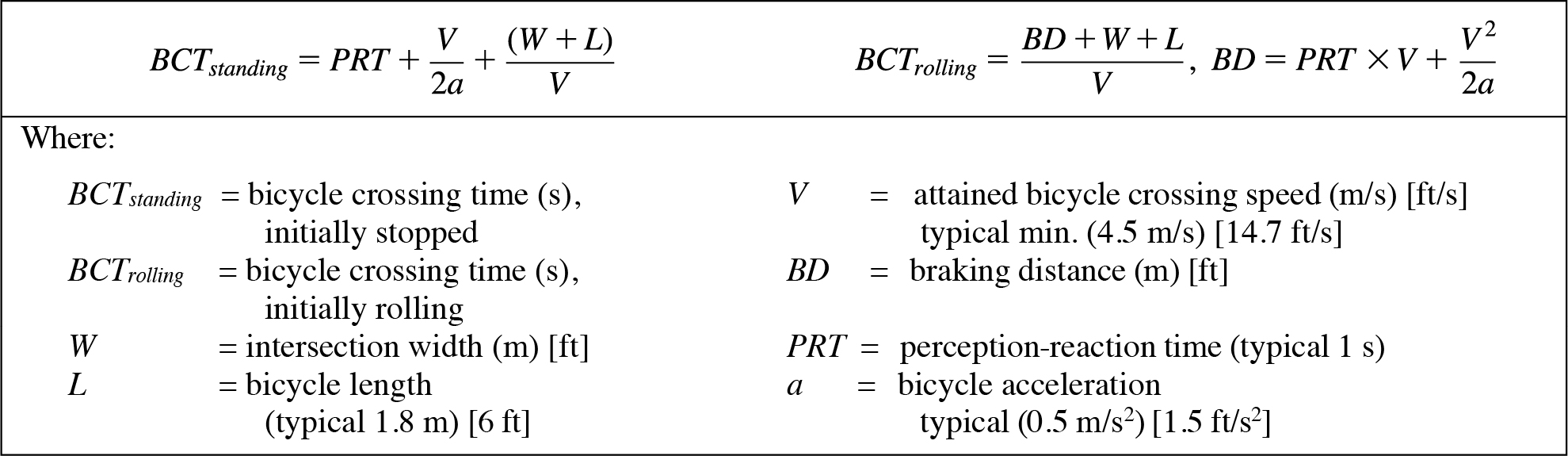
Signal Timing. Whether in a road or bicycle lane, more experienced bicyclists can be comfortable entering intersections during mid-to-late green intervals, while others tend to slow down when approaching a green signal so they can start at the beginning of a green interval (1). Youth bicyclists often use crosswalks and pedestrian push buttons to cross intersections, indicating that these facilities should be made available to bicyclists who rely on them to cross comfortably (1). Some traffic signal controllers have bicycle minimum green parameters, which can be used with appropriate detection to provide bicyclists with enough time to clear the intersection (1). An all-red interval can be used to provide time for crossing bicyclists to pass beyond the far side of an intersection (1).
Leading Bicycle Intervals. A leading bicycle interval (LBI) can reduce right-turn conflicts by giving bicyclists a head start and priority over turning motor vehicles (2). The leading interval increases bicyclist conspicuity by placing them ahead of other vehicles and making them the only travelers in the intersection during the interval. Through and right-turning bicycles can receive the LBI, followed by through and right-turning motor vehicles, which must yield to bicyclists and crossing pedestrians who have not yet completed traversing the intersection (2).
Bicycle Signal Heads. Bicycle signal heads are electrically powered traffic control devices that can be used where stand-alone bike paths or lanes cross a street (especially when the bicycle clearance time differs from the pedestrian clearance time). Their purpose is to split signal phases at intersections where bicycle movement conflicts with motor vehicle movement during a green phase, to give bicyclists an advanced green, or indicate an “all-bike” phase where bicyclist turning movements are highly common. Bicycle signal heads are most frequently placed at intersections with high numbers of bicycle and motor vehicle crashes, and at intersections near school zones (3). Bicycle signal heads can help separate bicycle movements from conflicting motor vehicle, streetcar, light rail, or pedestrian movements in urban settings. In addition, they can provide priority to bicycle movements at intersections and accommodate bicycle-only movements within signalized intersections, providing a measure of protection in high-conflict areas. Overall, they can help simplify movements through complex intersections (3). Bicycle signal heads can be placed in a location that is clearly visible to oncoming bicycles (3). If the bicycle phase is not set for each cycle, bicycle signals may be installed with appropriate detection and actuation (3). Adequate clearance intervals, such as those in this moduleʼs design guidelines section, can be provided to ensure that the bicyclists entering the intersection during the green phase can travel through the intersection so that conflicts with turning or entering vehicles are minimized (3). When the bicycle signal is used to separate through bicycles from right-turning vehicles, the right turn on red shall be prohibited while the bicycle signal is active (3).
Hybrid Beacons for Bike Route Crossing. Hybrid beacons have been modified by several cities from being pedestrian-focused to incorporating bicycle crossings (3). Hybrid beacons are used to enhance non-motorized crossings of major streets in places where crossing street volumes donʼt support the installation of a conventional traffic signal and can be adapted to midblock crossing locations as well (3). Installing bike signals and signal detection as supplementary measures, along with hybrid beacons, can be used to increase detection and subsequent signal change, reducing the frequency of bicyclists crossing when not signaled to do so on major streets (3). Hybrid beacons and possibly even RRFBs can be used to create gaps for bicyclists to cross busier streets and are associated with a very high driver compliance (3).
Design Considerations
If the intersection controller does not have bicycle detection capabilities but a greater minimum green is needed for local bicyclists, increasing the minimum green time can be considered (1). It may be beneficial to add an LBI in locations where sidewalk riding is common, and the bike rider could be expected to be in the crosswalk.
Cross References
Selecting Beacons to Increase Pedestrian Conspicuity at Crosswalks
Heuristics for Selecting the Yellow Timing Interval
Key References
1. AASHTO. (2012). Guide for the Development of Bicycle Facilities (4th ed.). Washington, DC.
2. National Association of City Transportation Officials. (2019). Donʼt Give Up at the Intersection. New York, NY.
3. National Association of City Transportation Officials. (2014). NACTO Urban Bikeway Design Guide (2nd ed.). New York, NY.
MARKINGS FOR BICYCLES AT INTERSECTIONS
Introduction
Bicyclists are particularly vulnerable at intersections because they can be less noticeable due to their size. Other factors, such as wide A and B pillars in large vehicles and interactive screens within vehicles that can distract drivers, increase the likelihood that a driver will fail to notice a bicyclist. Bicycle crashes with motor vehicles can be severe due to the bicycleʼs lack of protective structures and its small mass relative to motor vehicles. This guideline discusses considerations for intersection lane marking countermeasures that can increase bicyclist visibility and conspicuity and minimize conflicts with motor vehicles.


Discussion
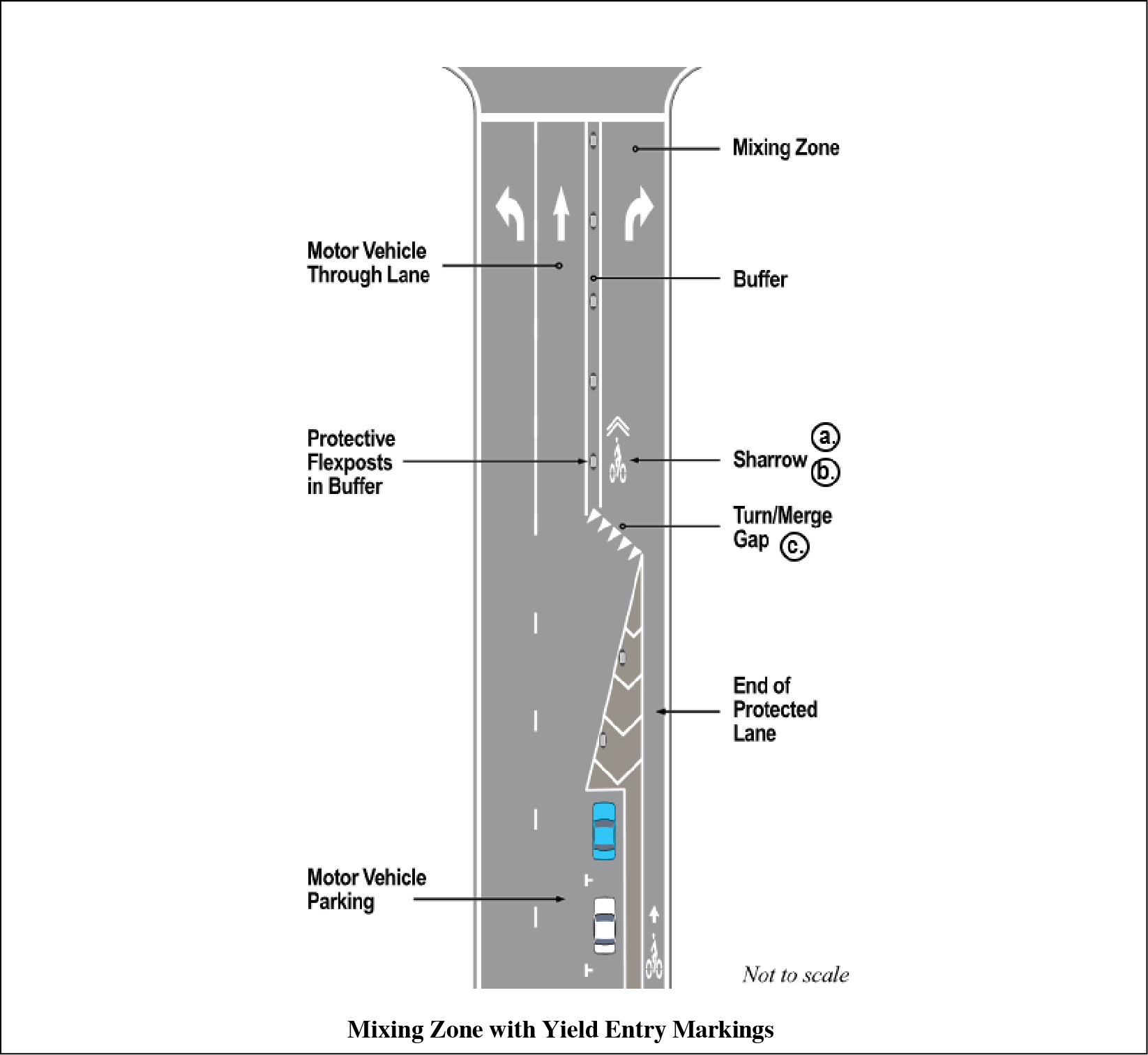
When planning the layout of intersections, designers can consider potential conflicts among all road users, not only between motorists. Through bicycle lanes (TBL) next to left-turn lanes, as shown in the figure on the previous page, can help position bicyclists and reduce merging confusion between them and motorists by providing and marking physical separations between bicyclists and other road users. In one study comparing various intersection bicycle lane designs, this design had high correct lane use both by turning vehicles (87%) and through bicyclists (91%). This suggests a clear benefit of a restricted entry approach while creating a semi-protected TBL (4). Separate bicycle left-turn lanes could be considered when there are considerable volumes of left-turning bicycles or if a preferred bicycle route makes a left turn (1). One tactic used to reduce bicyclist exposure to traffic while making left turns at multilane intersections from a right-side bicycle lane is to install two-stage turn queue boxes (5). These two-stage turns can provide more comfort to bicyclists making left turns, provide a formal queuing space for bicyclists making these turns, reduce turning conflicts between bicyclists and vehicles, prevent conflicts from bicyclists queuing in a bicycle lane or crosswalk, and separate turning bicyclists from through bicyclists (5). For right-turning lanes with mixing zones, such as in the design guideline figure, video evaluation found that nearly all (93%) of the turning vehicles used the lane as intended—the highest compliance of all evaluated designs (4). Using mixing zones maintains bicyclist priority in the absence of a dedicated TBL and reduces the potential of right-hook crashes at intersections (5). See “Shared-Use Lanes” on page 25-12 for guidance on designing shared-use lanes and their markings.
Lane markings that control bicycle traffic can be presented in a way that all road users understand that the signal relates to the bicyclist (6). Clear marking, including vertical delineation, of the vehicle entry point to the turning lane is beneficial to all road users and reduces stress in bicyclists (4, 5). Bicycle lane markings straight through intersections can raise awareness for bicyclists and motorists for potential conflict areas, reinforce bicyclist priority over turning vehicles, make bicycle movements more predictable, and increase the visibility of bicyclists. Installation of bike boxes can lower the number of conflicts with and increase yielding behavior to bicyclists by ensuring that bicyclists waiting at red light intersections are visible to the first driver in the queue (5, 7, 8). Other benefits of bike boxes are that they reduce signal delays for bicyclists, help prevent right-hook conflicts with turning vehicles at the start of the green indication, provide priority for bicyclists at signalized crossings of major streets, group bicyclists together to clear intersections more quickly, and benefit pedestrians through reduced encroachment of vehicles into crosswalks (5). Bike boxes that extend across all lanes at intersections can also facilitate left turn positioning for bicyclists and transitions from a right-side bicycle lane to a left-side bicycle lane during red signal indications (5). With the presence of bike boxes, motorists give bicyclists the right-of-way more often, leading to 77% of bicyclists feeling safer moving through intersections using bike boxes (5). Conversions of traditional intersections to roundabouts have resulted in decreases in vehicular injuries and fatalities but increases in bicyclist injuries as well (9). Design considerations for roundabouts that enhance bicyclist safety are discussed in “Accommodations for Bicyclists at Roundabouts” on page 12-8.
Design Considerations
Corner radii at intersections should be as small as practical to reduce merging conflicts between bicyclists and motorists, as larger corner radii allow high vehicle turning speeds (1). While two-stage turn queue boxes can increase comfort for turning bicyclists, they also typically increase delays for these bicyclists since they must now wait to receive two separate green signals to make their turn (5). Also, a two-stage turn box may allow bicyclists to more comfortably make left turns at multilane signalized intersections from a right-side cycle track or bicycle lane, or right turns from a left-side cycle track or bicycle lane (see https://nacto.org/publication/urban-bikeway-design-guide/designing-safe-intersections/improve-visibility-at-turn-conflicts/).
Cross References
Accommodations for Bicyclists at Roundabouts
Key References
1. AASHTO. (2012). Guide for the Development of Bicycle Facilities (4th ed.). Washington, DC.
2. Fitzpatrick, K., Chrysler, S. T., Van Houten, R., Hunter, W. W., and Turner, S. (2011). Evaluation of Pedestrian and Bicycle Engineering Countermeasures: Rectangular Rapid-Flashing Beacons, Hawks, Sharrows, Crosswalk Markings, and the Development of an Evaluation Methods Report.
3. Foletta, N., Nielson, C., Patton, J., Parks, J., and Rees, R. (2015). Green shared lane markings on urban arterial in Oakland, California: Evaluation of super sharrows. Transportation Research Record: Journal of the Transportation Research Board, 2492, 61–68.
4. Monsere, C. M., Foster, N., Dill, J., and McNeil, N. (2015). User behavior and perceptions at intersections with turning and mixing zones on protected bicycle lanes. Transportation Research Record: Journal of the Transportation Research Board (2520), 112–122.
5. National Association of City Transportation Officials. (2014). Urban Bikeway Design Guide (2nd ed.). New York, NY.
6. Goodno, M., McNeil, N., Parks, J., and Dock, S. (2013). Evaluation of innovative bicycle facilities in Washington, D.C.: Pennsylvania Avenue median lanes and 15th Street cycle track. Transportation Research Record: Journal of the Transportation Research Board, 2387, 139–148.
7. Dill, J., Monsere, C., and McNeil, N. (2011). Evaluation of Bike Boxes at Signalized Intersections.
8. Taylor, S., Giang, C., Chau, P., and Aumann, P. (2017). Cycling Aspects of Austroads Guides (Report No. 9781925451641).
9. Jensen, S. U. (2013). Safety effects of converting intersections to roundabouts. Transportation Research Record: Journal of the Transportation Research Board, 2389, 22–29.
BICYCLE LANES
Introduction
Bicycle lanes include conventional and buffered lanes that use pavement markings to designate a portion of the roadway exclusively for bicyclistsʼ use. While designated bicycle lanes without a physical separation are not the preferred treatments for the majority of people who ride bicycles, they can provide additional width to reduce crash potential by separating motor vehicles from bicycles, reducing “dooring” from bicycles colliding with parked car doors, and increasing motor vehicle driversʼ awareness by indicating where they can expect bicyclists to be traveling. This guideline discusses methods for reducing bicyclistsʼ potential exposure to crashes and increasing bicyclistsʼ comfort when designing bicycle lanes.

Long Description.
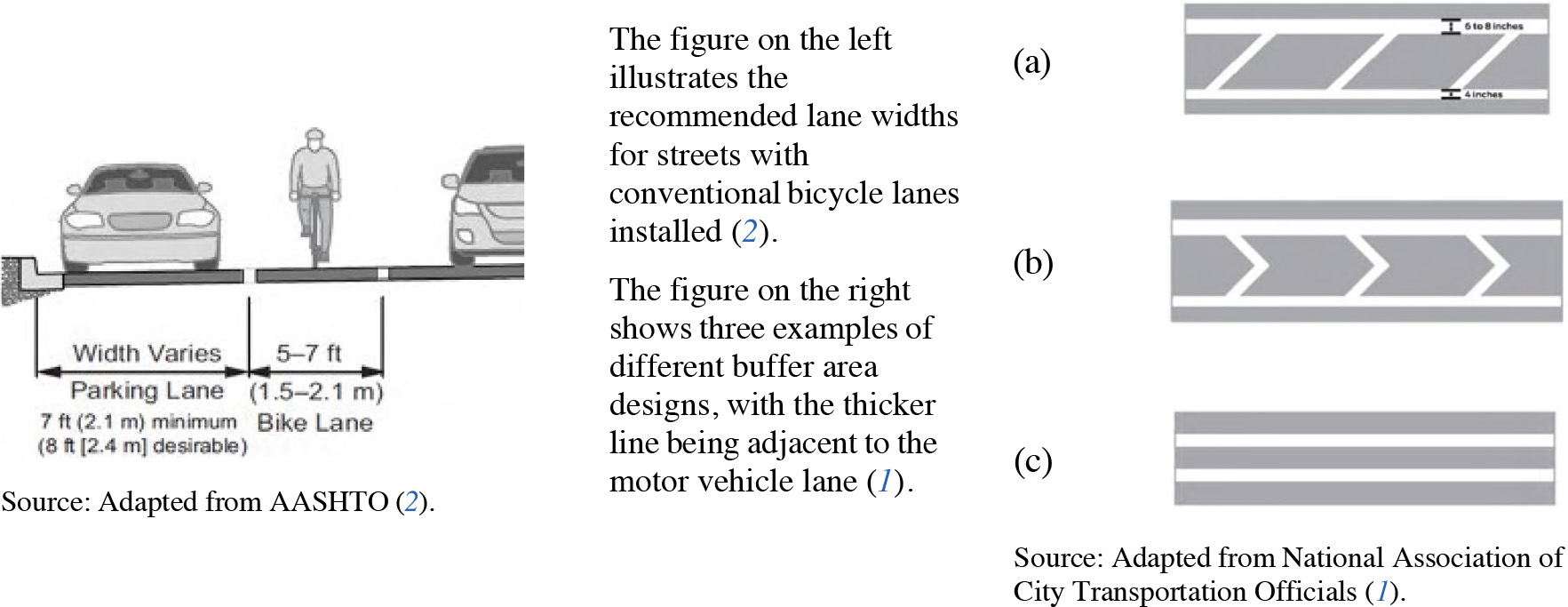
Line segments for each part of the illustration indicate that the width of the parking lane varies, with a 7 foot minimum and 8 foot-width being desirable. The bike lane is labeled as being 5 to 7 foot-width
Discussion
Bicycle lanes designate a space for bicyclists using pavement markings. In general, bicycle lanes enable bicyclists to ride at their preferred speed without interference from motor vehicle traffic and can facilitate predictable behaviors and movements between bicyclists and motor vehicles (1). Roadway geometry, available road width, and traffic density can dictate where and when to implement bicycle lanes.
Conventional Bicycle Lanes. Conventional bicycle lanes are typically installed on the right side of the street between the adjacent travel lane and the curb, road edge, or parking lane (1). Conventional bicycle lanes are most helpful on streets with average daily traffic of more than 3,000 motor vehicles, on streets with posted speed limits that are greater than 25 mi/h, on streets with high transit vehicle volumes, and on streets with 10–12 ft. wide travel lanes (1, 3). These lanes can be used to create separation between bicyclists and motor vehicles, visually remind motorists of bicyclistsʼ right to drive on the streets, encourage motor vehicles to stay in their lane when passing bicyclists, and increase bicyclist comfort and confidence on busier streets (1, 5, 6). If designing a bicycle lane next to a parking lane, minimizing the parking lane width in favor of increasing bicycle lane width will give bicyclists more space to keep outside of the “door zone” (3). Because left-side bicycle lanes are conventional bicycle lanes placed on the left side of one-way streets or two-way median-divided streets, the guidance for the design of conventional bicycle lanes can be translated to left-side bicycle lanes (1). Left-side bicycle lanes can help minimize “door zone,” bus stop, and loading zone conflicts (1).
Buffered Bicycle Lanes. Buffered bicycle lanes pair conventional bicycle lanes with a designated buffer space between the bicycle lane and the motor vehicle travel lane. These buffers can be installed on streets with extra lanes or extra lane width, and on streets with high travel speeds, high travel volumes, and/or high amounts of heavy-vehicle traffic (1). Special consideration should be given for installing buffered bicycle lanes at transit stops to manage bicycle and pedestrian interactions (1). Buffered bicycle lanes can provide a wider shy distance between motor vehicles and bicycles, provide space for bicyclists to pass other bicyclists without encroaching onto the motor vehicle lane, encourage bicyclists to ride outside of the “door zone” when the buffer is between the bicycle lane and parked cars, and encourage bicycle riding in general by contributing to an increased perception of safety among bicyclists (1, 3).
Design Considerations
Not all roadways have enough space and/or width to accommodate bicycle lanes. A common lane reduction treatment is to convert an undivided four-lane (two-way) roadway to a three-lane roadway (central two-way left-turn lane). This provides space for bike lanes on both sides of the road, moderates top speeds of vehicles because there is only one lane in each direction, eliminates the likelihood of multiple-threat crashes, and reduces sideswipe crashes since motorists no longer change lanes to a right-side lane in order to pass left-turning vehicles (2). Striped or painted buffers offer a small increase in bicyclistsʼ comfort, whereas buffers with some sort of physical protection, even protection as minimal as a plastic flex post, yield significant increases in perceived comfort for potential bicyclists with safety concerns (7).
Cross References
Markings for Bicycles at Intersections
Mitigating Heavy-Vehicle Conflicts with Bicycles
Key References
1. National Association of City Transportation Officials. (2014). Urban Bikeway Design Guide. (2nd ed.). New York, NY.
2. AASHTO. (2012). Guide for the Development of Bicycle Facilities (4th ed.). Washington, DC.
3. Torbic, D. J., Bauer, K. M., Fees, C. A., Harwood, D. W., Van Houten, R., Laplante, J., and Roseberry, N. (2014). NCHRP Report 766: Recommended Bicycle Lane Widths for Various Roadway Characteristics. Transportation Research Board of the National Academies, Washington, DC.
4. FHWA. (2023). Manual on Uniform Traffic Control Devices for Streets and Highways (11th ed.). Washington, DC.
5. Mehta, K., Mehran, B., and Hellinga, B. (2015). Evaluation of the passing behavior of motorized vehicles when overtaking bicycles on urban arterial roadways. Transportation Research Record: Journal of the Transportation Research Board, 2520, 8–17.
6. Sando, T. (2014). Operational Analysis of Shared Lane Markings and Green Bicycle Lanes on Roadways with Speeds Greater Than 35 mi/h. Jacksonville, FL: University of North Florida.
7. McNeil, N., Monsere, C. M., and Dill, J. (2015). Influence of bicycle lane buffer types on perceived comfort and safety of bicyclists and potential bicyclists. Transportation Research Record: Journal of the Transportation Research Board, 2520, 132–142.
SEPARATED BICYCLE LANES
Introduction
Separated bicycle lanes are one or two-way exclusive bikeways parallel to the roadway yet physically separated from moving traffic. Separated bicycle lane barriers can consist of curb separations, landscaped medians, flexible delineators or bollards, or other vertical structures. They remove exposure to crashes and increase comfort by separating bicyclists and larger vehicles in areas with higher traffic volumes and speeds. This guideline discusses considerations for strategies to implement separated bicycle lanes.

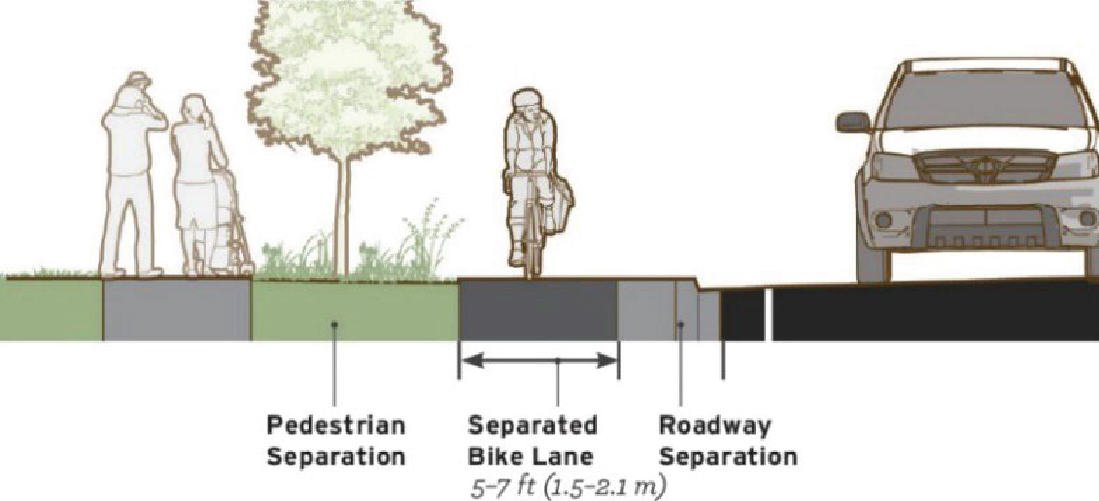
The figure below is an example of a one-way separated bicycle lane with pedestrian and motor vehicle barriers from Dickman et al. (2).
Source: Dickman et al. (2)
Example of a One-Way Separated Bicycle Lane
Long Description.
The cross-section begins with a sidewalk, and then a pedestrian separation segment with a tree, a bike lane with a width of 5 to 7 feet, a roadway separation, and then a road with vehicles.
Discussion
Separation of bicycle lanes from motor traffic may be desirable for various reasons such as high traffic speeds, high traffic volumes, aggressive motor vehicle driving, or general lack of consideration by drivers towards bicyclistsʼ use of roads (5). Additional separation from the sidewalk is valuable for reducing unwanted pedestrian encroachment into the bicycle lane (1, 2). The use of physical separation with vertical elements, unpaved separation, or detectable edges may be more effective than visual delineation at reducing unwanted encroachment into the bicycle lane (2). Separated bicycle lanes provide benefits for bicyclists by dedicating and protecting space for bicyclists in order to increase perceived comfort and safety, providing a more attractive facility for bicyclists of all levels and ages, eliminating the potential and fear of crashes with overtaking vehicles, reducing potential for ‘dooring’ (crashes in which the bicyclist rides into a motor vehicleʼs open door) compared to a bicycle lane, and eliminating the potential of a ‘doored’ bicyclist being run over by a motor vehicle (1, 2). One-way separated bicycle lanes could be used on streets with parking lanes, streets for which conflicts at intersections can be effectively mitigated using parking lane setbacks, bicycle markings through the intersection and through other signalized intersection treatments, along streets with high bicycle volumes, and along streets with high motor vehicle volumes and/or speeds (1, 2). Two-way separated bicycle lanes should only be used if there is not enough room for one-way separated bicycle lanes on both sides of the street, where contraflow bicycle travel is desired (see page 25-10), and on streets with extra space for right-of-way on one side (1). Separated bicycle lanes have also been especially useful to bicyclists when installed at connections between and among high-demand destinations such as schools, parks, transit stops; commercial areas; residential clusters; and disadvantaged populations (2, 6).
Since many barriers cannot continue through an intersection or across driveways, treatments such as “Yield to Bikes” signage, colored pavement markings, yield lines, and signal adjustments could be used to manage conflicts between bicyclists and motorists at these locations and make it clear that the cycle track has priority over entering and exiting traffic (1, 5). Motor vehicle traffic crossing the cycle track could be channelized to make turns at sharp angles to reduce travel speed prior to the crossing (1). See “Markings for Bicycles at Intersections” (page 25-4) for guidelines on designing bicycle lane markings through intersections.
Additional consideration should be given to installing separated bicycle lanes around transit stops for managing bicycle and pedestrian interactions (1). Placing a separated bicycle lane on the left side of a one-way street (out of the way of transit stops along the right side) or choosing to install a separated bicycle lane on a nearby parallel corridor away from transit can help minimize bicyclist-pedestrian conflicts (2). It may also be beneficial to place separated bicycle lanes adjacent to rail corridors to encourage bicyclists to ride away from in-street rail tracks that may increase the potential for crashes (2).
Using landscaped barriers, such as “Oasis Greenways,” to separate bicycles and motor vehicles provides additional benefits compared to markings including recreational areas, public health, and increased land value by removing lanes from roads with unneeded capacity and using that space for bicycle lanes, wide sidewalks, and planting strips (4).
Design Considerations
Some drivers have expressed concern that installing separated bicycle lanes will potentially increase vehicular travel times (7). Solutions for implementing separated bicycle lanes should consider tradeoffs associated with impacts on vehicular traffic flow while providing the protection to bicycles afforded by separation from traffic (7). Separated bicycle lanes may create a false sense of security that encourages bicyclists to react less cautiously than they would on shared-use lanes (5).
Cross References
Markings for Bicycles at Intersections
Key References
1. National Association of City Transportation Officials. (2014). Urban Bikeway Design Guide (2nd ed.). New York, NY.
2. Dickman, D. et al. (2016). Small Town and Rural Multimodal Networks. Washington, DC: FHWA.
3. FHWA. (2023). Manual on Uniform Traffic Control Devices for Streets and Highways. (11th ed.). Washington, DC.
4. Bertulis, T., and Furth, P. (2014). Oasis greenways: A new model of urban park and bikeway within constrained street rights-of-way. 93rd Annual Meeting of the Transportation Research Board.
5. DuBose, B., Lasky, M. E., and Sallaberry, M. J. (2013). Separated Bikeways. Washington, DC: Institute of Transportation Engineers.
6. Wang, J., and Lindsey, G. (2017). Equity of bikeway distribution in Minneapolis, Minnesota. Transportation Research Record: Journal of the Transportation Research Board, 2605, 18–31.
7. Burke, C. M., and Scott, D. M. (2017). Identifying sensible locations for separated bike lanes on a congested urban road network: Case study in Toronto, Canada. 96th Annual Meeting of Transportation Research Board.
CONTRAFLOW BICYCLE LANES
Introduction
Contraflow bicycle lanes are bicycle lanes installed on the left side of a one-way street to give bicyclists the option to ride opposite the flow of traffic in a designated bicycle lane. Contraflow bicycle lanes may be considered in situations where travel in a with-flow bicycle lane would result in substantial out-of-direction travel or around high bicycle-use destinations to provide more direct access (1). This guideline discusses methods and considerations for reducing bicyclist crash potential and traffic conflicts when designing contraflow bicycle lanes.

The figure below is an example of a contraflow bicycle lane design from NACTO (3).
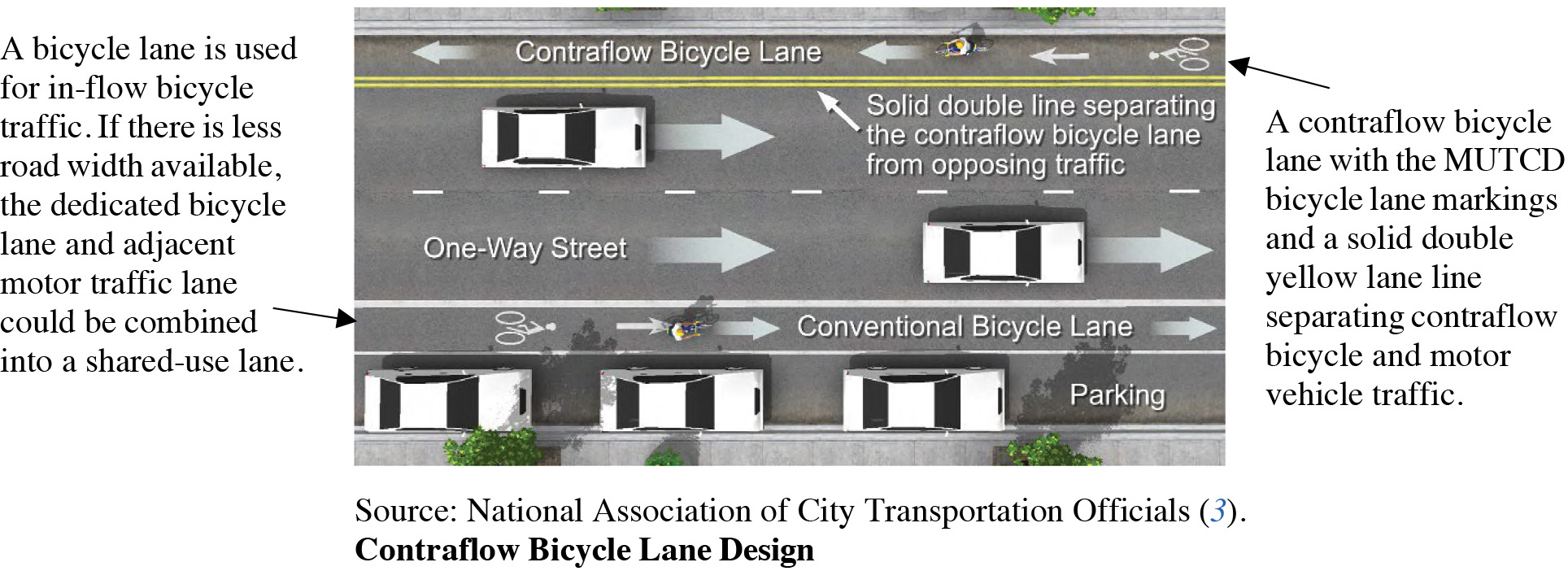
Long Description.
The illustration shows a solid yellow double line separating the contraflow bicycle lane from opposing traffic. The conventional bicycle lane is on the opposite side of the road and is separated from traffic with a single white line. Both bicycle lanes have MUTCD bicycle lane markings. A bike lane is used for with-flow bicycle traffic. If there is less road width available, the dedicated bike lane and adjacent motor traffic lane could be combined into a shared use lane.
Discussion
Contraflow bicycle lanes are designed to allow bicyclists to ride in the opposite direction of motor vehicle traffic and are used to create a two-way bicycle street on a one-way motor traffic street (3). Contraflow bicycle lanes separate traffic using yellow center lane striping or a buffer (3) and are generally recommended in areas with numerous one-way streets or where it would be difficult for bicyclists to follow traffic flow (4). Separating contraflow bicycle lanes from motor vehicle traffic with a double solid yellow line indicates to motor vehicles that there is opposing bicycle traffic on the other side of the line and no passing is allowed to the left of the double solid yellow line (1, 3). In areas with higher speeds or traffic volumes, the installation of buffers, medians, or traffic separators between the contraflow bicycle lane and the adjacent motor traffic lane should be considered to provide more separation between motorists and bicyclists traveling in opposing directions (1, 3). While yellow center lane striping can alert adjacent motor vehicle traffic to the presence of a contraflow bicycle lane, cross traffic entering one-way streets may not expect these contraflow bicyclists. Extending contraflow bicycle lane markings across intersections can alert cross traffic to look for contraflow bicyclists and be aware of their presence (3).
Contraflow bicycle lanes can be installed on streets where large numbers of bicyclists are already riding in the opposite direction of motor vehicle traffic, on corridors where alternative routes lead to excessive out-of-direction travel or where the alternative route is through streets with high traffic volumes and/or no bicycle facilities, on streets where the contraflow lane would provide direct access to popular destinations, and preferably on low-speed, low-volume streets (3). Contraflow bicycle lanes can provide connectivity and access to bicyclists traveling in both directions; reduce dangerous wrong-way riding and sidewalk riding; decrease trip distance, number of intersections encountered, and travel times; and allow bicyclists to use safer, less trafficked streets (3). See the “Bicycle Lanes” guideline on page 25-6 for information about designing left-side bicycle lanes that travel with the flow of traffic.
Design Considerations
Where parking is present along a contraflow bicycle lane, motorists leaving a parking space may have difficulty seeing bicyclists in the contraflow bicycle lane, as sight lines may be blocked by other parked vehicles. Therefore, the design of contraflow bicycle lanes is discouraged where parking is present on the same side of the street (1).
Cross References
Markings for Bicycles at Intersections
Key References
1. AASHTO. (2012). Guide for the Development of Bicycle Facilities (4th ed.).Washington, DC.
2. FHWA. (2023). Manual on Uniform Traffic Control Devices for Streets and Highways. (11th ed.). Washington, DC.
3. National Association of City Transportation Officials. (2014). Urban Bikeway Design Guide (2nd ed.). New York, NY.
4. Raborn, C., Torbic, D. J., Gilmore, D. K., Thomas, L. J., Hutton, J. M., Pfefer, R., Neuman, T. R., Slack, K. L., Bond, V., and Hardy, K. K. (2008). NCHRP Report 500: Guidance for Implementation of the AASHTO Strategic Highway Safety Plan, Volume 18: A Guide for Reducing Collisions Involving Bicycles. Transportation Research Board of the National Academies, Washington, DC.
SHARED-USE LANES
Introduction
Shared-use lanes are lanes on the roadway that are designated for mixed use between bicyclists and motorists. Shared-use lanes can be associated with greater crash potential due purely to the physical proximity between road users and, relatedly, the reduced time for the users to respond to one another. Shared lane markings, also known as sharrows, are markings used to indicate the shared lane environment and promote proper bicyclist positioning. When shared-use lanes are supplemented with shared lane markings, bicycle traffic on the street is legitimized and motor vehicle drivers are alerted to the potential presence of bicyclists without requiring additional street space (1). This guideline discusses methods that could reduce crash potential and traffic impacts when designing shared-use bicycle lanes.

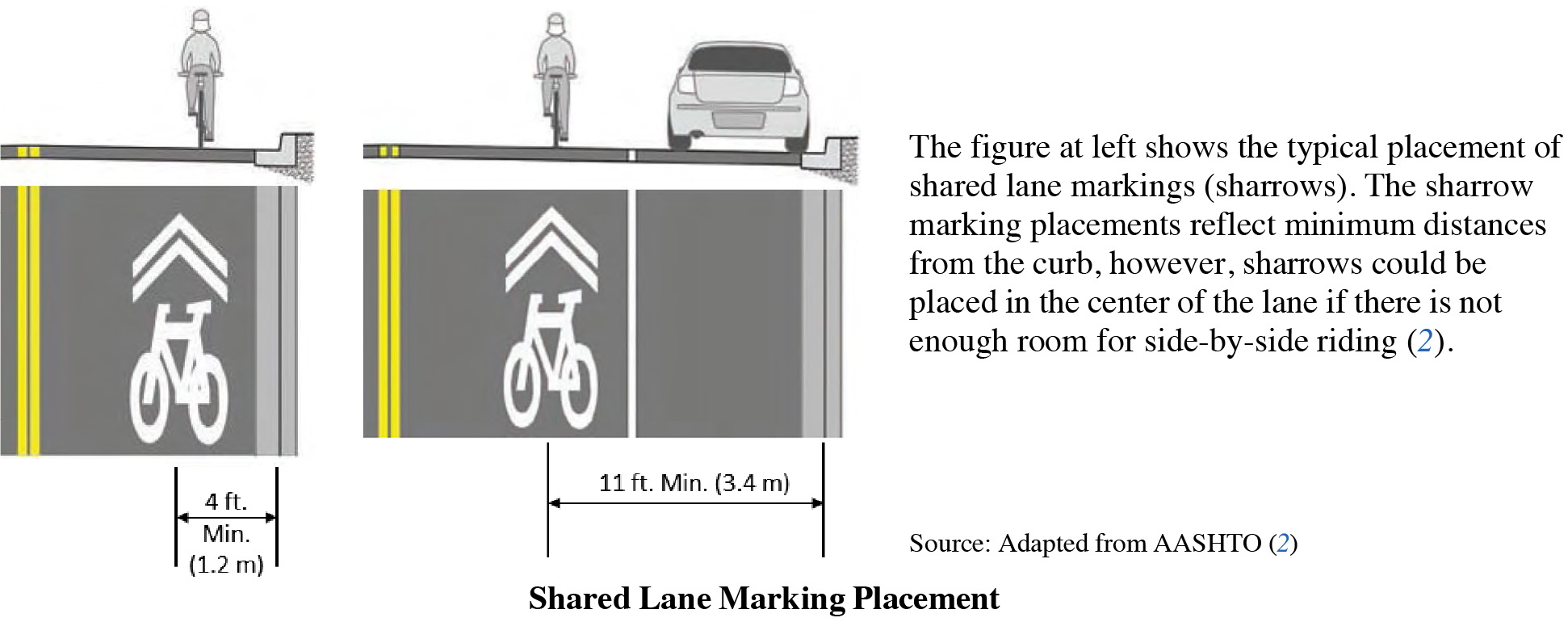
Long Description.
The first illustration shows a bicycle lane on the right of the road with a 4-foot minimum distance between the shared lane marking and the curb. The second illustration shows a parking lane on the right and a bicycle lane with shared lane markings at a minimum of 11 feet from the curb.
Discussion
Shared-Use Lanes. Shared-use lanes can be used on bicycle boulevards, traffic calmed streets with a designed speed of less than 25 mi/h, downhill segments (if space does not permit a wide downhill bicycle lane), within single or multilane roundabouts, along front-in angled parking, and where street widths can only accommodate a dedicated bicycle lane in one direction (2). Using shared-use lanes on roads with narrow lane widths may increase bicyclist lateral distance to the curb, increase lateral separation between vehicles and bicycles, reduce vehicle encroachment to the adjacent inside lane when passing bicycles, and reduce wrong-way riding (7, 8).
Shared Lane Markings. Shared lane markings indicate a shared lane environment for bicycles and motor vehicles and are painted at an alignment that represents a practical path for bicycle travel (2). Shared lane markings could be placed in the center of the usable lane unless it is possible for bicyclists and motorists to share the lane safely side-by-side (9). Implementing shared-use lane markings alerts motor vehicle drivers to the potential presence of bicyclists, alerts road users of the lateral position bicyclists are expected to occupy within the travel lane, advertises the presence of bikeway routes to all users, provides a wayfinding element along bike routes, keeps bicyclists out of the “door zone,” encourages safer passing by motorists, and reduces wrong-way bicycling while requiring no additional street space (2).
Design Considerations
From the perspective of both safety and reducing potential traffic impacts, designated bicycle lanes are preferred over shared-use lanes when the road is sufficiently wide enough to accommodate bicycle lanes (9, 10, 11).
Cross References
Markings for Bicycles at Intersections
Key References
1. National Association of City Transportation Officials. (2014). Urban Bikeway Design Guide (2nd ed.). New York, NY: NACTO.
2. AASHTO. (2012). Guide for the Development of Bicycle Facilities (4th ed.). Washington, DC.
3. FHWA. (2023). Manual on Uniform Traffic Control Devices for Streets and Highways (11th ed.). Washington, DC.
4. Kassim, A., Ismail, K., and Woo, S. (2017). Investigation of the effect of super-sharrows on cyclist and vehicle behavior. 96th Annual Meeting of the Transportation Research Board.
5. Foletta, N., Nielson, C., Patton, J., Parks, J., and Rees, R. (2015). Green shared lane markings on urban arterial in Oakland, California: Evaluation of super sharrows. Transportation Research Record: Journal of the Transportation Research Board, 2492, 61–68.
6. Furth, P. G., and Dulaski, D. M. (2011). More than sharrows: Lane-within-a-lane bicycle priority treatments in three U.S. cities. 90th Annual Meeting of the Transportation Research Board.
7. Sando, T. (2014). Operational Analysis oif Shared Lane Markings and Green Bicycle Lanes on Roadways with Speeds Greater than 35 MPH. Jacksonville, FL: University of North Florida.
8. Raborn, C., Torbic, D. J., Gilmore, D. K., Thomas, L. J., Hutton, J. M., Pfefer, R., Neuman, T. R., Slack, K. L., Bond, V., and Hardy, K. K. (2008). NCHRP Report 500: Guidance for Implementation of the AASHTO Strategic Highway Safety Plan, Volume 18: A Guide for Reducing Collisions Involving Bicycles. Transportation Research Board of the National Academies, Washington, DC.
9. Brady, J. F., Mills, A. F., Loskorn, J. A., Duthie, J. C., and Machemehl, R. B. (2010). Effects of shared lane markings on bicyclist and motorist behavior along multi-lane facilities. Annual Conference of the Canadian Society for Civil Engineering.
10. Hourdos, J., Lehrke, D., Duhn, M., Ermagun, A., Singer-Berk, L., and Lindsey, G. (2017). Traffic Impacts of Bicycle Facilities. Minneapolis, MN: University of Minnesota.
11. Love, D. C., Breaud, A., Burns, S., Margulies, J., Romano, M., and Lawrence, R. (2012). Is the three-foot bicycle passing law working in Baltimore, Maryland? Accident Analysis & Prevention, 48, 451–456.
SHARED BUS-BICYCLE LANES
Introduction
Shared bus-bicycle lanes are dedicated lanes with right-of-way restricted to the use of buses, bicycles, and sometimes right-turning vehicles. Increasingly, cities across the United States are implementing these lanes to improve multimodal mobility. Shared lanes can be associated with greater crash potential due purely to the physical proximity between road users and (relatedly) the reduced time for the users to respond to one another. Safety implications associated with shared bus-bicycle lanes are related to disparities in travel speeds and vehicle sizes, shared lane width, bicycle visibility, and interactions between buses and bikes, particularly at and around bus stops. This guideline provides considerations for designing bus-bicycle shared lanes that can help mitigate these safety challenges.

The figure below shows suggested lane widths and possible configurations for shared bus-bicycle lanes (1).
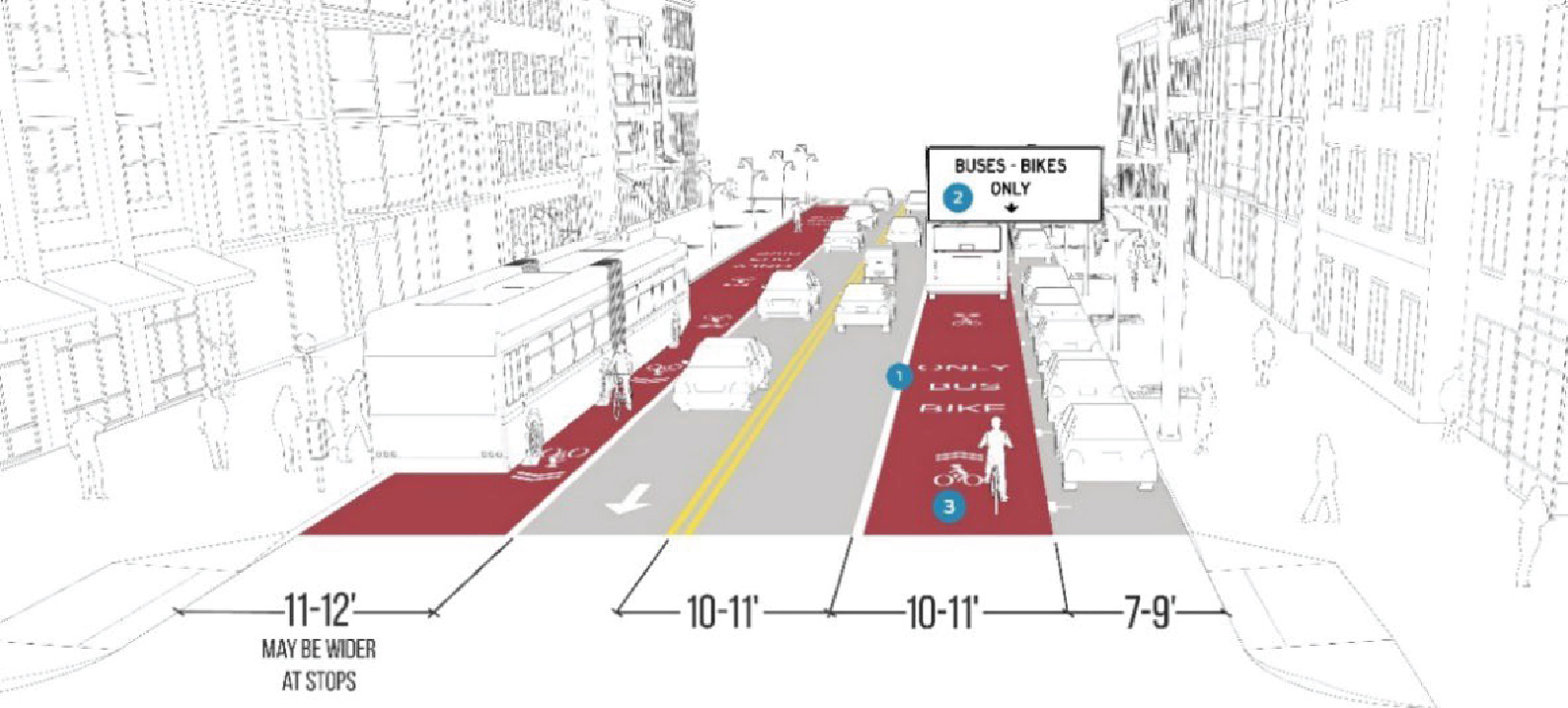
Suggested Lane Widths for Shared Bus-Bicycle Lanes
Source: National Association of City Transportation Officials (1)
Long Description.
The shared bus-bicycle lane next to the curb is 11 to 12 feet and may be wider at stops. The vehicle lanes are 10 to 11 feet. The shared bus-bicycle lane between traffic and parking lanes is 10 to 11 feet. The parking lane is 7 to 9 feet.
Discussion
Shared bus-bicycle lanes (SBBLs) are lanes dedicated for use by both buses and bicyclists, and often, right-turning vehicles at intersections (3). SBBLs provide a time advantage to buses by prioritizing their travel over other vehicular traffic, while also providing bicyclist protection from mixed traffic (3) and reducing the impact of general traffic on both buses and bicycles when insufficient roadway space is available to provide separate exclusive facilities for the two modes (1, 4). For both modes of travel, however, SBBLs are low-comfort solutions because buses and bicyclists compete for the same space near the curb, often with limited lane width and close proximity when passing each other (1). Separate dedicated bus and bicycle lanes are preferred over SBBLs, particularly on high-volume bus routes during peak traffic times (1).
Lane width is an important consideration when designing SBBLs. Because buses tend to overtake bicyclists on the road, adequate lane widths are necessary for the bus to pass without encroaching on the adjacent vehicle lane (1). Although wider shared lanes provide bicyclists with more space during bus overtaking maneuvers, they also result in higher overtaking speeds by buses (5). Even when not being overtaken, bicyclists in the study by De Ceunynck et al. had significantly higher riding speeds at narrower roads if they knew a bus was behind them, indicating a level of discomfort for bicyclists in these situations (5).
There are several other issues created by SBBLs that can be considered when designing shared lanes. Bicyclists approaching a stopped bus at a bus stop often pass the bus to avoid stopping themselves (6). Because bicycles are typically much slower than buses, the bus will generally overtake and pass the bicyclist after leaving the bus stop (6). This “leapfrogging” between buses and bicycles heightens the crash potential for bicyclists by increasing the number of interactions between the vehicles. Countermeasures to minimize “leapfrogging” and provide enough clearance for bicycles to pass are recommended where feasible. Another potential conflict is when a bus pulls forward from a bus stop at the same time that a bicyclist attempts to overtake the previously stopped bus (1). Separating a bicycle lane from the SBBL at bus stops can minimize bus-bicycle interactions by providing bicyclists a way to safely pass buses while passengers are boarding and disembarking the bus and for buses to safely pass bicyclists upon leaving the bus stop (1). Right and left hook crashes may also occur when buses turn right or left while a bicycle is passing in the blind spot (1). Bicycle lane markings straight through intersections can raise awareness for bicyclists and motorists for potential conflict areas, reinforce bicyclist priority over vehicles that are turning, make bicycle movements more predictable, and increase the visibility of bicyclists (2).
Design Considerations
Shared bus and bicycle lanes will not provide the same level of benefit as other bus lane types, particularly when right turns need to be accommodated at intersections, and there will typically be some degree of illegal driving, parking, or stopping activity in the lane despite active enforcement efforts (4). Roadways with significant uphill grades are not good candidates for SBBLs because the speed differential between bicycles and buses is considerably greater compared to level or downhill roadway sections (4). Roadways with a high volume of oncoming traffic in the adjacent lane are also not good candidates for SBBLs since buses would frequently need to slow behind bicyclists while waiting for a gap in traffic to move around the bicyclist (4). Current road design guidelines assume that bicyclists take up a width of one meter. However, observations collected by De Ceunynck et al. showed that bicyclists may take up much less space while being overtaken (5).
Cross References
Markings for Bicycles at Intersections
Mitigating Heavy-Vehicle Conflicts with Bicycles
Key References
1. National Association of City Transportation Officials. (2016). Transit Street Design Guide. Washington, DC: Island Press.
2. National Association of City Transportation Officials. (2014). Urban Bikeway Design Guide (2nd ed.). New York, NY.
3. Hillsman, E. L., Hendricks, S. J., and Fiebe, J. (2012). A Summary of Design, Policies, and Operational Characteristics for Shared Bicycle/Bus Lanes. Tampa, FL: University of South Florida.
4. Ryus, P., Laustsen, K., Blume, K., Beaird, S., and Langdon, S. (2016). TCRP Report 183: A Guidebook on Transit-Supportive Roadway Strategies. Transportation Research Board, Washington, DC.
5. De Ceunynck, T., Dorleman, B., Daniels, S., Laureshyn, A., Brijs, T., Hermans, E., and Wets, G. (2017). Sharing Is (S)caring? Interactions between Buses and Bicyclists on Bus Lanes Shared with Bicyclists. Transportation Research Part F: Traffic Psychology and Behaviour, 46, Part B, 301–315.
6. AASHTO. (2012). Guide for the Development of Bicycle Facilities (4th ed.). Washington, DC.
MITIGATING HEAVY-VEHICLE CONFLICTS WITH BICYCLES
Introduction
The difference in mass and size between heavy vehicles and bicycles can contribute to serious bicyclist injuries or fatalities when conflicts between these two modes of travel occur. Heavy-vehicle blind zones and reliance on mirrors for visibility make it difficult for heavy-vehicle operators to observe bicyclists riding close to the vehicle, while bicyclists are often unaware of these visibility challenges and ride too close to the truck or engage in maneuvers that increase the potential for crashes with the truck. This guideline provides considerations for road designs that may help to mitigate heavy-vehicle conflicts with bicycles.

RECOMMENDED LANE WIDTHS FOR URBAN AND SUBURBAN TWO-LANE UNDIVIDED ROADWAYS WITH ON-STREET PARKING AND CONSTRAINED ROADWAY WIDTHS (6)
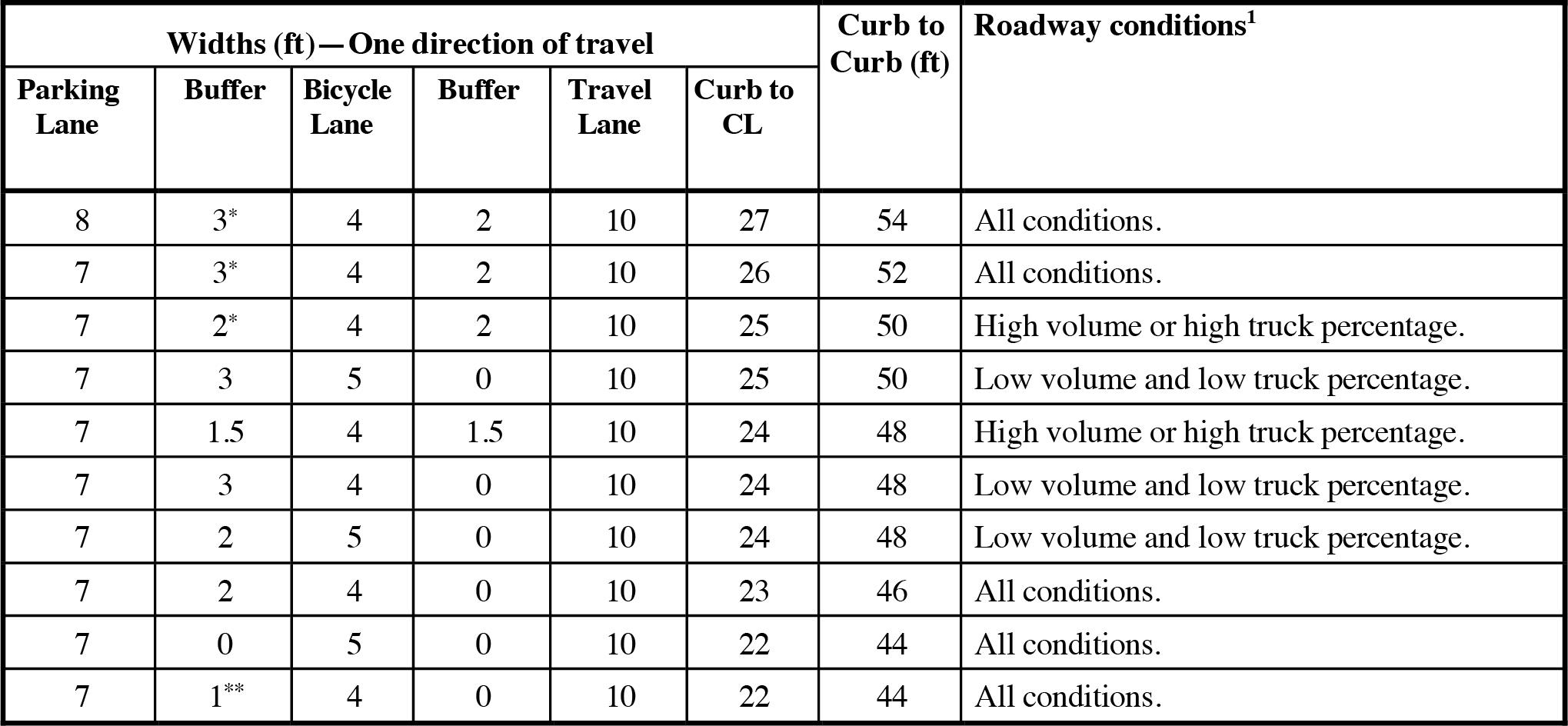
* May consider combining buffers to create a 4-ft buffer between parking and bicycle lanes.
** Caution that striping of double white lines may cause confusion.
1 The suggested threshold for distinguishing between low and high traffic volume is 20,000 vehicles per day, and the suggested threshold for distinguishing between low and high truck percentage is 10 percent trucks in the vehicle mix.
Long Description.
The table has 8 column headings: Columns 1 to 6 provide the widths in feet for different elements. Column 1: Parking Lane. Column 2: Buffer. Column 3: Bicycle Lane. Column 4: Buffer. Column 5: Travel Lane. Column 6: Curb to C L. Column 7: Curb to curb (in feet). Column 8: Roadway conditions.; Note that the suggested threshold for distinguishing between low and high traffic volume is 20,000 vehicles per day, and the suggested threshold for distinguishing between low and high truck percentage is 10 percent trucks in the vehicle mix.. Row 1: 8; 3 Refer to note A; 4; 2; 10; 27; 54; All conditions.. Row 2: 7; 3 Refer to note A; 4; 2; 10; 26; 52; All conditions.. Row 3: 7; 2 Refer to note A; 4; 2; 10; 25; 50; High volume or high truck percentage.. Row 4: 7; 3; 5; 0; 10; 25; 50; Low volume and low truck percentage.. Row 5: 7; 1.5; 4; 1.5; 10; 24; 48; High volume or high truck percentage.. Row 6: 7; 3; 4; 0; 10; 24; 48; Low volume and low truck percentage.. Row 7: 7; 2; 5; 0; 10; 24; 48; Low volume and low truck percentage.. Row 8: 7; 2; 4; 0; 10; 23; 46; All conditions.. Row 9: 7; 0; 5; 0; 10; 22; 44; All conditions.. Row 10: 7; 1 Refer to note B; 4; 0; 10; 22; 44; All conditions.
Discussion
Heavy vehicle-bicycle crashes in urban settings were generally found to occur in locations with higher employment shares in freight-dependent industries (e.g., wholesale, transportation, warehousing, and retail) (5). A study conducted in Beijing suggests using a median division between the roadway and bikeway to help reduce crashes in areas like the freight-dependent commercial sections of cities (1). Of all heavy vehicle-bicycle lane violations, about 81% were in standard lanes, while only 7% were in protected lanes or curbside lanes (5).
Torbic et al. found that bicyclists positioned themselves approximately 2.5 to 3.0 ft closer to parked vehicles or the curb when in the presence of a higher proportion of heavy vehicles (2). As such, on streets with truck percentages above 10%, additional displacement of bicyclists due to trucks should be considered when determining the allocation of street width between parking lanes, bicycle lanes, and travel lanes (2). In particular, consideration should be given to designating additional street width to bicyclists and/or providing a buffer to account for the additional displacement of bicyclists at higher truck percentages (2). Akhtar et al. recommend using an overtaking clearance of at least 1.5 m, citing an incident in which a truck driver tried to overtake bicyclists with just 0.5 m of clearance and struck one of the bicyclists with the trailer (7). In most situations where a bicycle lane is adjacent to on-street parking, Fees et al. recommend an 8-ft width for the parking lane. An 8-ft parking lane provides sufficient space for a large percentage of heavy vehicles to park within the limits of the parking lane, and it allows more of the roadway cross section to be designated for bicyclists in the bicycle lane and motor vehicles in the travel lanes (6, 8).
A rather small distance between the bicycle and vehicle lanes at intersections is preferred because of the increasing obstructive view of the bicycle in the truckʼs mirror with increased distance between vehicle lanes (3). The effect of this obstruction can be seen in left and right hook crashes (3). Bicycle lane markings straight through intersections can raise awareness for bicyclists and motorists for potential conflict areas, reinforce bicyclist priority over vehicles that are turning, make bicycle movements more predictable, and increase the visibility of bicyclists (4). Other visibility countermeasures for bicycles, such as the installation of bike boxes ahead of traffic at intersections, are discussed further in “Markings for Bicycles at Intersections” on page 25-4. Countermeasures for designing bicycle signals and adjusting signal timing for bicycles can be found in “Signals and Signal Timing for Bicycles at Intersections” on page 25-2.
Design Considerations
The addition of bicycle lanes on local roads that serve as commercial vehicle delivery routes can have a negative impact on bicycle safety because of commercial vehicle parking while making deliveries. Commercial vehicle drivers have been found to park their trucks on bicycle lanes while making their deliveries, requiring bicyclists to exit the bicycle lane and merge into traffic (5), increasing their exposure to potential crashes. Designs that accommodate commercial vehicle parking in such areas are preferable whenever possible.
Cross References
Signals and Signal Timing for Bicycles at Intersections
Markings for Bicycles at Intersections
Heuristics for Selecting the Yellow Timing Interval
Key References
1. Yan, X., Ma, M., Huang, H., Abdel-Aty, M., and Wu, C. (2011). Motor vehicle-bicycle crashes in Beijing: Irregular maneuvers, crash patterns, and injury severity. Accident Analysis & Prevention, 43(5), 1751–1758.
2. Torbic, D. J., Bauer, K. M., Fees, C. A., Harwood, D. W., Van Houten, R., Laplante, J., and Roseberry, N. (2014). NCHRP Report 766: Recommended Bicycle Lane Widths for Various Roadway Characteristics. Transportation Research Board of the National Academies, Washington, DC.
3. Richter, T., and Sachs, J.-C. (2016). Turning accidents between vehicles and cyclists driving straight ahead. Road Safety on Five Continents (RS5C): 17th International Conference.
4. National Association of City Transportation Officials. (2014). Urban Bikeway Design Guide (2nd ed.). New York, NY.
5. Conway, A., Tavernier, N., Leal-Tavares, V., Gharamani, N., Chauvet, L., Chiu, M., and Yeap, X. B. (2016). Freight in a bicycle-friendly city: Exploratory analysis with New York City open data. Transportation Research Record: Journal of the Transportation Research Board, 2547, 91–101.
6. Fees, C. A., Torbic, D. J., Bauer, K. M., Van Houten, R., Roseberry, N., and LaPlante, J. (2015). Design guidance for bicycle lane widths. Transportation Research Record: Journal of the Transportation Research Board, 2520, 78–89.
7. Akhtar, J., Aust, M. L., Eriksson, R. J., Fagerlind, H., Hoye, A., Phillips, R. O., and Sagberg, F. (2010). Factors Contributing to Road Fatalities: Analysis of In-Depth Investigation Data from Passenger Car Intersection Crashes and from Collisions Between Bicycles and Motorized Vehicles. (Report No. 1067/2010). Institute of Transport Economics, Oslo, Norway.
8. AASHTO. (2012). Guide for the Development of Bicycle Facilities (4th ed.) Washington, DC.


